Finnish Tradition (Kalevala)Primordial Mother
Ilmatar
Ilmatar
Also known as Ilman impi (Maiden of the Air), Veden emo (Water-mother)
- the air
- creation
- the primeval sea
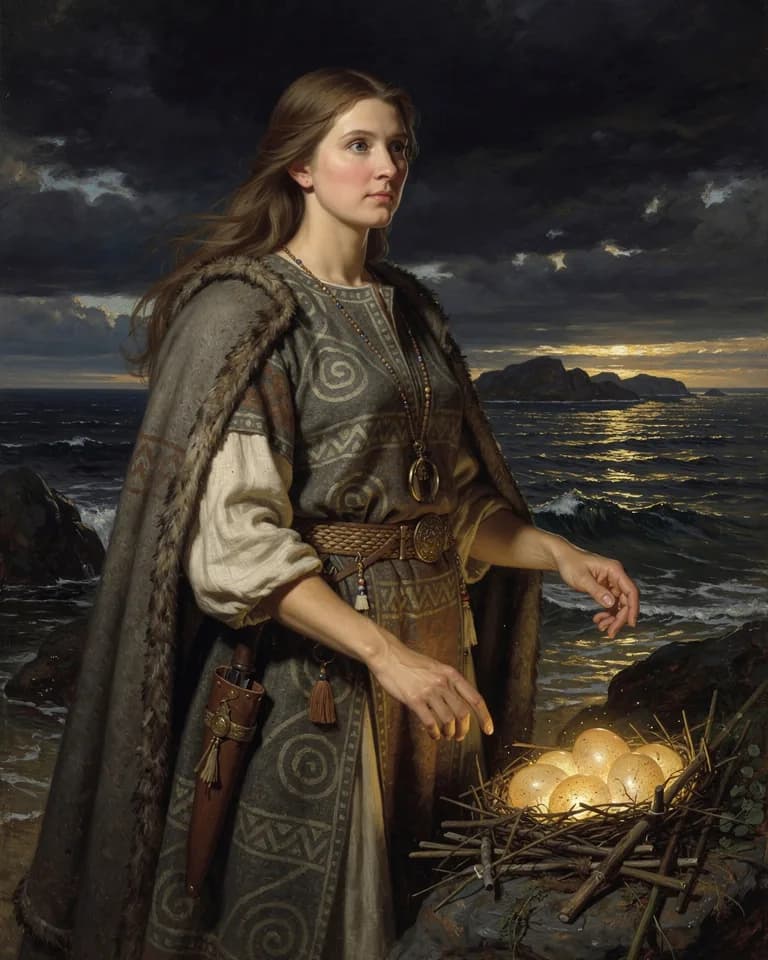
The virgin daughter of the air who, in the Kalevala's first rune, descends to the primeval sea, becomes pregnant by wind and wave, and on whose knee a duck lays the eggs from which earth, sky, sun, moon, and stars are made; mother of Väinämöinen.
About Ilmatar
In the Kalevala
Lönnrot's epic opens with the maiden of the air, long alone in the empty heavens, who descends to the sea. The east wind and the waves make her pregnant, and she drifts for seven hundred years, unable to give birth. A duck, searching for a place to nest, sees her raised knee as a grassy hillock and lays six golden eggs and one of iron there. When the knee grows hot, Ilmatar jerks it, the eggs fall and break, and their pieces become the earth below, the vault of heaven above, the sun from the yolk, the moon from the white, the stars from the speckled parts, and the clouds from the dark. Ilmatar then shapes the coasts, bays, and reefs with her body, and finally gives birth to Väinämöinen.
Lönnrot's arrangement
In most of the folk variants Lönnrot knew, it is Väinämöinen himself, floating on the sea, on whose knee the bird lays its eggs. The name Ilmatar and her role as creator-mother are largely Lönnrot's shaping of scattered material; the first edition of 1835 differs from the canonical edition of 1849. The world-egg motif itself is old and widespread in Finnic tradition.
Origin story
The daughter of the air, living alone in the heavens before she descends to the sea (Kalevala, Rune 1).
Worship and cult
Temples, festivals, and practices recorded for Ilmatar
Not known as an object of cult; Ilmatar is a figure of Lönnrot's epic built on folk-poetry motifs of the air-maiden and water-mother.
Family
Ilmatar's family at a glance
- Who are Ilmatar's children?
- Children of Ilmatar recorded in the atlas: Väinämöinen.
In the atlas
Where Ilmatar appears
Sources and further reading
Source notes
These references are recorded in the catalog. Their passage wording and translation have not been checked, so quotations are not displayed here.
- Kalevala (trans. John Martin Crawford, 1888), Rune I
- Kalevala (trans. John Martin Crawford, 1888), Rune I
Appears in
Ancient and classical works featuring this figure.
the air-maiden, mother of Väinämöinen (Rune 1)
About this entry
By Elizabeth Stein for Mythos Atlas. About the author. Editorial notes are grounded in the site's cited sources and can be challenged through the contact page.
Parallels are editorial comparisons across traditions: a shared role does not, by itself, establish a shared origin.
Family relationships come from the atlas's kinship records. Ancient sources often disagree on divine genealogy.
Genealogy
Family tree
Ilmatar's parents, consorts, children and rivals, as recorded in the atlas.