Mythos Atlas

Side by sideParent and child

Ilmatar vs Väinämöinen

Ilmatar
IlmatarFinnish Tradition (Kalevala)
Väinämöinen
VäinämöinenFinnish Tradition (Kalevala)

Ilmatar and Väinämöinen are recorded as parent and child in the Finnish Tradition (Kalevala).

At a glance

Ilmatar and Väinämöinen compared
IlmatarVäinämöinen
TraditionFinnish Tradition (Kalevala)Finnish Tradition (Kalevala)
Domainsthe air, creation, the primeval seasong and poetry, wisdom and magic, the kantele
Symbolsthe duck's eggs, the primeval seathe kantele, the boat, the Sampo
Also calledIlman impi (Maiden of the Air), Veden emo (Water-mother)Väinö, Wainamoinen, Vanha Väinämöinen (Old Väinämöinen)

Where they meet

The atlas records no domain or symbol that Ilmatar and Väinämöinen share.

They are compared because of how the myths connect them, not because of what they rule.

Where they part

Only Ilmatar

Associated with the air, creation, and the primeval sea.

Only Väinämöinen

Associated with song and poetry, wisdom and magic, and the kantele.

How each was worshipped

Ilmatar

Not known as an object of cult; Ilmatar is a figure of Lönnrot's epic built on folk-poetry motifs of the air-maiden and water-mother.

Väinämöinen

Festivals
Kalevala Day (28 February), Finland's day of Finnish culture, marking the date Lönnrot signed the preface to the first Kalevala in 1835.

Invoked in folk charms as the first and greatest sage; tietäjät (folk healers and seers) claimed his knowledge of the 'origins' of things.

The two figures

Finnish Tradition (Kalevala)

Ilmatar

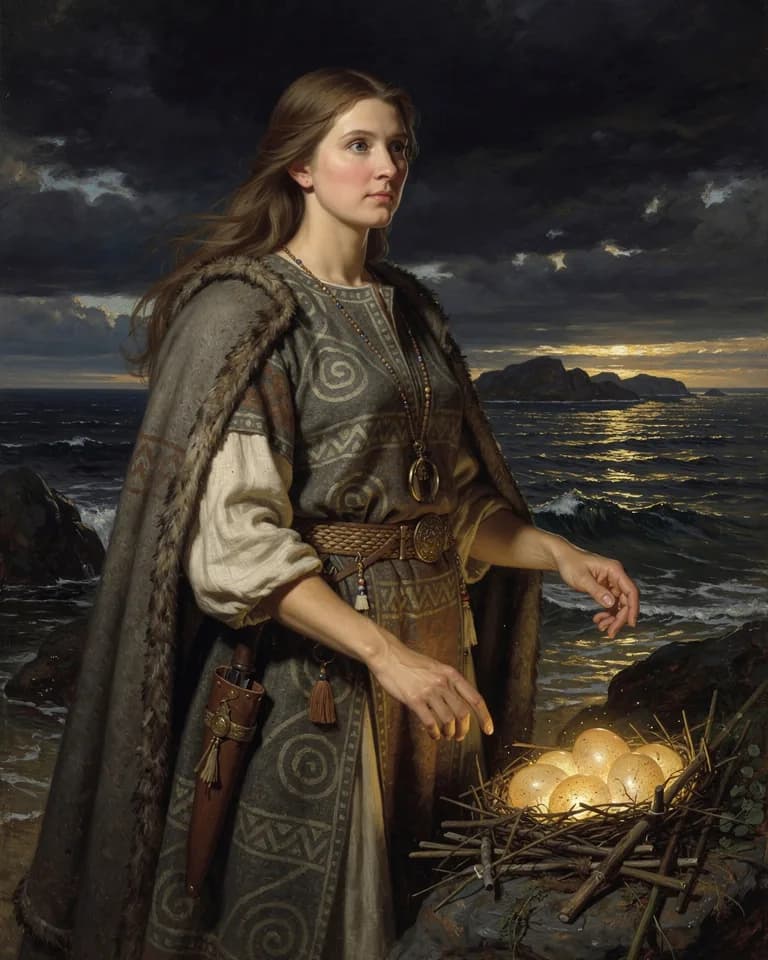
The virgin daughter of the air who, in the Kalevala's first rune, descends to the primeval sea, becomes pregnant by wind and wave, and on whose knee a duck lays the eggs from which earth, sky, sun, moon, and stars are made; mother of Väinämöinen.

The daughter of the air, living alone in the heavens before she descends to the sea (Kalevala, Rune 1).

Lönnrot's epic opens with the maiden of the air, long alone in the empty heavens, who descends to the sea. The east wind and the waves make her pregnant, and she drifts for seven hundred years, unable to give birth. A duck, searching for a place to nest, sees her raised knee as a grassy hillock and lays six golden eggs and one of iron there. When the knee grows hot, Ilmatar jerks it, the eggs fall and break, and their pieces become the earth below, the vault of heaven above, the sun from the yolk, the moon from the white, the stars from the speckled parts, and the clouds from the dark. Ilmatar then shapes the coasts, bays, and reefs with her body, and finally gives birth to Väinämöinen.

Read the full Ilmatar entry

Finnish Tradition (Kalevala)

Väinämöinen

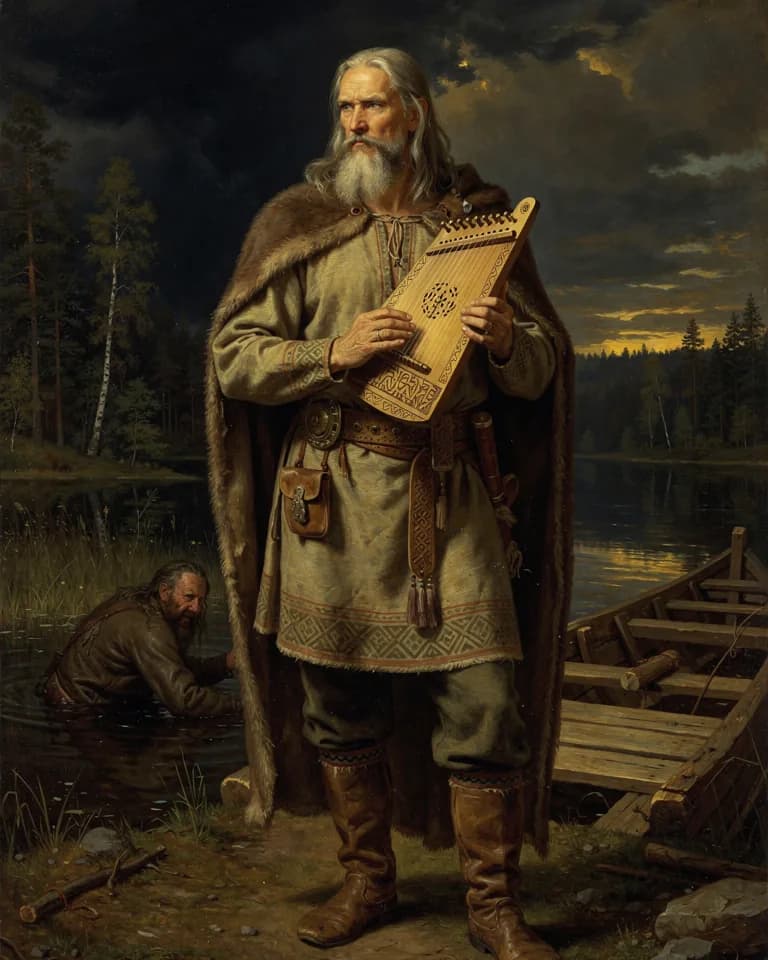
The 'steady old' singer and sage of Finnish runo-song, named by Agricola in 1551 as the maker of songs, who in the Kalevala is born of Ilmatar, sings his rival into a bog, builds the first kantele from a pike's jawbone, leads the theft of the Sampo, and finally sails away.

Born of Ilmatar after thirty years in her womb on the primeval sea (Kalevala, Rune 1).

Agricola's list of 1551 says that Väinämöinen 'forged songs'. In folk poetry he is the eternal sage (*tietäjä iänikuinen*), a singer whose words have creative and magical force: he sings the world into order, sings rivals into the ground, and knows the 'origins' of things, the charms that give power over iron, fire, and wounds. In many folk variants he is himself the one on whose knee the world-egg is laid.

Read the full Väinämöinen entry
About this comparison

Comparisons pair figures that play a similar role across traditions, or that the myths connect within one. A shared role does not, by itself, establish a shared origin.