Finnish Tradition (Kalevala)tragedy
Aino
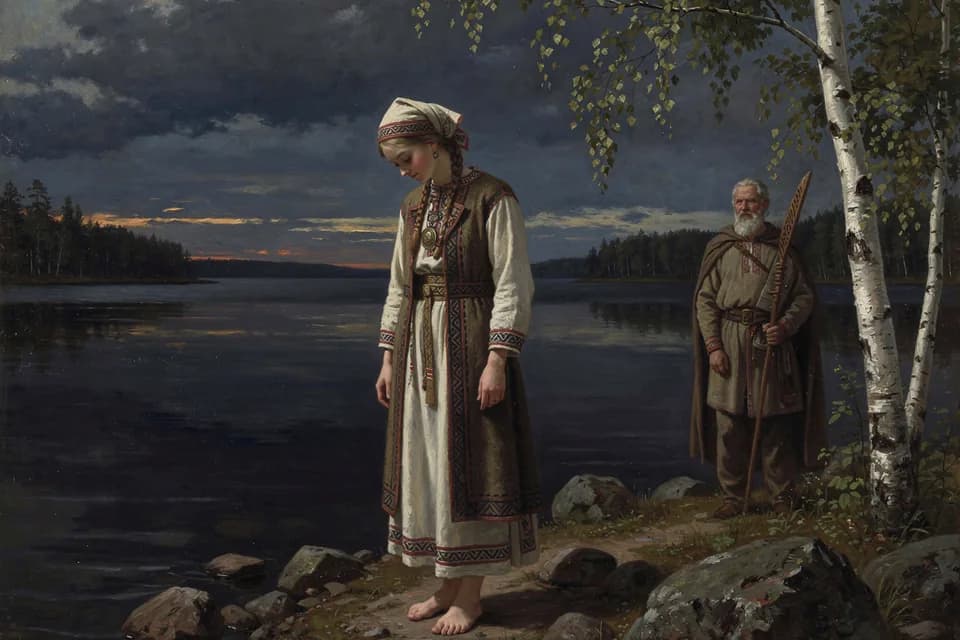
Defeated in a singing duel, young Joukahainen pledges his sister Aino to old Väinämöinen; unwilling to marry him, she drowns herself in the sea, and when Väinämöinen later hooks a strange fish, it is Aino, who mocks him and slips away forever.
An editorial retelling
The story
The singing duel
In the third rune of the Kalevala, the young Lapp singer Joukahainen, proud of his learning, drives his sledge against Väinämöinen's on a narrow road and challenges him to a contest of knowledge. Joukahainen's wisdom proves shallow: he boasts of knowing the ways of the fish and birds, and claims to have been present at the making of the world. Väinämöinen, angered, begins to sing. His song sinks Joukahainen into a swamp, first to the waist, then to the armpits, then to the mouth. In terror Joukahainen offers his bow, his boat, his horse, his gold, and at last his sister Aino. Väinämöinen accepts and sings him free.
Aino's refusal
Joukahainen goes home weeping, and his mother is delighted: to have the great Väinämöinen as a son-in-law is a fine thing. But Aino weeps. When she meets Väinämöinen in the birch grove and he asks her to wear her ornaments for him alone, she tears off her beads and crosses and throws them down, saying she will not dress up for him. At home her mother urges her to accept, and tells her to put on her finest clothes from the storehouse. Aino dresses in them and walks out alone into the wilderness.
The sea
At the shore of a strange sea she finds three maidens bathing on a rock. She swims out to the colorful stone to join them, and the stone sinks beneath her into the depths. So Aino drowns. The hare is sent with the news to her family, and her mother weeps; from her tears, the song says, flow three rivers, and beside them grow three birches, in which three cuckoos sing.
The fish
Väinämöinen goes fishing and catches a strange fish, unlike any salmon or trout. He takes out his knife to cut it for his meal, but the fish leaps from his hands into the sea and speaks. She is Aino, she says; she came not to be sliced for his dinner but to be his companion and wife, and now he has lost her forever. Väinämöinen begs her to return and tries to catch her with nets, but she is gone. In his grief his dead mother speaks to him from her grave and tells him to seek a wife instead among the daughters of Pohjola.
Reading the story
The Aino cycle is one of the passages Lönnrot shaped most heavily, joining folk songs about the singing contest, a girl's lament against a forced marriage, and a fish-maiden into a single tragedy. It gave Finnish culture one of its most enduring images of a young woman's refusal, painted by Akseli Gallen-Kallela in his Aino Triptych (1891).
Listen or change reading mode
Highlights
Väinämöinen sings Joukahainen into a swamp and wins the promise of his sister Aino; she tears off her ornaments, walks to the sea, and drowns on a sinking rock; later she returns as a fish in Väinämöinen's net and escapes him forever.
Why it matters
The Kalevala's most famous tragedy of a young woman, a touchstone of Finnish art and literature, and a clear example of Lönnrot combining separate folk songs into one narrative.
Sources and further reading
By Elizabeth Stein for Mythos Atlas. About the author. Editorial notes are grounded in the site's cited sources and can be challenged through the contact page.
Works cited
Kalevala, Runes 3-5
Elias Lönnrot; trans. John Martin Crawford