Finnish Tradition (Kalevala)creation
Ilmatar and the World Egg
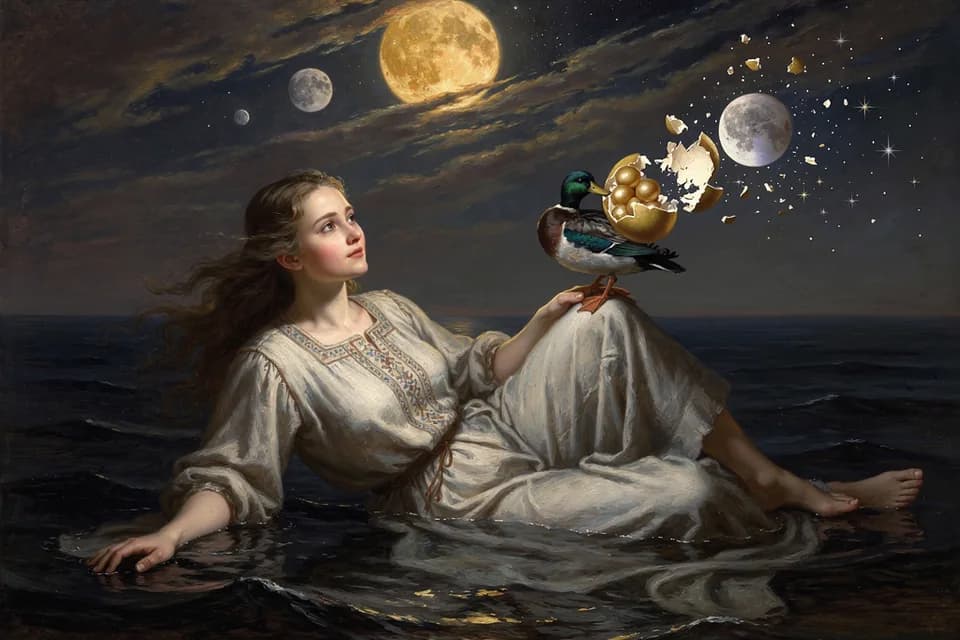
The air-maiden drifts for centuries on the primeval sea until a duck nests on her knee; when the eggs break, their pieces become earth, sky, sun, moon, stars, and clouds, and at last the aged singer Väinämöinen is born.
An editorial retelling
The story
The maiden of the air
The Kalevala begins before the world. A maiden, daughter of the air, lived alone for ages in the empty expanses of heaven, until she grew weary of her loneliness and came down to the sea. A storm wind from the east rose and tossed her on the waves, and the wind and water made her pregnant. For seven hundred years she drifted, unable to give birth, swimming to every quarter of the sea. At last she wept and called on Ukko, ruler of the heavens, to come and deliver her.
The duck's nest
Scarcely had she finished when a duck came flying over the waters, looking for a place to nest. It flew east and west, north and south, but found no dry land, no tuft of grass, only wind and water. Then the maiden raised her knee above the waves, and the duck, taking it for a grassy hillock, settled there, built its nest, and laid its eggs: six of gold and a seventh of iron. It sat on them for three days until the maiden's knee grew so hot it seemed to burn. She jerked her knee, and the eggs rolled into the sea and broke.
The world from the egg
The pieces did not perish in the water. In Crawford's translation: 'From one half the egg, the lower, / Grows the nether vault of Terra: / From the upper half remaining, / Grows the upper vault of Heaven; / From the white part come the moonbeams, / From the yellow part the sunshine, / From the motley part the starlight, / From the dark part grows the cloudage'. Time began to pass, the new sun shining and the full moon glowing.
The shaping of the coasts
In the tenth summer the maiden lifted her head and began to shape the world. Where she turned her hand, headlands rose; where her foot touched bottom, deep places for fish were hollowed; where she dived, the deeps of the sea opened; where she lay on her side, smooth shores formed; and where she rested her head, bays and inlets appeared. She made islands, reefs where ships would later founder, and the pillars of the sky.
The birth of the singer
Still the singer Väinämöinen had not been born. For thirty summers and thirty winters he lay in his mother's womb, pondering how to live in that dark place. He called on the moon, the sun, and the Great Bear to free him, and when they did not, he opened the gate with his own ring finger, crawled out, and fell into the sea. He swam for eight years before coming ashore on a barren headland, where he stood up to see the sun and moon and the stars. So the wise old singer was born of Ilmatar, the daughter of the air.
Lönnrot's arrangement
In most of the folk songs Lönnrot knew, the bird nests not on a sky-maiden's knee but on Väinämöinen's, as he floats on the primeval sea, and he himself is the creator. Lönnrot, wanting a birth for his hero, moved the role to the air-maiden and named her Ilmatar. The egg that becomes the world is an old motif in Finnic song; its placement here is the compiler's.
Listen or change reading mode
Highlights
The air-maiden drifts for seven hundred years; a duck lays six golden eggs and one iron egg on her knee; the broken eggs become earth, sky, sun, moon, stars, and clouds; after thirty years in the womb, Väinämöinen is born and comes ashore.
Why it matters
The opening of the Finnish national epic and one of the best-known world-egg creation myths, whose structure shows Lönnrot's editorial hand as clearly as the folk tradition behind it.
Other versions
1 alternate account in the catalog.
Finnish and Karelian folk songs of the creation
In most recorded variants the bird (often a teal or goldeneye) nests on the knee of Väinämöinen himself as he floats on the sea, and he is the creator; there is no air-maiden.
Note: Lönnrot moved the episode to Ilmatar to give his hero a birth story.
Sources and further reading
By Elizabeth Stein for Mythos Atlas. About the author. Editorial notes are grounded in the site's cited sources and can be challenged through the contact page.
Works cited
Kalevala, Rune 1
Elias Lönnrot; trans. John Martin Crawford
Suomen Kansan Vanhat Runot (creation songs)
Finnish Literature Society