Finnish Tradition (Kalevala)Creature
Elk of Hiisi
- outrunning any hunter
- trampling villages
- made by magic
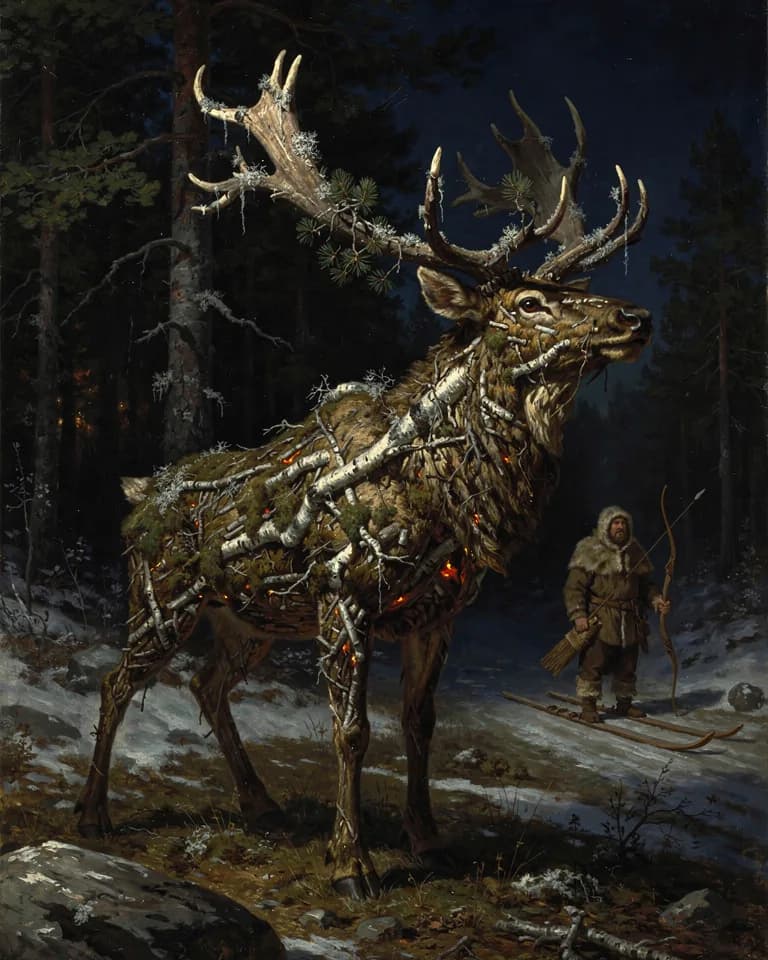
The magical elk built by the demon Hiisi's folk from forest materials, which Louhi sets Lemminkäinen to ski down as the first of his tasks, and which he captures only after praying to Tapio and Mielikki.
About Elk of Hiisi
The first task
In Runes 13 and 14 of the Kalevala, Louhi tells Lemminkäinen that he must ski down Hiisi's elk (Crawford translates it as 'wild-moose') before she will give him her daughter. The creature has been made by Hiisi's people from the materials of the forest, with a head of rotten wood, horns of willow branches, legs of fence stakes, and veins of dry grass, and it runs wild through the villages of Lapland, overturning pots and startling the women.
The chase
Lemminkäinen has a master ski-maker craft him the best skis ever made and sets off. He overtakes the elk and catches it, but it breaks free and smashes his skis. Then he prays to Ukko and to the forest's rulers, Tapio and Mielikki, promising offerings of gold and silver; they drive the elk to him, and he brings it to Pohjola.
Hiisi
Hiisi originally meant a sacred grove or burial place in Finnish, attested in place names across Finland; after Christianization the word came to mean a demon or evil spirit, and the Kalevala's Hiisi is a devilish power of the forest. The elk hunt reflects the central place of elk hunting on skis in the Finnish past, depicted in prehistoric rock paintings.
Sources and further reading
Source notes
These references are recorded in the catalog. Their passage wording and translation have not been checked, so quotations are not displayed here.
- Kalevala (trans. John Martin Crawford, 1888), Rune XIV
About this entry
By Elizabeth Stein for Mythos Atlas. About the author. Editorial notes are grounded in the site's cited sources and can be challenged through the contact page.
The danger rating is an editorial shorthand for how the myths portray the creature, not a claim made by the sources.