Finnish Tradition (Kalevala)
Mielikki
Mielikki
Also known as Metsän emäntä (Mistress of the Forest)
- the forest
- the hunt
- the protection of cattle in the woods
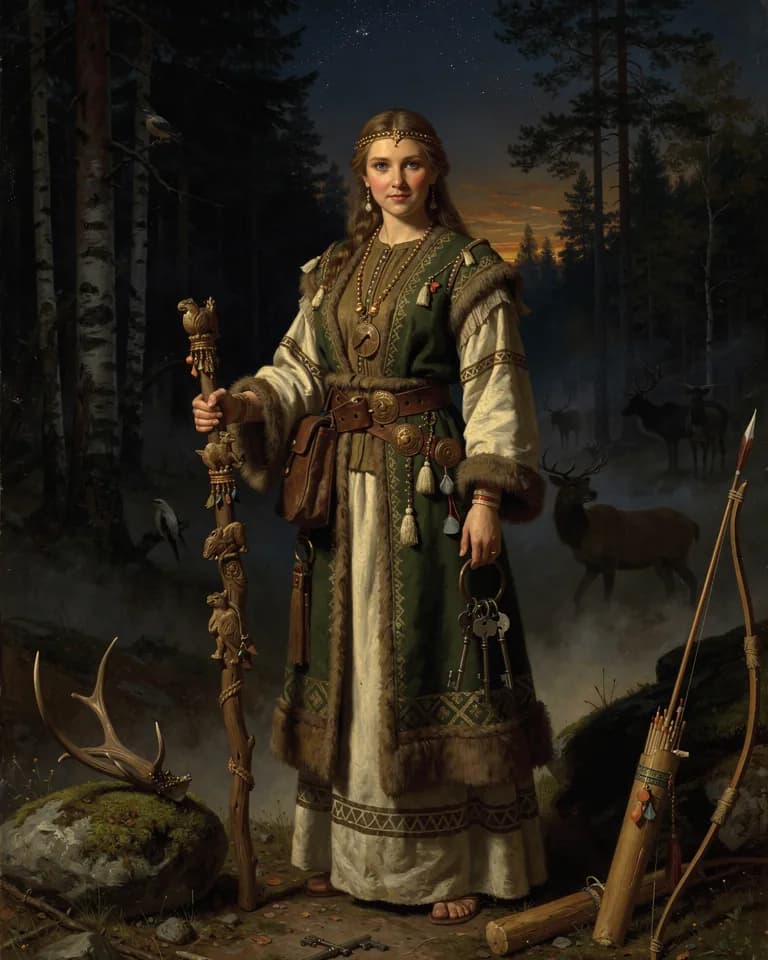
The mistress of the forest and wife of Tapio, who holds the keys to the forest's storehouse of game and whom hunters and herders, and Lemminkäinen in the Kalevala, entreat for luck and protection.
About Mielikki
Mistress of the forest
In Finnish runo-songs and charms, Mielikki is the forest's mistress (metsän emäntä) and the wife of Tapio, the forest's king. Hunters ask her to open the forest's storehouse and send them game; herders ask her to keep their cattle safe from bears and wolves when the animals graze in the woods. She was often imagined as more generous than her husband, and prayers flatter her beauty and ornaments.
In the Kalevala
When Lemminkäinen hunts the elk of Hiisi, he addresses her directly: 'Mistress of the woods, Mielikki, / Forest-mother, formed in beauty', asking her for her silver keys, and she drives the elk to him. Later cattle charms in the epic ask Mielikki and other forest powers to protect the herd.
Evidence
Mielikki is not in Agricola's list, but she is well attested in charms and songs recorded from the eighteenth century onward and appears in Ganander's Mythologia Fennica (1789).
Origin story
No origin is told.
Worship and cult
Temples, festivals, and practices recorded for Mielikki
Hunters' and herders' prayers and charms for game and for the safety of cattle grazing in the forest.
Family
In the atlas
Where Mielikki appears
Stories
Sources and further reading
Source notes
These references are recorded in the catalog. Their passage wording and translation have not been checked, so quotations are not displayed here.
- Kalevala (trans. John Martin Crawford, 1888), Rune XIV
About this entry
By Elizabeth Stein for Mythos Atlas. About the author. Editorial notes are grounded in the site's cited sources and can be challenged through the contact page.
Parallels are editorial comparisons across traditions: a shared role does not, by itself, establish a shared origin.
Family relationships come from the atlas's kinship records. Ancient sources often disagree on divine genealogy.
Genealogy
Family tree
Mielikki's parents, consorts, children and rivals, as recorded in the atlas.