Finnish Tradition (Kalevala)
Tapio
Tapio
Also known as Metsän kuningas (King of the Forest)
- the forest
- game and hunting
The god of the forest and giver of game, named by Agricola in 1551, whom hunters in the runo-songs and the Kalevala address with his wife Mielikki to open the forest's storehouse to them.
About Tapio
Attestation
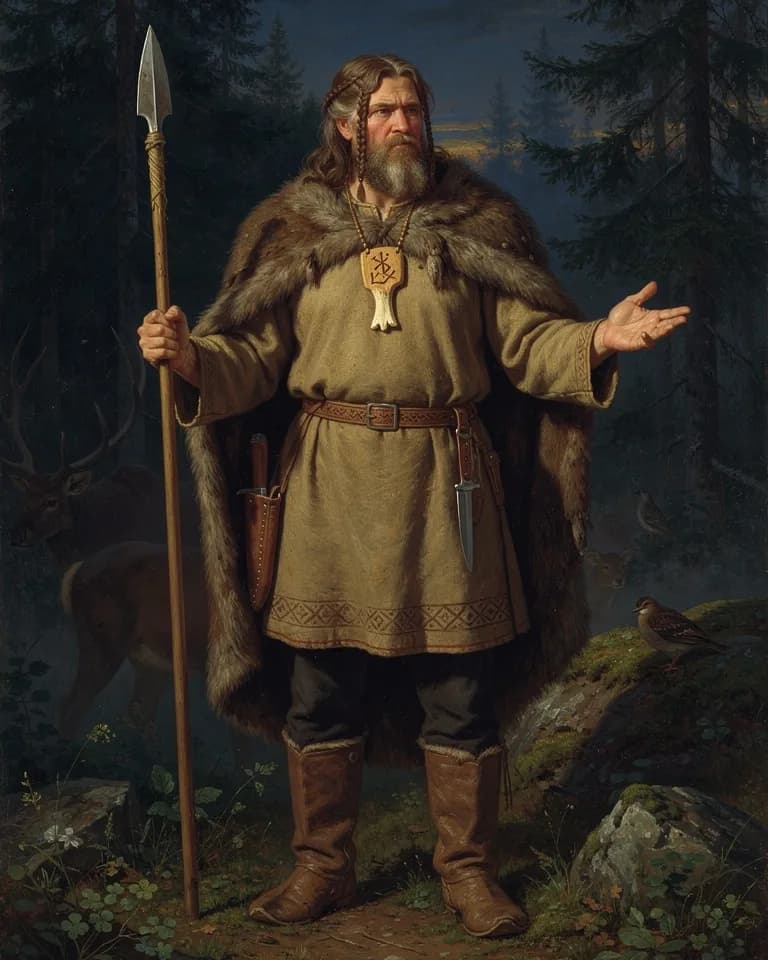
Agricola's list of 1551 says of the Tavastians that Tapio gave them game from the forest. In folk poetry and charms, Tapio is the old king of the forest, with a beard of lichen and a hat of fir, living in Tapiola with his wife Mielikki, their son Nyyrikki, and daughter Tellervo. Hunters sang to him to ask for game, promising respect and offerings, and avoided offending the forest by loud boasting or careless behavior.
In the Kalevala
When Lemminkäinen must capture the elk of Hiisi, he prays to Tapio and Mielikki to open their forest to him, promising gifts of gold and silver, and the elk is driven into his hands. In another rune, cattle charms ask the forest powers to protect the herds while they graze in the woods.
The forest in Finnish life
For a people whose land was mostly forest, Tapio stood for the forest as a society with its own rulers, rights, and moods. Sibelius's last tone poem, Tapiola (1926), takes its name from his realm.
Origin story
No origin is told.
Worship and cult
Temples, festivals, and practices recorded for Tapio
Hunters' prayers and charms to Tapio and Mielikki before the hunt; small offerings and respectful behavior in the forest; the first catch was sometimes left on a tree stump for the forest.
Family
In the atlas
Where Tapio appears
Stories
Sources and further reading
Source notes
These references are recorded in the catalog. Their passage wording and translation have not been checked, so quotations are not displayed here.
- Mikael Agricola, preface to Dauidin Psaltari (paraphrase)
About this entry
By Elizabeth Stein for Mythos Atlas. About the author. Editorial notes are grounded in the site's cited sources and can be challenged through the contact page.
Parallels are editorial comparisons across traditions: a shared role does not, by itself, establish a shared origin.
Family relationships come from the atlas's kinship records. Ancient sources often disagree on divine genealogy.
Genealogy
Family tree
Tapio's parents, consorts, children and rivals, as recorded in the atlas.