Finnish Tradition (Kalevala)relic
Golden Maiden of Ilmarinen
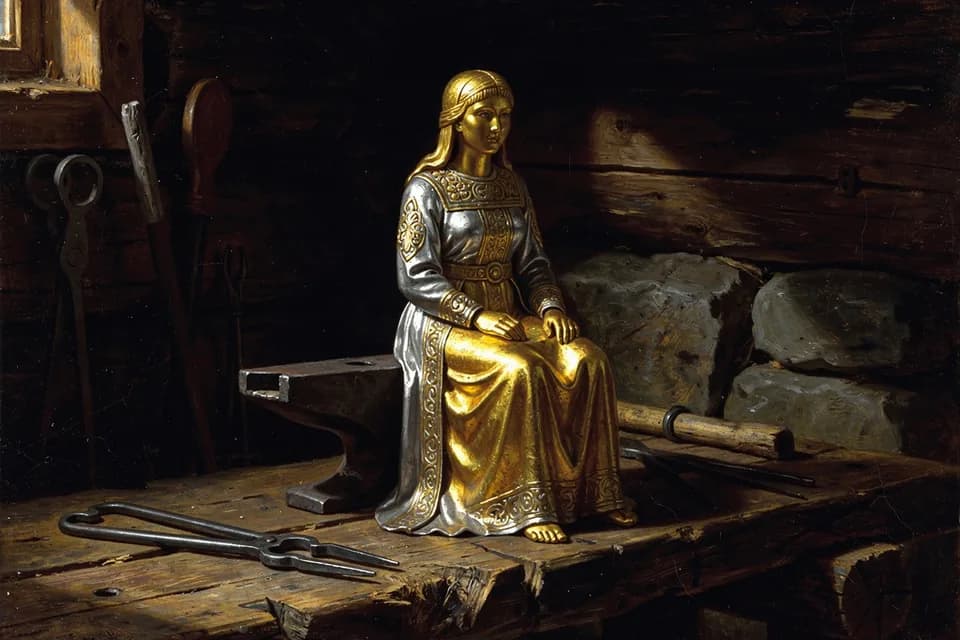
- Unmatched beauty
- Chilling whoever lies beside her
The bride of gold and silver that the grieving smith Ilmarinen forges after his wife's death, beautiful but cold as ice beside him at night; Väinämöinen tells him to melt her down and warns young men never to court gold.
About Golden Maiden of Ilmarinen
A bride from the forge
After his wife, the Maiden of Pohjola, is killed through Kullervo's revenge, Ilmarinen mourns for months. In Rune 37 he decides to forge himself a new wife. He throws gold and silver into the furnace; after several failed attempts that produce a sheep, a colt, and other things, a maiden of gold and silver emerges, and he works her with great skill into a beautiful woman. But she cannot speak or feel, and when he lies beside her at night, the side of his body that touches her freezes.
Väinämöinen's advice
Ilmarinen offers the golden maiden to Väinämöinen, who looks at her and tells the smith to throw her back into the fire and make useful things from her, or to send her to foreign lands where men want gold. Then he warns the young men of later generations never to bow to gold or court a golden bride, for gold is cold.
Meaning
The episode, like the Greek story of Pandora or the Pygmalion legend in reverse, turns on a manufactured woman; here the lesson is explicitly against valuing wealth over a living companion.
Origin
Forged by Ilmarinen from gold and silver after the death of his wife (Kalevala, Rune 37).
Sources and further reading
Source notes
These references are recorded in the catalog. Their passage wording and translation have not been checked, so quotations are not displayed here.
- Kalevala, Rune 37 (paraphrase)
About this entry
By Elizabeth Stein for Mythos Atlas. About the author. Editorial notes are grounded in the site's cited sources and can be challenged through the contact page.