
Side by sideParallel across traditions

Hephaestus vs Ptah

Hephaestus
HephaestusGreek
Ptah
PtahEgyptian

Greek writers directly identified Ptah with Hephaestus as the divine patron of craftsmen and metalworkers.

At a glance

Hephaestus and Ptah compared
HephaestusPtah
TraditionGreek PantheonEgyptian Pantheon
Domainsfire, metalworking, crafts, sculpturecreation through thought and speech, craftsmen, architects, sculptors
Symbolshammer, anvil, tongs, forgewas-scepter, djed-pillar, and ankh combined, skull-cap, straight false beard
Also calledVulcan, HephaistosNone recorded

Where they meet

The atlas records no domain or symbol that Hephaestus and Ptah share.

They are compared for the part each plays in their own tradition rather than for any attribute in common.

Where they part

Only Hephaestus

Associated with fire, metalworking, crafts, and sculpture.

Only Ptah

Associated with creation through thought and speech, craftsmen, architects, and sculptors.

How each was worshipped

Hephaestus

Cult sites
Hephaesteion above the Athenian Agora; Island cult on Lemnos
Festivals
Chalkeia; Hephaisteia

Smiths and fire that can be worked. The Chalkeia linked him with Athena Ergane. Lemnos kept an older, dirtier fire-god. Lameness is myth; the cult is bronze, volcano, and the workshop.

Ptah

Cult sites
Great Temple of Ptah at Memphis (Hut-ka-Ptah, a name some scholars connect to the later Greek 'Aigyptos,' the origin of 'Egypt'); Shrines within temples across Egypt as patron of craftsmen
Festivals
Festivals tied to the installation of the sacred Apis bull, his living manifestation at Memphis

Ptah's cult centered on Memphis, where his temple complex and its associated Apis bull cult made the city a major religious center for the length of Egyptian history. Craftsmen and builders across Egypt regarded him as their patron, invoking him for skill in their work.

The two figures

Greek Pantheon

Hephaestus

God of fire, metalworking, and crafts. Son of Hera (and possibly Zeus), cast from Olympus due to his lameness but later readmitted.

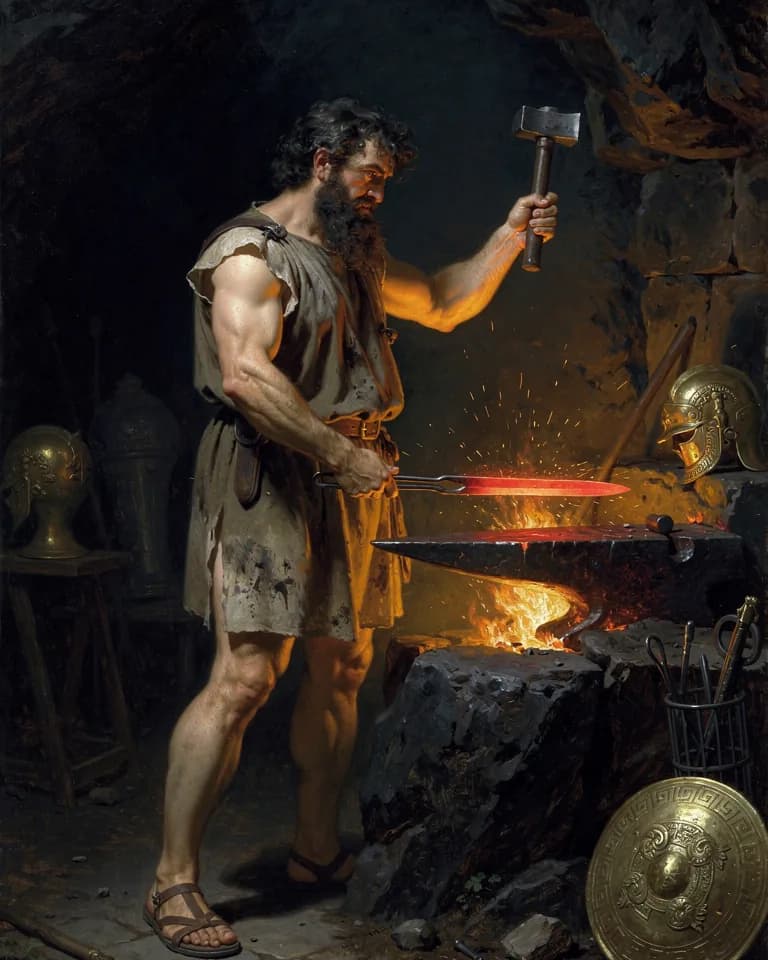
Hephaestus is the master blacksmith of the gods, controlling fire and the forge. He is the patron of all craftsmen. Unlike the other beautiful immortals, he was born lame and was cast off Olympus by his mother Hera (or Zeus).

Read the full Hephaestus entry

Egyptian Pantheon

Ptah

Creator god and patron of craftsmen, head of the Memphite Triad. The Memphite Theology credits Ptah with creating the world and the other gods through the thought of his heart and the command of his tongue, rather than through physical acts alone.

Ptah was the chief god of Memphis, credited in the Memphite Theology, inscribed on the Shabaka Stone, with creating the other gods and the ordered world through the thought conceived in his heart and the words spoken by his tongue, rather than through physical acts of craftsmanship alone.

Ptah was the chief god of Memphis, one of ancient Egypt's most important cult centers, and head of the Memphite Triad alongside his consort Sekhmet and their son Nefertem. Depicted as a mummiform man in a tight skull-cap, holding a composite scepter combining the was (power), djed (stability), and ankh (life) signs, Ptah stood apart from Egypt's many animal-headed gods in his fully human, static form.
Read the full Ptah entry
About this comparison

Comparisons pair figures that play a similar role across traditions, or that the myths connect within one. A shared role does not, by itself, establish a shared origin.