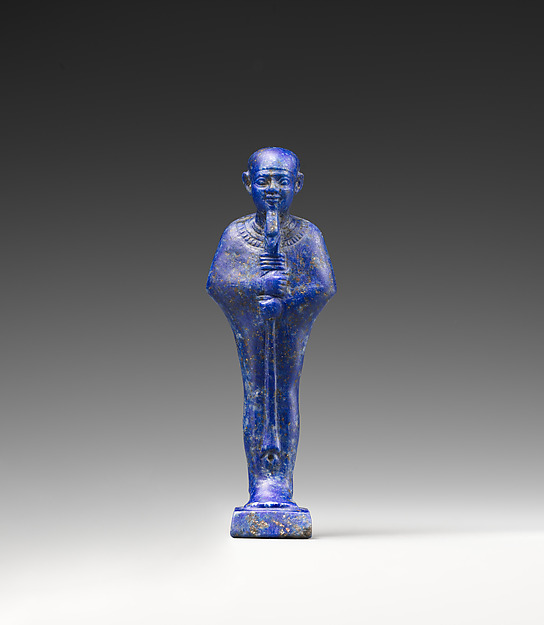
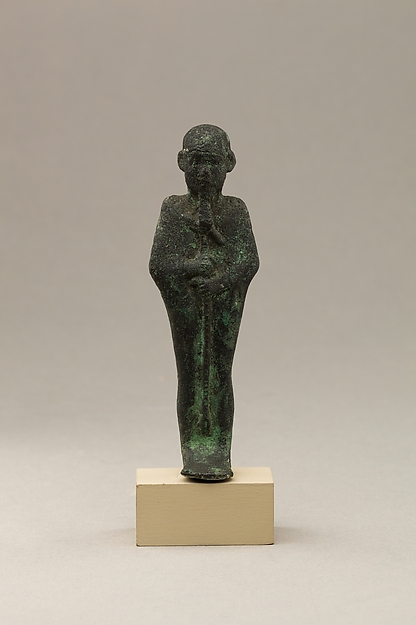
Cult Image of the God Ptah, The Metropolitan Museum of Art
Egyptian pantheon
Ptah
Ptḥ(Ptah)
creation through thought and speech
craftsmen
architects
sculptors
Creator god and patron of craftsmen, head of the Memphite Triad. The Memphite Theology credits Ptah with creating the world and the other gods through the thought of his heart and the command of his tongue, rather than through physical acts alone.
Ptah was the chief god of Memphis, one of ancient Egypt's most important cult centers, and head of the Memphite Triad alongside his consort Sekhmet and their son Nefertem. Depicted as a mummiform man in a tight skull-cap, holding a composite scepter combining the was (power), djed (stability), and ankh (life) signs, Ptah stood apart from Egypt's many animal-headed gods in his fully human, static form.
Creation Through Thought and Word
Ptah's most distinctive theological role comes from the Memphite Theology, preserved on the Shabaka Stone, a granite slab inscribed under the 25th-Dynasty pharaoh Shabaka (c. 710 BCE) that presents its text as a copy of a much older original, though the true antiquity of the underlying composition is debated among Egyptologists. In this text, Ptah creates the other gods and all things not by physical craftsmanship alone but through the conception of his heart (mind) and the command of his tongue (speech): what he thinks and names comes into being. This has led some scholars to compare Ptah's creative word to Logos theology in later religious traditions, though such comparisons should be drawn carefully rather than treated as a direct historical influence.
Patron of Craftsmen
As the divine artisan, Ptah was the patron of sculptors, metalworkers, builders, and craftsmen of every kind, including those who built and decorated tombs and temples. The Greeks, encountering this aspect of Ptah, identified him with their own smith-god Hephaestus.
The Apis Bull and Later Syncretism
Ptah's cult was closely tied to the Apis bull, worshipped at Memphis as his living manifestation. In later periods, Ptah was frequently fused with other gods in composite forms such as Ptah-Sokar-Osiris, reflecting his deep association with craftsmanship, the afterlife, and creation across shifting theological currents.
Origin Story
Ptah was the chief god of Memphis, credited in the Memphite Theology, inscribed on the Shabaka Stone, with creating the other gods and the ordered world through the thought conceived in his heart and the words spoken by his tongue, rather than through physical acts of craftsmanship alone.
One role, many cultures
The creation through thought and speech archetype across pantheons
Greek writers directly identified Ptah with Hephaestus as the divine patron of craftsmen and metalworkers
Source Notes
These records lack edition and translator details. Their wording has not been verified as a direct quotation.
There came into being in the heart, there came into being on the tongue [something] in the form of Atum. The great and mighty Ptah, who transmitted [life] to all the gods, as well as their kas, through this heart, by which Horus became Ptah, and through this tongue, by which Thoth became Ptah.
Ancient Texts
Book of the Dead by Various Egyptian priests
c. 1550-50 BCE·Ancient Egyptian (Hieroglyphic)
Ptah appears in funerary spells invoking the great gods of the afterlife
Recommended translations:E.A. Wallis Budge (1895), Raymond O. Faulkner (1972)
Gods and Pharaohs from Egyptian Mythology by Geraldine Harris
1982·English
Covers Ptah's role in the Memphite Triad and the Memphite Theology
References & further reading
Editorial notes for deeper study (not a full bibliography).
Lichtheim, Miriam. *Ancient Egyptian Literature, Volume I: The Old and Middle Kingdoms* (University of California Press, 1973) — includes a translation of the Memphite Theology.
Wilkinson, Richard H. *The Complete Gods and Goddesses of Ancient Egypt* (Thames & Hudson, 2003).
Browse representative texts and policies on the Sources page.
Worship & Cult
How Ptah was venerated in ancient times
Sacred Temples
•Great Temple of Ptah at Memphis (Hut-ka-Ptah, a name some scholars connect to the later Greek 'Aigyptos,' the origin of 'Egypt')
•Shrines within temples across Egypt as patron of craftsmen
Festivals & Celebrations
Festivals tied to the installation of the sacred Apis bull, his living manifestation at Memphis
Worship Practices
Ptah's cult centered on Memphis, where his temple complex and its associated Apis bull cult made the city a major religious center for the length of Egyptian history. Craftsmen and builders across Egypt regarded him as their patron, invoking him for skill in their work.
Domains
creation through thought and speech
craftsmen
architects
sculptors
Symbols
was-scepter, djed-pillar, and ankh combined
skull-cap
straight false beard
In the museums
Ptah in art
Real objects in public collections, released into the public domain by the museums that hold them. Dates refer to when each object was made. Objects made within the tradition come first, later depictions after.
Egyptian, Third Intermediate Period–Late Period · ca. 945–600 BCE · Lapis lazuli
A lapis lazuli statuette identified by the museum as a cult image of Ptah, shown in his standard mummiform pose holding a staff. Small images like this were placed in shrines or temples as votive offerings.
Egyptian, Late Period–Ptolemaic Period · 664–30 BCE · Cupreous metal
A cast metal statuette the museum catalogs simply as Ptah, showing the god's characteristic close-fitting cap and mummiform body. Votive figures of this type were mass-produced for temple donation in the Late Period.