
Side by sideParallel across traditions

Ma'at vs Shamash

Ma'at
Ma'atEgyptian
Shamash
ShamashMesopotamian

Both personify truth, justice, and the correct cosmic/social order that must be maintained.

At a glance

Ma'at and Shamash compared
Ma'atShamash
TraditionEgyptian PantheonMesopotamian Pantheon
Domainstruth, justice, harmony, order, balancesun, justice, truth, divination
Symbolsostrich feather, scales, ankh, was sceptersun disk with rays, saw, measuring rod
Also calledMayetUtu, Babbar

Where they meet

Both are associated with truth and justice.

Where they part

Only Ma'at

Associated with harmony, order, and balance.

Only Shamash

Associated with sun and divination.

How each was worshipped

Ma'at

Cult sites
No great independent temple; a chapel in major houses and the vizier's hall
Festivals
Daily offering of Maat by the king

Truth as a goddess you present, not a pilgrimage. The king lifts a small Maat figure to the gods each day. Judges wear her. Cult is the act of keeping the world from tipping, repeated in every sanctuary.

Shamash

Cult sites
Ebabbar at Sippar; Ebabbar at Larsa
Festivals
Justice oaths at sunrise

The sun who sees the lawsuit. Hammurabi's stele puts him over the king. Cult is courtroom light as much as astronomy.

The two figures

Egyptian Pantheon

Ma'at

Goddess embodying truth, justice, and cosmic order. Her feather is weighed against the hearts of the dead in judgment.

Ma'at is not just a goddess but the fundamental concept of truth, balance, order, law, morality, and justice. Without Ma'at, the universe would crumble into chaos.

Read the full Ma'at entry

Mesopotamian Pantheon

Shamash

The sun god and divine judge. Shamash sees all that occurs under the sun and is the god of justice, truth, and moral order.

Shamash is the son of the moon god Nanna/Sin, emerging from the underworld each dawn through the eastern mountains. Each night he descends through the western gates to travel through the underworld, bringing light even to the realm of the dead, before rising again at dawn.

Shamash traverses the sky each day, seeing everything that occurs beneath his rays. This all-seeing nature makes him the natural god of justice and truth. Nothing can be hidden from his sight, no lie escapes his notice, no injustice occurs beyond his witness. He is the great equalizer who treats beggar and king alike.

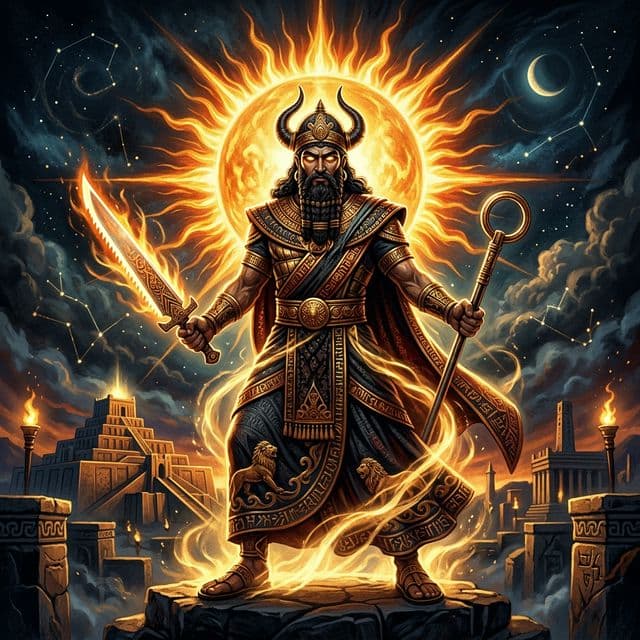
Read the full Shamash entry
About this comparison

Comparisons pair figures that play a similar role across traditions, or that the myths connect within one. A shared role does not, by itself, establish a shared origin.