Mythos Atlas

Side by sideParallel across traditions

Mithra vs Shamash

Mithra
MithraPersian (Iranian)
Shamash
ShamashMesopotamian

Both are all-seeing gods of the sun's light who guard oaths and justice, though Mithra's primary sense is the covenant itself rather than the solar disk.

At a glance

Mithra and Shamash compared
MithraShamash
TraditionPersian (Iranian) TraditionMesopotamian Pantheon
Domainscontracts and oaths, truth, the light of dawn, judgment of soulssun, justice, truth, divination
Symbolsa thousand ears and ten thousand eyes, the chariot drawn by white horses, the boar Verethragna running before himsun disk with rays, saw, measuring rod
Also calledMihr, Mehr, Mithra of wide pasturesUtu, Babbar

Where they meet

Both are associated with truth.

Where they part

Only Mithra

Associated with contracts and oaths, the light of dawn, and judgment of souls.

Only Shamash

Associated with sun, justice, and divination.

How each was worshipped

Mithra

Cult sites
Zoroastrian fire temples are also called Dar-e Mehr, 'the court of Mithra'.
Festivals
Mehregan, the autumn festival on the day Mihr of the month Mihr, still celebrated in Iran.

Invoked as witness and guardian of contracts and oaths; in Zoroastrian eschatology he judges souls with Sraosha and Rashnu at the Chinvat Bridge.

Shamash

Cult sites
Ebabbar at Sippar; Ebabbar at Larsa
Festivals
Justice oaths at sunrise

The sun who sees the lawsuit. Hammurabi's stele puts him over the king. Cult is courtroom light as much as astronomy.

The two figures

Persian (Iranian) Tradition

Mithra

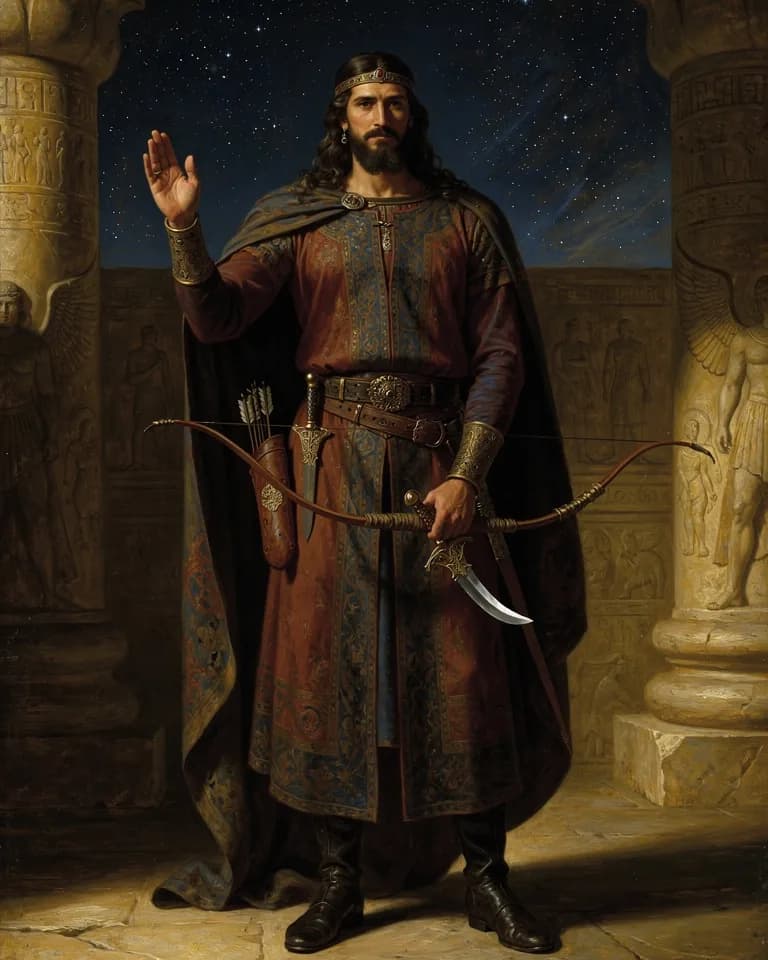
The yazata of the covenant, 'lord of wide pastures', who watches with a thousand ears and ten thousand eyes over everyone who keeps or breaks their word, and whom Ahura Mazda created 'as worthy of sacrifice as myself'.

Created by Ahura Mazda as worthy of worship as himself (Yasht 10.1).

Yasht 10, one of the longest hymns of the Avesta, is devoted to Mithra. It opens with Ahura Mazda declaring that he created Mithra as worthy of sacrifice and prayer as himself, and it describes a watchful, terrible god of the covenant: the first of the heavenly beings to rise over Mount Hara before the sun, he drives a chariot across the sky, sees everything with his thousand ears and ten thousand eyes, and brings ruin on the 'Mithra-deceiver' who breaks a contract, while protecting those who keep faith. Before him runs Verethragna, victory, in the shape of a boar.

Read the full Mithra entry

Mesopotamian Pantheon

Shamash

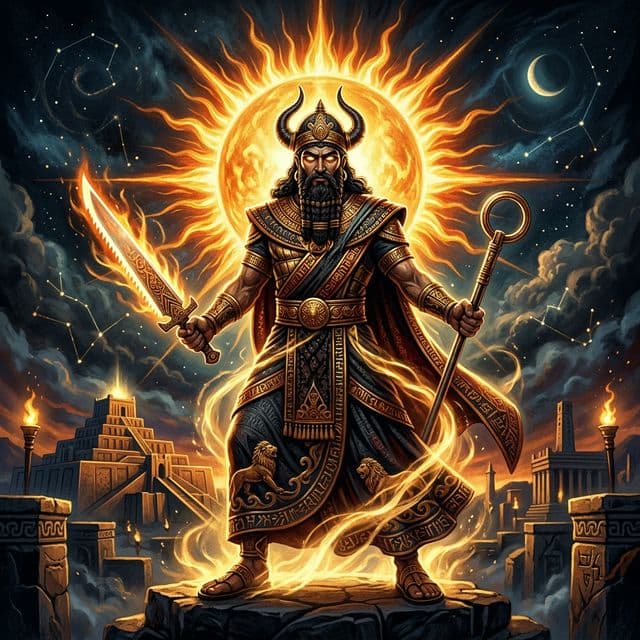
The sun god and divine judge. Shamash sees all that occurs under the sun and is the god of justice, truth, and moral order.

Shamash is the son of the moon god Nanna/Sin, emerging from the underworld each dawn through the eastern mountains. Each night he descends through the western gates to travel through the underworld, bringing light even to the realm of the dead, before rising again at dawn.

Shamash traverses the sky each day, seeing everything that occurs beneath his rays. This all-seeing nature makes him the natural god of justice and truth. Nothing can be hidden from his sight, no lie escapes his notice, no injustice occurs beyond his witness. He is the great equalizer who treats beggar and king alike.

Read the full Shamash entry
About this comparison

Comparisons pair figures that play a similar role across traditions, or that the myths connect within one. A shared role does not, by itself, establish a shared origin.