Persian (Iranian) Traditioncreation
Ohrmazd and Ahriman: The Two Spirits and the Assault on Creation
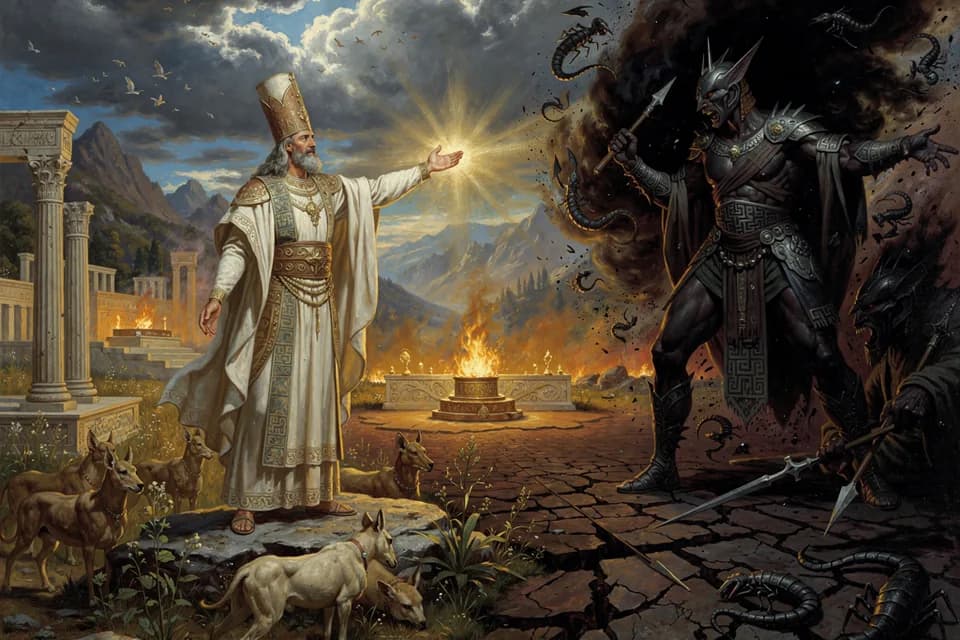
From the Gathas' two primal spirits and the choice between truth and the lie to the Bundahishn's cosmic drama: Ohrmazd in light and Ahriman in darkness, a created world attacked and corrupted, and the promise of its final renewal.
An editorial retelling
The story
The choice of the two spirits
The oldest layer of this story is not a narrative at all. In one of the Gathas (Yasna 30), Zarathushtra describes two primal spirits, called twins, who in the beginning chose between the good and the bad in thought, word, and deed: one chose truth, the other the lie. When they first came together they established life and non-life, and the followers of the lie will have the worst existence at the end, the followers of truth the best mind. Humans, like the spirits, must choose. The hymn's emphasis is ethical: the world is a place of decision.
Light above, darkness below
The Middle Persian Bundahishn ('Primal Creation'), compiled in the ninth century CE from older traditions, turns this into a cosmic history. In the beginning Ohrmazd dwelt on high in endless light, omniscient and good; Ahriman dwelt below in endless darkness, ignorant and destructive; between them lay empty space. Ohrmazd, knowing Ahriman existed, created the world first in a spiritual, invisible state. When Ahriman rose to the boundary and saw the light, he desired to destroy it. Ohrmazd offered peace, which Ahriman refused, and so Ohrmazd proposed a fixed period of struggle, knowing that a limited war would end in Ahriman's defeat. Then Ohrmazd recited the Ahuna Vairya prayer, and Ahriman, seeing his final ruin in it, fell back stunned into the darkness for three thousand years.
The seven creations
During that time Ohrmazd made the material world in seven stages: the sky, water, earth, plants, the sole-created bull, the first man Gayomard, and fire, which pervades all the others. Everything was at first perfect and still, the sun standing at noon.
The assault
At the end of the three thousand years Ahriman attacked. He broke through the sky, pierced the earth, poisoned the waters, withered the plants, and sent disease and death against the bull and against Gayomard. The world became mixed: good and evil entangled everywhere, the sun beginning to move and time to pass. But the bull's seed, purified in the moon, gave rise to the animals; and from Gayomard's seed, after forty years, grew a rhubarb plant from which the first human couple, Mashya and Mashyana, emerged.
The renewal
The struggle continues through the ages of the world, which the Bundahishn and related texts divide into periods of three thousand years, with Zarathushtra's revelation at the start of the last. At the end, a savior (Saoshyant) born of Zarathushtra's preserved seed will raise the dead; a river of molten metal will purify all people; Ahriman will be defeated and made powerless; and the world will be renewed, never to grow old or die. The Zamyad Yasht of the Avesta already looks forward to that renewal, 'when the dead will rise, when life and immortality will come'.
Variants
The Zurvanite version, reported by Christian and Armenian writers, made Ohrmazd and Ahriman twin sons of Zurvan, Infinite Time, reading the Gathas' 'twins' literally; later Zoroastrian orthodoxy rejected it.
Listen or change reading mode
Highlights
Two primal spirits choose between truth and the lie; Ohrmazd creates the world in seven stages; Ahriman breaks in and mixes good with evil; from the first man's seed grow Mashya and Mashyana; at the end the dead rise and the world is renewed.
Why it matters
The foundation of Zoroastrian cosmology and ethics, and one of the earliest fully dualist accounts of the world, influential in discussions of the origins of ideas about the end of time, resurrection, and judgment.
Other versions
1 alternate account in the catalog.
Eznik of Kolb, Refutation of the Sects
Ohrmazd and Ahriman are twin sons of Zurvan (Time): Ohrmazd born of his sacrifice, Ahriman of his doubt, with Ahriman granted a limited reign by Zurvan's vow.
Note: Known mainly from hostile Christian and Armenian writers; later Zoroastrian orthodoxy rejected it.
Sources and further reading
By Elizabeth Stein for Mythos Atlas. About the author. Editorial notes are grounded in the site's cited sources and can be challenged through the contact page.
Works cited
Avesta, Yasna 30 (Gathas)
trans. L. H. Mills; Helmut Humbach
Bundahishn, chs. 1-4 (West's numbering, SBE 5)
trans. E. W. West
Avesta, Yasht 19.89-96
trans. James Darmesteter