Persian (Iranian) TraditionAdversary
Angra Mainyu
Aŋra Mainyu(Angra Mainyu; Middle Persian Ahriman)
Also known as Ahriman, Ahreman, the Hostile Spirit
- destruction
- the lie (druj)
- death
- darkness
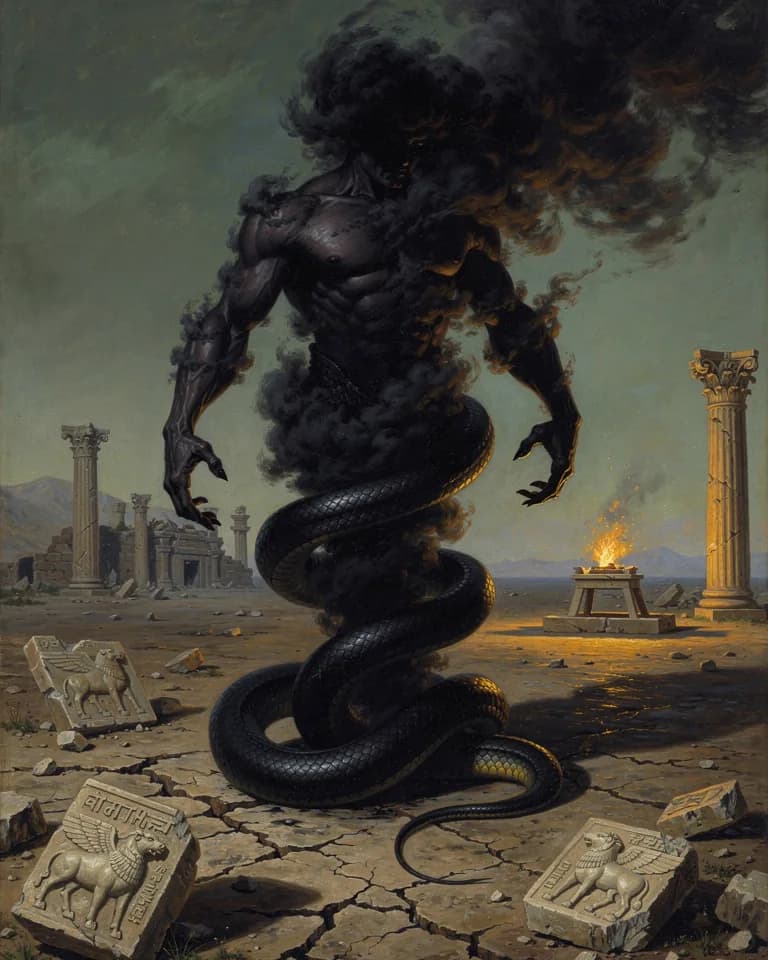
The Hostile Spirit of Zoroastrianism, source of death, lies, and every plague, who in the Vendidad 'counter-creates' an evil against each good land Ahura Mazda makes, and who will be defeated at the end of time.
About Angra Mainyu
The counter-creator
The opening chapter of the Vendidad lists sixteen good lands created by Ahura Mazda and, against each, a plague created by Angra Mainyu, 'who is all death': the serpent and winter, the locust, plunder, doubt, witchcraft, and more. The pattern of creation and counter-creation is the core of his character: he makes nothing good, only corruption of what is good.
In the Gathas and after
The Gathas speak of two primal spirits, one more beneficent and one hostile, and of the choice every being makes between them; they do not describe the Hostile Spirit in narrative detail. The Middle Persian books of the ninth century develop Ahriman into a cosmic adversary: dwelling in endless darkness, he attacks Ohrmazd's creation, breaks through the sky, kills the first man Gayomard and the primordial bull, and fills the world with noxious creatures, beginning the mixed age of good and evil in which humanity now lives. At the end, he will be defeated and rendered powerless.
Not worshipped
Angra Mainyu is not a god who received worship; Zoroastrian practice aims to repel him, through truthfulness, purity laws, and the destruction of creatures regarded as his. The Sasanian-era Zurvanite current made him Ohrmazd's twin brother, born of Zurvan's doubt, a view rejected by later orthodoxy.
Origin story
In the Gathas one of two primal spirits, called twins (Yasna 30.3); in the Zurvanite myth the elder of Zurvan's twin sons, born of his father's doubt.
Worship and cult
Temples, festivals, and practices recorded for Angra Mainyu
Not worshipped. Zoroastrian purity laws, truthfulness, and the ritual killing of creatures regarded as his (khrafstra) are ways of opposing him.
Family
Angra Mainyu's family at a glance
- Who are Angra Mainyu's parents?
- The atlas's kinship records name one parent of Angra Mainyu: Zurvan. Ancient accounts do not always agree on divine parentage.
- Who are Angra Mainyu's siblings?
- Siblings of Angra Mainyu recorded in the atlas: Ahura Mazda.
In the atlas
Where Angra Mainyu appears
Sources and further reading
Source notes
These references are recorded in the catalog. Their passage wording and translation have not been checked, so quotations are not displayed here.
- Avesta, Vendidad, Fargard 1.2 (trans. Darmesteter)
- Avesta, Yasht 19.96 (trans. Darmesteter)
About this entry
By Elizabeth Stein for Mythos Atlas. About the author. Editorial notes are grounded in the site's cited sources and can be challenged through the contact page.
Parallels are editorial comparisons across traditions: a shared role does not, by itself, establish a shared origin.
Family relationships come from the atlas's kinship records. Ancient sources often disagree on divine genealogy.
Genealogy
Family tree
Angra Mainyu's parents, consorts, children and rivals, as recorded in the atlas.