Persian (Iranian) Tradition
Atar
Ātar(Atar; Middle Persian Adur, Azar)
Also known as Adur, Azar, Atash
- fire
- truth
- ritual purity
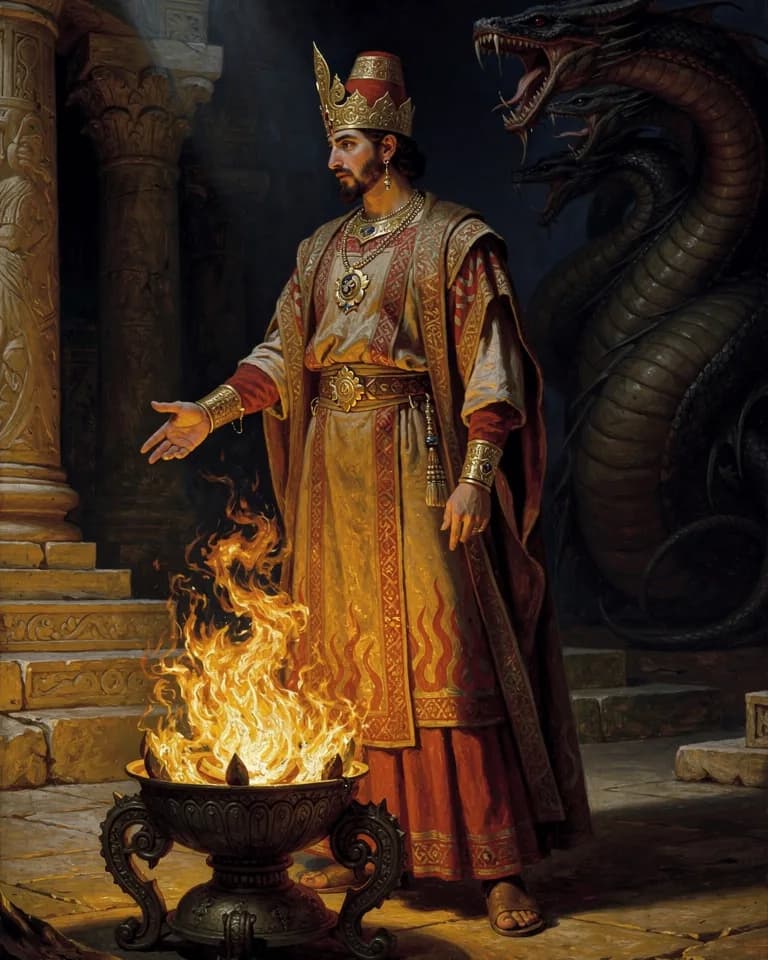
Fire as a divine being, 'son of Ahura Mazda', the visible focus of Zoroastrian worship, who in the Zamyad Yasht faces down the three-mouthed dragon Azhi Dahaka in the struggle for the royal Glory.
About Atar
Son of Ahura Mazda
The Avesta calls Atar, fire, 'the son of Ahura Mazda', and fire is the element through which Zoroastrians approach God: prayers are said facing a fire or another source of light, and consecrated fires are kept burning in fire temples. Fire is not itself worshipped as God, Zoroastrians emphasize, but honored as the purest of creations and the symbol of truth and divine light.
Atar against the dragon
The Zamyad Yasht (Yasht 19) tells how the Good Spirit and the Evil Spirit struggled for the royal Glory (khvarenah) after it left Yima. Atar came forward to seize it, but the three-mouthed Azhi Dahaka rushed at him, threatening to extinguish him so that he would never again blaze on the earth; Atar drew back his hands. Then when Azhi tried to seize it, Atar threatened in turn to enter the dragon and blaze up in his jaws, and Azhi drew back. The Glory escaped into the sea Vouru-Kasha.
The great fires
Sasanian tradition named three great fires: Adur Farnbag, the fire of the priests; Adur Gushnasp, the fire of the warriors and kings, housed at the sanctuary now called Takht-e Soleyman in northwestern Iran; and Adur Burzen-Mihr, the fire of the farmers. Fires are graded today as Atash Behram, Atash Adaran, and Atash Dadgah, according to their consecration.
Origin story
Son of Ahura Mazda, in the standard Avestan formula.
Across traditions
Parallel figures
Figures who play a role like Atar's in other traditions.
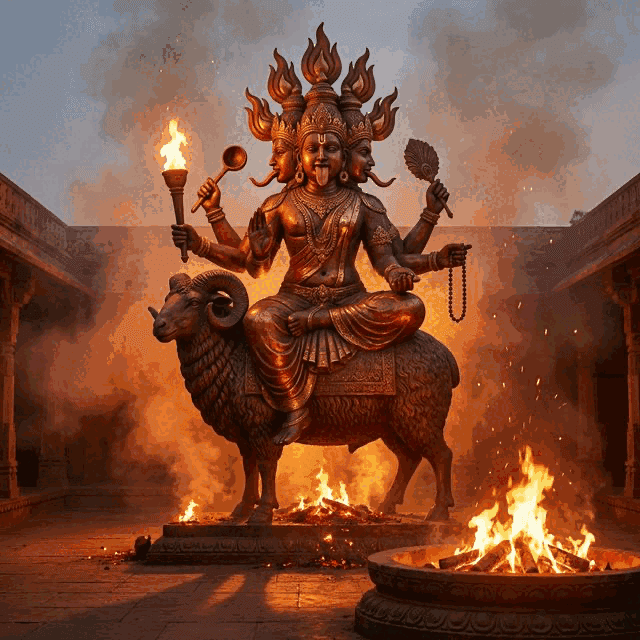 HinduAgni
Both are sacrificial fire personified as a god at the center of Indo-Iranian ritual; the names are not cognate, but the ritual role of fire as the medium between worshippers and the divine is shared.
Compare Atar and Agni side by side
Worship and cult
Temples, festivals, and practices recorded for Atar
Consecrated fires are fed with sandalwood and incense by priests five times a day; the faithful pray facing the fire and must never pollute it.
Sacred sites
- The Sasanian royal fire Adur Gushnasp at Takht-e Soleyman, Iran.
- Living Atash Behram fires at Yazd (Iran) and Udvada (India), among others.
Festivals
- Adargan, the feast of fire on the day Adar of the month Adar.
Family
Atar's family at a glance
- Who are Atar's parents?
- The atlas's kinship records name one parent of Atar: Ahura Mazda. Ancient accounts do not always agree on divine parentage.
Sources and further reading
Source notes
These references are recorded in the catalog. Their passage wording and translation have not been checked, so quotations are not displayed here.
- Avesta, Yasht 19.47 (trans. Darmesteter)
- Avesta, Yasht 19.50 (trans. Darmesteter)
About this entry
By Elizabeth Stein for Mythos Atlas. About the author. Editorial notes are grounded in the site's cited sources and can be challenged through the contact page.
Parallels are editorial comparisons across traditions: a shared role does not, by itself, establish a shared origin.
Family relationships come from the atlas's kinship records. Ancient sources often disagree on divine genealogy.
Genealogy
Family tree
Atar's parents, consorts, children and rivals, as recorded in the atlas.