Persian (Iranian) TraditionCreator
Ahura Mazda
Ahura Mazdā(Ahura Mazdā; Old Persian Auramazdā; Middle Persian Ohrmazd)
Also known as Ohrmazd, Auramazda, Hormozd, Wise Lord
- creation
- wisdom
- truth (asha)
- kingship
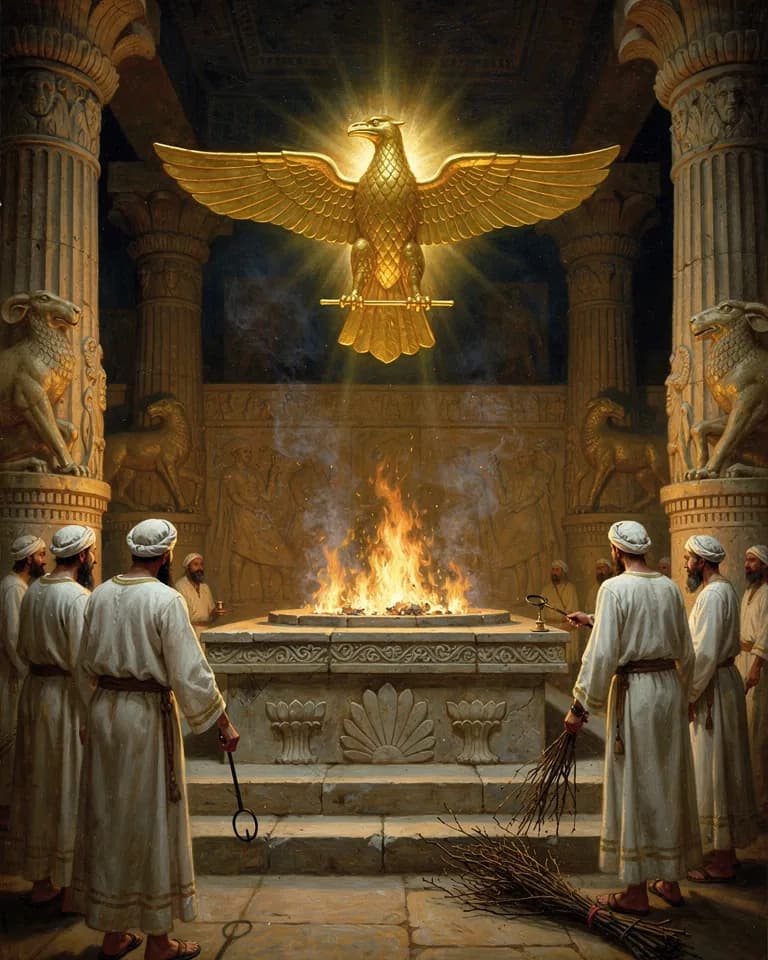
The Wise Lord, uncreated creator of the good world in Zoroastrianism, addressed by Zarathushtra in the Gathas and credited by the Achaemenid kings with their rule; opposed by the Hostile Spirit, Angra Mainyu.
About Ahura Mazda
In the Gathas
Zarathushtra's hymns address Ahura Mazda as the creator who established the earth below and held up the sky, who ordered the paths of sun and stars, and who is the father of the good powers: Truth (Asha), Good Mind (Vohu Manah), and Devotion (Armaiti), whom one hymn calls his daughter. The Gathas are hymns of questioning and devotion rather than narratives; they present a world in which every being must choose between truth and the lie, and in which the Wise Lord will judge by that choice.
In the Achaemenid inscriptions
Darius I (r. 522-486 BCE) names Ahuramazda again and again in his inscription at Behistun, attributing his seizure of power to 'the favor of Ahuramazda', and his tomb inscription at Naqsh-e Rostam praises Ahuramazda as the great god who created earth, sky, man, and happiness for man, and who made Darius king. Whether the early Achaemenids were Zoroastrians in a strict sense is debated, but their god is recognizably the same.
Ohrmazd against Ahriman
In the Middle Persian books of the ninth century CE, Ohrmazd dwells in endless light above and Ahriman in darkness below; their struggle shapes a cosmic history of twelve thousand years that ends with the renovation of the world (frashokereti). Zoroastrians today worship Ahura Mazda as the one God, in the presence of fire as the symbol of his light and truth.
Origin story
Uncreated in orthodox Zoroastrianism. In the Sasanian-era Zurvanite current, known mainly from Christian and Armenian polemic, Ohrmazd and Ahriman are twin sons of Zurvan, Infinite Time.
Across traditions
Parallel figures
Figures who play a role like Ahura Mazda's in other traditions.
 GreekZeus
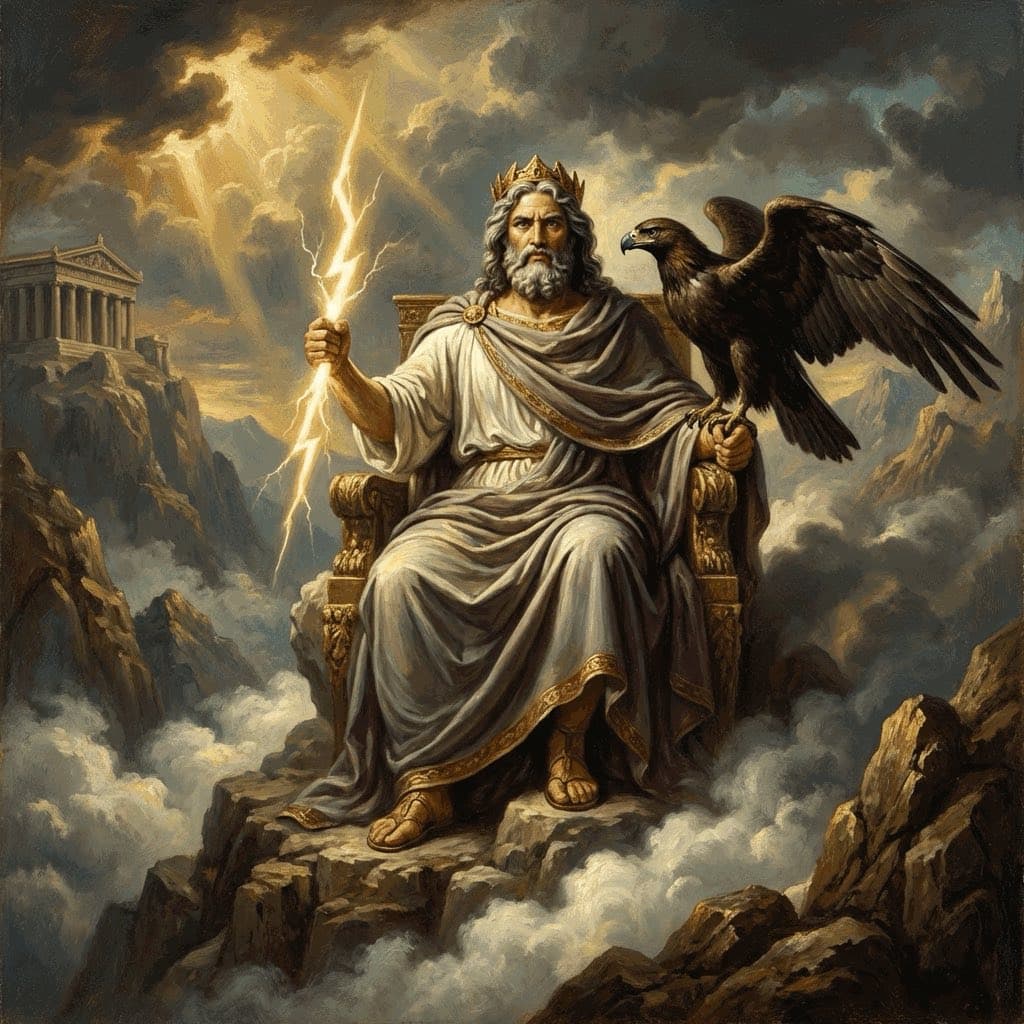
Herodotus (1.131) says the Persians called the whole vault of the sky Zeus, and at Nemrut Dağ in Commagene (1st century BCE) King Antiochus I paired the two as Zeus-Oromasdes; the equation is a Greek interpretation, not a claim of identity.
Compare Ahura Mazda and Zeus side by side
Worship and cult
Temples, festivals, and practices recorded for Ahura Mazda
Prayer five times a day in the presence of fire or light, with the Ahuna Vairya and Ashem Vohu prayers; the tying of the sacred cord (kusti) over the sacred shirt (sudreh). Herodotus reports that the ancient Persians sacrificed on mountaintops without temples or statues.
Sacred sites
- Zoroastrian fire temples, in which a consecrated fire is kept burning as the focus of worship; the highest grade, the Atash Behram, includes the fire at Yazd, Iran, and the Iranshah fire at Udvada, India.
Festivals
- The six seasonal gahambars and Nowruz, the new year at the spring equinox.
Family
Ahura Mazda's family at a glance
- Who are Ahura Mazda's parents?
- The atlas's kinship records name one parent of Ahura Mazda: Zurvan. Ancient accounts do not always agree on divine parentage.
- Who are Ahura Mazda's children?
- Children of Ahura Mazda recorded in the atlas: Atar and Spenta Armaiti.
- Who are Ahura Mazda's siblings?
- Siblings of Ahura Mazda recorded in the atlas: Angra Mainyu.
In the atlas
Where Ahura Mazda appears
Sources and further reading
Source notes
These references are recorded in the catalog. Their passage wording and translation have not been checked, so quotations are not displayed here.
- Avesta, Yasna 44.4 (paraphrase of the Gathic questions)
- Darius I, tomb inscription at Naqsh-e Rostam (DNa), §1 (paraphrase)
- Behistun Inscription, col. I (paraphrase)
Appears in
Ancient and classical works featuring this figure.
the Wise Lord, creator, addressed in the Gathas and speaker of the Yashts and Vendidad (throughout)
About this entry
By Elizabeth Stein for Mythos Atlas. About the author. Editorial notes are grounded in the site's cited sources and can be challenged through the contact page.
Parallels are editorial comparisons across traditions: a shared role does not, by itself, establish a shared origin.
Family relationships come from the atlas's kinship records. Ancient sources often disagree on divine genealogy.
Genealogy
Family tree
Ahura Mazda's parents, consorts, children and rivals, as recorded in the atlas.