Persian (Iranian) Tradition
Tishtrya
Tištriia(Tishtrya; Middle Persian Tishtar, Tir)
Also known as Tishtar, Tir, Sirius
- rain
- the star Sirius
- fertility of the land
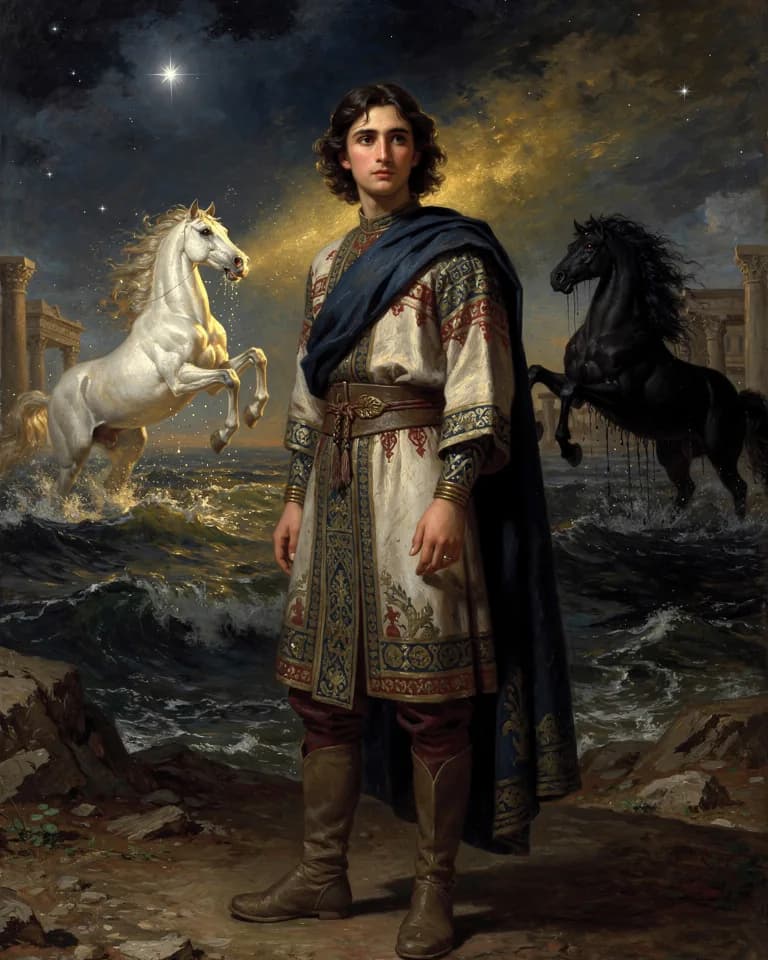
The star Sirius as a rain-bringing yazata, who in the Tir Yasht descends to the cosmic sea as a white horse, is at first overcome by the black horse of the drought demon Apaosha, and then, strengthened by worship, defeats him and releases the rains.
About Tishtrya
The Tir Yasht
Yasht 8 is devoted to Tishtrya, the brightest star in the sky. He flies toward the sea Vouru-Kasha as swiftly as the arrow that the archer Erekhsha shot from Mount Khshaotha to Mount Hvanvant, and Ahura Mazda, the waters, and the plants aid him, while Mithra opens a wide way for him. He takes three forms in turn: a young man of fifteen, a bull with golden horns, and a white horse with golden ears.
Battle with drought
As a white horse he goes down to the sea, where the demon of drought, Apaosha, rushes to meet him as a black horse 'stamped with brands of terror'. They fight hoof against hoof for three days and nights, and Apaosha wins, driving Tishtrya from the sea. Tishtrya laments that men do not worship him with a sacrifice in which he is invoked by his own name; when he receives such worship, he returns with renewed strength, defeats Apaosha at noon, and the waters of Vouru-Kasha rise in clouds that carry rain to the seven regions of the earth.
Festival and later tradition
The summer festival of Tirgan, on the day Tir of the month Tir, honored Tishtrya and was later linked with the legend of the archer Arash (Avestan Erekhsha), whose arrow fixed the frontier between Iran and Turan. Tirgan is still celebrated in parts of Iran, with water-splashing and the tying of colored bands.
Origin story
No birth is told; he is the star Sirius, a creation of Ahura Mazda.
Worship and cult
Temples, festivals, and practices recorded for Tishtrya
Sacrifice in which he is invoked by his own name, which the Tir Yasht presents as the source of his strength against drought; prayers for rain.
Festivals
- Tirgan, the midsummer festival on the day Tir of the month Tir, still observed in parts of Iran.
In the atlas
Where Tishtrya appears
Sources and further reading
Source notes
These references are recorded in the catalog. Their passage wording and translation have not been checked, so quotations are not displayed here.
- Avesta, Yasht 8.7 (trans. Darmesteter)
- Avesta, Yasht 8.20 (trans. Darmesteter; diacritics simplified)
Appears in
Ancient and classical works featuring this figure.
the star Sirius, who battles the drought demon Apaosha (Yasht 8 (Tir Yasht))
About this entry
By Elizabeth Stein for Mythos Atlas. About the author. Editorial notes are grounded in the site's cited sources and can be challenged through the contact page.
Parallels are editorial comparisons across traditions: a shared role does not, by itself, establish a shared origin.
Genealogy
Family tree
Tishtrya's parents, consorts, children and rivals, as recorded in the atlas.