Persian (Iranian) Traditionmyth
Yima and the Var
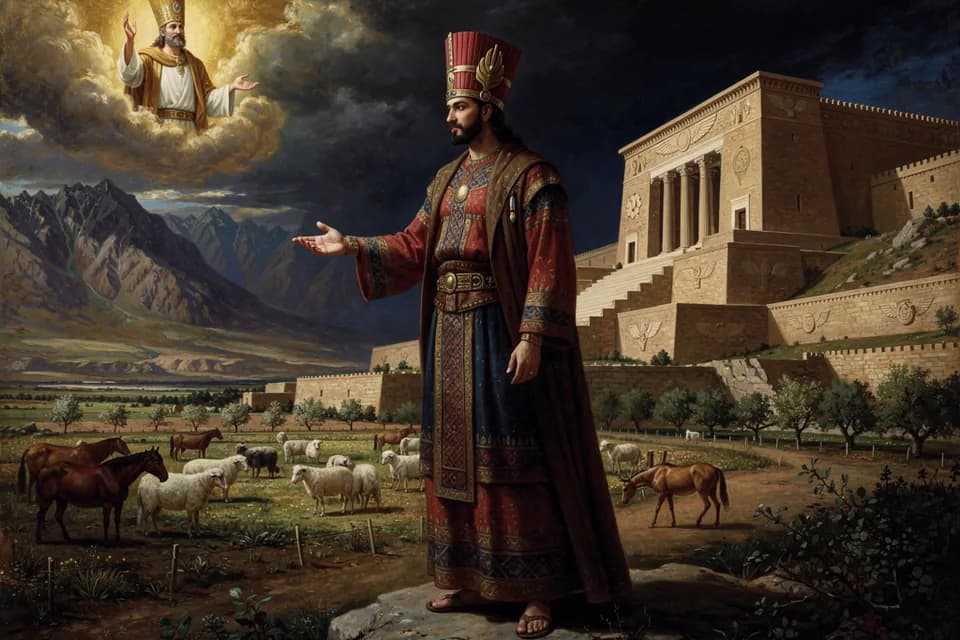
Yima, the first king, declines to be Ahura Mazda's prophet but agrees to rule and protect the world; he enlarges the earth three times, then builds an enclosure to preserve the best of every living thing from the coming winters, before his pride costs him the royal Glory.
An editorial retelling
The story
The first to hear the religion
In the second chapter of the Vendidad, Zarathushtra asks Ahura Mazda who was the first mortal before himself with whom the Wise Lord spoke. Ahura Mazda answers: the fair Yima, the good shepherd, son of Vivanghat. He asked Yima to be the preacher and bearer of his religion, but Yima replied that he was not born or taught for that. So Ahura Mazda asked him instead to make the world increase and grow, to nourish it, rule it, and watch over it, and Yima agreed: while he was king there would be neither cold wind nor hot wind, neither disease nor death. Ahura Mazda gave him a golden seal and a dagger inlaid with gold as signs of his rule.
The growing earth
Under Yima's rule three hundred winters passed, and the earth became so full of flocks and herds, people, dogs, birds, and red blazing fires that there was no more room. Ahura Mazda warned him, and Yima stepped forward into the light, southward along the path of the sun. He pressed the earth with the golden seal and bored it with the dagger, calling on Spenta Armaiti, the spirit of the earth, to open and stretch herself wider, and the earth grew larger by a third. After six hundred winters it happened again, and he enlarged it by two thirds; after nine hundred, by three thirds.
The winters and the Var
Then Ahura Mazda called an assembly and warned Yima that evil winters were about to fall on the material world, bringing fierce, deadly frost and snow lying thick even on the highest mountains; when the snow melted, the floods would leave the world desolate. He told Yima to make a vara, an enclosure, as long as a riding ground on every side, and to bring into it the seeds of the finest men and women, of every kind of cattle, of every plant and food, and of red blazing fires, in pairs, to be kept there imperishable. No one deformed, diseased, or wicked was to enter. Yima built it, with streets and houses, and lit it with lights both uncreated and created. Inside, the Vendidad says, people live the happiest life, a year seems like a day, and every forty years each couple bears a new pair.
The lost Glory
The Zamyad Yasht adds the end of Yima's story. For a long time the royal Glory clung to him, and under his rule neither age nor death touched the creatures, until he began to delight in words of falsehood. Then the Glory fled from him in the shape of a bird, three times, and was seized by Mithra, by Thraetaona, and by the hero Keresaspa. Yima, deprived of it, trembled before his foes; the same hymn names Spityura as the one who sawed him in two.
Jamshid
In Ferdowsi's Shahnameh Yima becomes King Jamshid, who teaches the arts of civilization and sits on a jeweled throne raised into the air by demons, the day that became Nowruz. Growing proud, he claims to be the creator of the world, loses the divine glory, and falls to the usurper Zahhak, who has him sawn in half.
Listen or change reading mode
Highlights
Yima refuses to be prophet but agrees to rule; with a golden seal and dagger he enlarges the earth three times; warned of deadly winters, he builds the Var to preserve the best of all living things; when he delights in falsehood the royal Glory flees him as a bird.
Why it matters
The Iranian myth of the first king and a lost golden age, whose enclosure against winter is often compared with flood stories, and whose Shahnameh form made Jamshid a byword for royal splendor and hubris in Persian literature.
Other versions
1 alternate account in the catalog.
Ferdowsi, Shahnameh
Jamshid builds no enclosure against winter; the emphasis falls on his civilizing work, the institution of Nowruz, and his fall through pride to Zahhak.
Note: The Islamic-era epic retells Yima as a human king, without the Avestan Var.
Sources and further reading
By Elizabeth Stein for Mythos Atlas. About the author. Editorial notes are grounded in the site's cited sources and can be challenged through the contact page.
Works cited
Avesta, Vendidad, Fargard 2
trans. James Darmesteter
Avesta, Yasht 19.31-38 (Zamyad Yasht)
trans. James Darmesteter
Shahnameh, reign of Jamshid
Abolqasem Ferdowsi