Persian (Iranian) TraditionPrimordial King
Yima
Yima Xšaēta(Yima Khshaeta; Middle Persian Jam; Persian Jamshid)
Also known as Jamshid, Jam, Yima Khshaeta
- kingship
- the golden age
- preservation of life
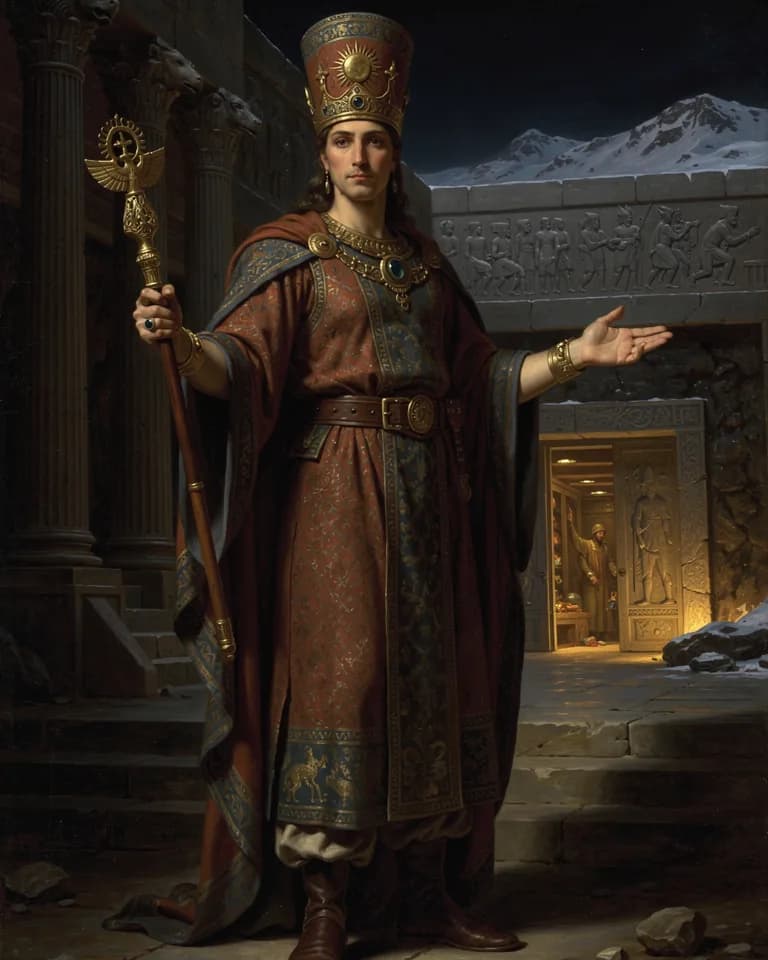
The first king, son of Vivahvant, under whose rule there was neither cold nor heat, age nor death; in the Vendidad he builds an enclosure to preserve life from devastating winters, and in the Shahnameh, as Jamshid, he loses the royal Glory through pride.
About Yima
The good shepherd
In the Vendidad (Fargard 2), Ahura Mazda first asks Yima, son of Vivanghat, to be the bearer of his religion; Yima declines but agrees to rule and protect the world, promising that under him there will be neither cold wind nor hot wind, disease nor death. Given a golden seal and a gold-inlaid dagger, he enlarges the earth three times as it fills with people and animals, calling on Spenta Armaiti to stretch wider. Warned of terrible winters to come, he builds the Var, an enclosure in which the best of every kind of person, animal, plant, and fire is preserved.
The lost Glory
The Zamyad Yasht (Yasht 19) says that when Yima began to delight in words of falsehood, the royal Glory fled from him in the shape of a bird, three times; Mithra, Thraetaona, and Keresaspa seized it in turn. The same hymn names Spityura as the one 'who sawed Yima in twain'.
Jamshid in the Shahnameh
Ferdowsi's Jamshid is a great civilizing king who teaches crafts, divides society into classes, and has the demons raise his jeweled throne into the sky, a day remembered as Nowruz. Growing proud, he claims to be the world's creator; the divine glory (farr) leaves him, and the usurper Zahhak takes his throne and later has him sawn in two. The ruins of Persepolis came to be called Takht-e Jamshid, 'Jamshid's Throne'.
The Indian twin
Yima is the Iranian counterpart of the Vedic Yama: both are sons of the sun-related Vivahvant or Vivasvant, and both names mean 'twin'. In India Yama became king of the dead; in Iran Yima remained the king of a lost golden age.
Origin story
Son of Vivanghat (Vivahvant), the first mortal with whom Ahura Mazda conversed before Zarathushtra (Vendidad 2.2).
Across traditions
Parallel figures
Figures who play a role like Yima's in other traditions.
 HinduYama
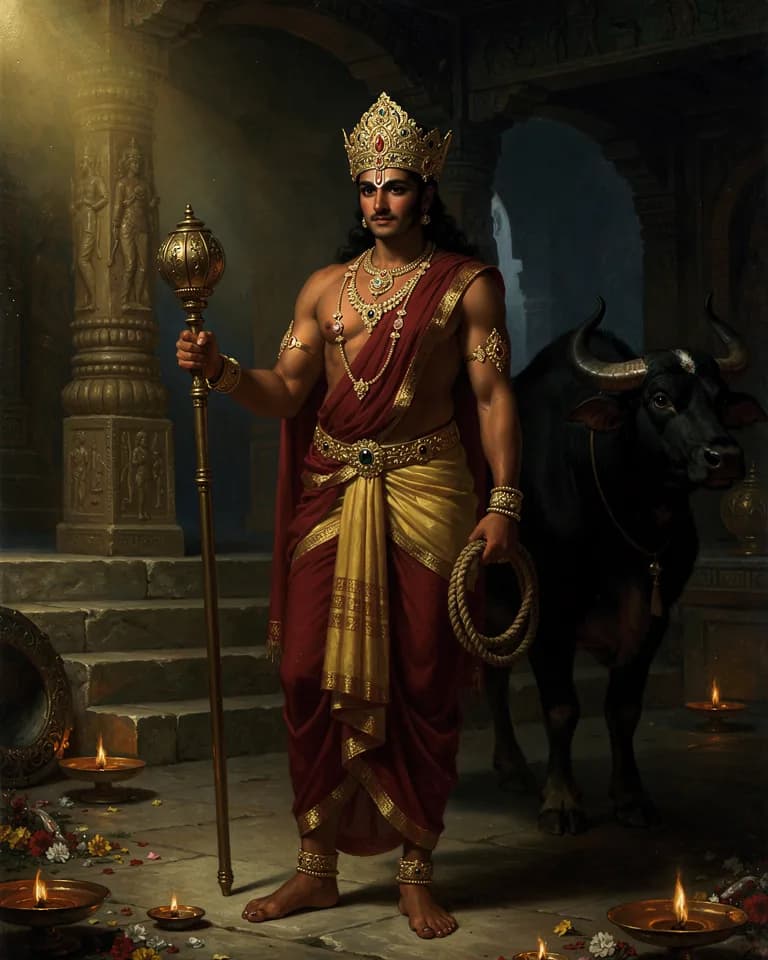
Yima and the Vedic Yama are the same Indo-Iranian figure: both are sons of Vivahvant/Vivasvant and both names mean 'twin'. The traditions diverged, making Yama lord of the dead and Yima the king of a vanished golden age.
Compare Yima and Yama side by side
Worship and cult
Temples, festivals, and practices recorded for Yima
Remembered rather than worshipped: Yima is honored in Zoroastrian tradition as the righteous first king who lost his glory through a lie, and Jamshid is a figure of Nowruz lore.
Festivals
- Nowruz, the Iranian new year, which the Shahnameh traces to the day Jamshid's throne was raised into the sky.
In the atlas
Where Yima appears
Sources and further reading
Source notes
These references are recorded in the catalog. Their passage wording and translation have not been checked, so quotations are not displayed here.
- Avesta, Vendidad 2.5 (trans. Darmesteter)
- Avesta, Yasht 19.34 (trans. Darmesteter)
Appears in
Ancient and classical works featuring this figure.
the first king, who builds the Var against the winters (Vendidad 2; Yasht 19)
retold as King Jamshid, who loses the royal glory through pride (reign of Jamshid)
About this entry
By Elizabeth Stein for Mythos Atlas. About the author. Editorial notes are grounded in the site's cited sources and can be challenged through the contact page.
Parallels are editorial comparisons across traditions: a shared role does not, by itself, establish a shared origin.
Genealogy
Family tree
Yima's parents, consorts, children and rivals, as recorded in the atlas.