Persian (Iranian) Tradition
Zurvan
Zurvān
Also known as Zurvan Akarana (Infinite Time), Zamān
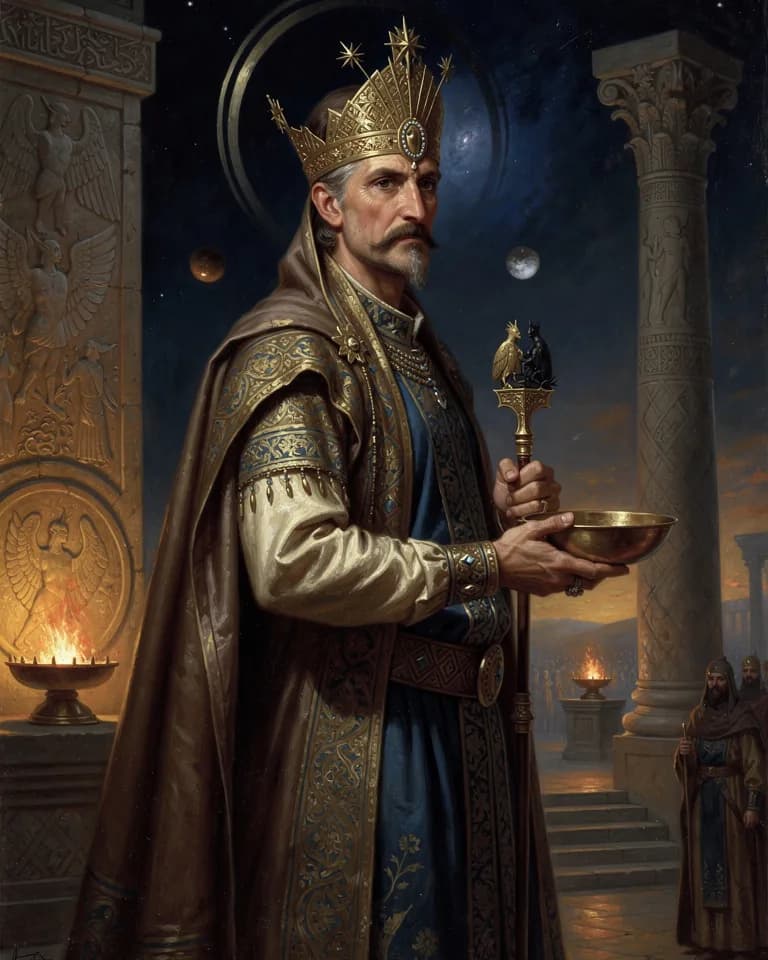
- time
- fate
- the origin of the two spirits
Infinite Time, whom a Sasanian-era current of Zoroastrian thought made the father of both Ohrmazd and Ahriman, born as twins from his sacrifice and his doubt; known mainly from hostile Christian and Armenian writers, and rejected by later orthodoxy.
About Zurvan
The Zurvanite myth
The fullest account comes not from a Zoroastrian text but from the fifth-century Armenian Christian Eznik of Kolb, in his Refutation of the Sects, with parallels in Syriac Christian sources. Before anything existed, Zurvan offered sacrifice for a thousand years in order to have a son who would create heaven and earth. Then he doubted whether his sacrifice would bear fruit, and from his doubt Ahriman was conceived, while from the sacrifice Ohrmazd was conceived. Zurvan vowed that whichever son reached him first would be king. Ohrmazd, knowing this, told his brother; Ahriman tore open the womb and presented himself, and Zurvan, bound by his vow, gave him rule for nine thousand years, after which Ohrmazd would reign.
A heresy or a current?
How widespread Zurvanism was is disputed. Some scholars saw it as the dominant theology of the Sasanian court; others see it as one speculative current among several. The Avesta mentions Zruvan, Time, only as a minor divine being, and the ninth-century Middle Persian books that became the basis of later orthodoxy present Ohrmazd as uncreated and Ahriman as his opposite, not his twin. No cult of Zurvan with temples or festivals is attested.
Why the myth mattered
The Zurvanite story tried to answer a question the Gathas leave open: why there should be two spirits at all. Its answer, that evil arose from a moment of doubt within a single origin, made the twins brothers, which later Zoroastrians found incompatible with Ohrmazd's goodness.
Origin story
Uncreated, the first being in the Zurvanite myth.
Worship and cult
Temples, festivals, and practices recorded for Zurvan
No cult is attested; Zurvanism appears as a theological current within Sasanian Zoroastrianism, known largely through its opponents.
Family
Zurvan's family at a glance
- Who are Zurvan's children?
- Children of Zurvan recorded in the atlas: Ahura Mazda and Angra Mainyu.
In the atlas
Where Zurvan appears
Sources and further reading
Source notes
These references are recorded in the catalog. Their passage wording and translation have not been checked, so quotations are not displayed here.
- Eznik of Kolb, Refutation of the Sects, Book 2 (paraphrase)
About this entry
By Elizabeth Stein for Mythos Atlas. About the author. Editorial notes are grounded in the site's cited sources and can be challenged through the contact page.
Parallels are editorial comparisons across traditions: a shared role does not, by itself, establish a shared origin.
Family relationships come from the atlas's kinship records. Ancient sources often disagree on divine genealogy.
Genealogy
Family tree
Zurvan's parents, consorts, children and rivals, as recorded in the atlas.