Roman Pantheon
Bacchus
Also known as Liber
- wine
- festivity
- theater
- fertility
- madness
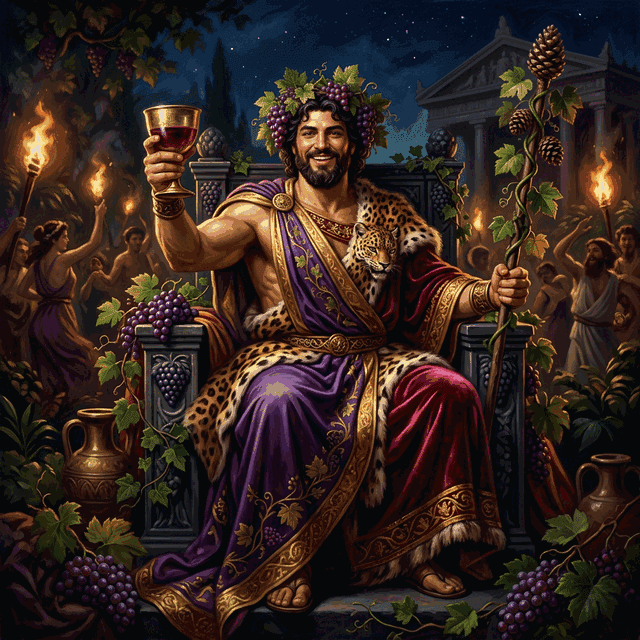
God of wine, festivity, fertility, and ritual madness. His cult included the Bacchanalia festivals. Roman equivalent of Dionysus, also identified with the Italian god Liber.
About Bacchus
Bacchus and Liber
Bacchus is wine, theater, and ritual frenzy, the Latin face of Dionysus and also the partner of the older Italian god Liber. His worship could be civic and licensed, or it could scare the Senate. In 186 BCE the Bacchanalia were restricted after a famous investigation; Livy tells the crackdown as a story about foreign rites and Roman control.
Wine and the city
Festivals of Liber on March 17 (Liberalia) marked young men's coming of age as much as the vine. The god who loosens also initiates. Stage performance, masks, and the vine-staff belong to him because theater, like wine, is a permitted loss of ordinary self.
Twice-born, twice named
The Semele story travels with him: the child sewn in Jupiter's thigh, the wanderer spreading the vine. Italians had already been pouring wine for Liber. Bacchus is the name that lets those two currents occupy one altar, sometimes comfortably, sometimes under police watch.
Across traditions
Parallel figures
Figures who play a role like Bacchus's in other traditions.
 GreekDionysusIllustration
Bacchus is the Roman name for the same wine and ecstatic-cult god
Compare Bacchus and Dionysus side by side
Worship and cult
Temples, festivals, and practices recorded for Bacchus
Boys often took the toga virilis at the Liberalia. The Senate's decree on the Bacchanalia in 186 BCE cut the mystery cells back after a moral panic. What remained in public was Liber's wine and theater, not an unregulated night cult.
Sacred sites
- Temple of Ceres, Liber, and Libera on the Aventine (Liber as the civic face of the wine god)
- No early independent state temple of Bacchus; the name is the imported mystery, Liber the older Italian wine god
Festivals
- Liberalia (17 March)
- Bacchanalia (restricted after 186 BCE)
Family
Sources and further reading
Source notes
These references are recorded in the catalog. Their passage wording and translation have not been checked, so quotations are not displayed here.
- Virgil, Aeneid, Book I (trans. Dryden)
About this entry
By Elizabeth Stein for Mythos Atlas. About the author. Editorial notes are grounded in the site's cited sources and can be challenged through the contact page.
Parallels are editorial comparisons across traditions: a shared role does not, by itself, establish a shared origin.
Family relationships come from the atlas's kinship records. Ancient sources often disagree on divine genealogy.
Keep exploring
One myth a week, with its sources in a short email. The sign-up form is just below.
Genealogy
Family tree
Bacchus's parents, consorts, children and rivals, as recorded in the atlas.