Diné (Navajo) TraditionHoly Person · Hero Twin
Monster Slayer (Naayééʼ Neizghání)
Naayééʼ Neizghání(Naayééʼ Neizghání)
Also known as Nayénĕzgani (Matthews's spelling), Slayer of Alien Gods
- protection of the Diné
- the destruction of the monsters
- war and courage
The elder of the Hero Twins, son of Changing Woman and the Sun, who with his brother journeys to their father's house and returns with lightning weapons to destroy the monsters that preyed on the Earth Surface People.
About Monster Slayer (Naayééʼ Neizghání)
The elder twin
Naayééʼ Neizghání, Monster Slayer, and his brother Tóbájíshchíní, Born for Water, are the Hero Twins of Diné tradition. Monster Slayer is the son of Changing Woman and the Sun, Jóhonaaʼéí. The twins grow up hidden from the naayééʼ, the monsters that are killing the people, and in time set out to find their father.
To the Sun and back
Helped by Spider Woman, who gives them protection and words to pacify the guardians along the way, the twins pass through dangerous places and reach the Sun's house. The Sun tests them severely before he accepts them as his sons, and then gives them armour of flint and weapons, among them arrows of lightning. They return to the earth, and their first victim is Yéʼiitsoh, the Big Monster, killed near Tsoodził (Mount Taylor).
The monsters, and those spared
After Yéʼiitsoh, Monster Slayer goes on to destroy many other monsters, among them the horned Déélgééd and the monster eagles of Tsé Bitʼaʼí (Shiprock). But in Matthews's 1897 version he spares Old Age, Cold, Poverty, and Hunger when each explains why the people need it: without old age there would be no new generations; without cold, no snow and water; without poverty, no new things made; without hunger, no pleasure in food. The story ends not with a world cleansed of every difficulty but with a world in balance.
After the killing
In several tellings the twins must undergo ceremonies to be restored after so much killing, which are the origin of ceremonies still practised; this site does not describe them.
Across traditions
Parallel figures
Figures who play a role like Monster Slayer (Naayééʼ Neizghání)'s in other traditions.
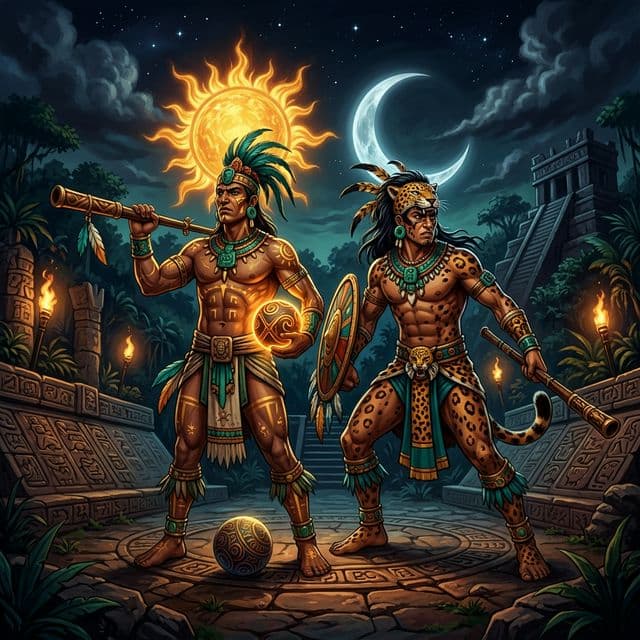 MesoamericanHunahpu and Xbalanque
Both are pairs of twin brothers who confront monstrous beings and must prove themselves to powerful elders; the Diné and K'iche' Maya stories are distinct traditions, not versions of one.
Compare Monster Slayer (Naayééʼ Neizghání) and Hunahpu and Xbalanque side by side
Worship and cult
Temples, festivals, and practices recorded for Monster Slayer (Naayééʼ Neizghání)
The Holy People are part of a living religion. Ceremonies associated with them, including the Blessingway (Hózhǫ́ǫ́jí) and the chantways conducted by hataałii (ceremonial practitioners), are not described on this site, and sandpaintings are not reproduced, because they are sacred and made for healing within ceremony. Many Diné families teach that the origin stories in which the Holy People appear should be told only in winter, after the first frost and before the first thunder of spring.
Family
Monster Slayer (Naayééʼ Neizghání)'s family at a glance
- Who are Monster Slayer (Naayééʼ Neizghání)'s parents?
- The atlas's kinship records name 2 parents of Monster Slayer (Naayééʼ Neizghání): The Sun Bearer (Jóhonaaʼéí) and Changing Woman (Asdzą́ą́ Nádleehé). Ancient accounts do not always agree on divine parentage.
- Who are Monster Slayer (Naayééʼ Neizghání)'s siblings?
- Siblings of Monster Slayer (Naayééʼ Neizghání) recorded in the atlas: Born for Water (Tóbájíshchíní).
In the atlas
Where Monster Slayer (Naayééʼ Neizghání) appears
Sources and further reading
Source notes
These references are recorded in the catalog. Their passage wording and translation have not been checked, so quotations are not displayed here.
- Washington Matthews, Navaho Legends
Appears in
Ancient and classical works featuring this figure.
Nayénĕzgani, slayer of the monsters (origin legend, the war gods)
Diné bahane': The Navajo Creation Story
Naayééʼ Neizghání (Part Four)
Further reading
The war gods' journey and their battles
Diné bahane': The Navajo Creation Story
Part Four of the creation story
About this entry
By Elizabeth Stein for Mythos Atlas. About the author. Editorial notes are grounded in the site's cited sources and can be challenged through the contact page.
Parallels are editorial comparisons across traditions: a shared role does not, by itself, establish a shared origin.
Family relationships come from the atlas's kinship records. Ancient sources often disagree on divine genealogy.
Genealogy
Family tree
Monster Slayer (Naayééʼ Neizghání)'s parents, consorts, children and rivals, as recorded in the atlas.