Mythos Atlas

Side by sideParallel across traditions

Hunahpu and Xbalanque vs Monster Slayer (Naayééʼ Neizghání)

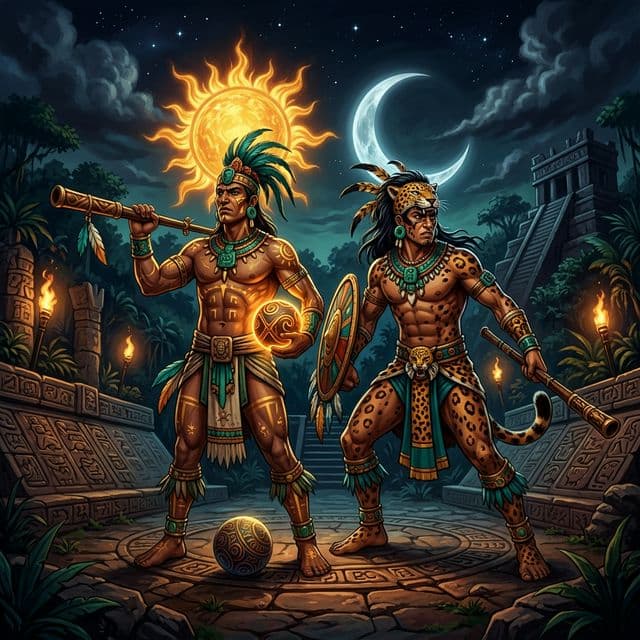
Hunahpu and Xbalanque
Hunahpu and XbalanqueMesoamerican
Monster Slayer (Naayééʼ Neizghání)
Monster Slayer (Naayééʼ Neizghání)Diné (Navajo)

Both are pairs of twin brothers who confront monstrous beings and must prove themselves to powerful elders; the Diné and K'iche' Maya stories are distinct traditions, not versions of one.

At a glance

Hunahpu and Xbalanque and Monster Slayer (Naayééʼ Neizghání) compared
Hunahpu and XbalanqueMonster Slayer (Naayééʼ Neizghání)
TraditionMesoamerican PantheonDiné (Navajo) Tradition
Domainssun, moon, heroism, ballgame, victory over deathprotection of the Diné, the destruction of the monsters, war and courage
Symbolsblowgun, jaguar spots, rubber ball, sun and moonlightning arrows, flint armor
Also calledThe Hero Twins, One Blowgunner and Jaguar DeerNayénĕzgani (Matthews's spelling), Slayer of Alien Gods

Where they meet

The atlas records no domain or symbol that Hunahpu and Xbalanque and Monster Slayer (Naayééʼ Neizghání) share.

They are compared for the part each plays in their own tradition rather than for any attribute in common.

Where they part

Only Hunahpu and Xbalanque

Associated with sun, moon, heroism, ballgame, and victory over death.

Only Monster Slayer (Naayééʼ Neizghání)

Associated with protection of the diné, the destruction of the monsters, and war and courage.

How each was worshipped

Hunahpu and Xbalanque

Cult sites
Ballcourts across the Maya world as ritual stages of their story; No single temple of Hunahpu and Xbalanque as a pair-god
Festivals
Ballgame rites; Popol Vuh recitation in K'iche' tradition

They are heroes of a book and of the court ballgame, not parish saints. Every ballcourt restages the underworld match. Cult is the game, the decapitation imagery, and the telling, not a pair of cult statues with a festival badge.

Monster Slayer (Naayééʼ Neizghání)

The Holy People are part of a living religion. Ceremonies associated with them, including the Blessingway (Hózhǫ́ǫ́jí) and the chantways conducted by hataałii (ceremonial practitioners), are not described on this site, and sandpaintings are not reproduced, because they are sacred and made for healing within ceremony. Many Diné families teach that the origin stories in which the Holy People appear should be told only in winter, after the first frost and before the first thunder of spring.

The two figures

Mesoamerican Pantheon

Hunahpu and Xbalanque

The Hero Twins of Maya mythology, sons of the maize god Hun Hunahpu. Through cleverness and sacrifice, they defeated the lords of death and became the sun and moon.

The Hero Twins were miraculously conceived from their father's skull. Born in the upper world, they became great heroes who defeated false gods, outwitted the lords of death, and became the sun and moon.

Hunahpu and Xbalanque are the central heroes of the **Popol Vuh**. Their adventures feature monster-slaying, underworld journeys, death and resurrection, and the establishment of cosmic order.

Read the full Hunahpu and Xbalanque entry

Diné (Navajo) Tradition

Monster Slayer (Naayééʼ Neizghání)

The elder of the Hero Twins, son of Changing Woman and the Sun, who with his brother journeys to their father's house and returns with lightning weapons to destroy the monsters that preyed on the Earth Surface People.

Naayééʼ Neizghání, Monster Slayer, and his brother Tóbájíshchíní, Born for Water, are the Hero Twins of Diné tradition. Monster Slayer is the son of Changing Woman and the Sun, Jóhonaaʼéí. The twins grow up hidden from the naayééʼ, the monsters that are killing the people, and in time set out to find their father.

Read the full Monster Slayer (Naayééʼ Neizghání) entry
About this comparison

Comparisons pair figures that play a similar role across traditions, or that the myths connect within one. A shared role does not, by itself, establish a shared origin.