Finnish Tradition (Kalevala)
Vellamo
Vellamo
Also known as Veden emäntä (Mistress of the Water)
- the waters
- the sea
- fish
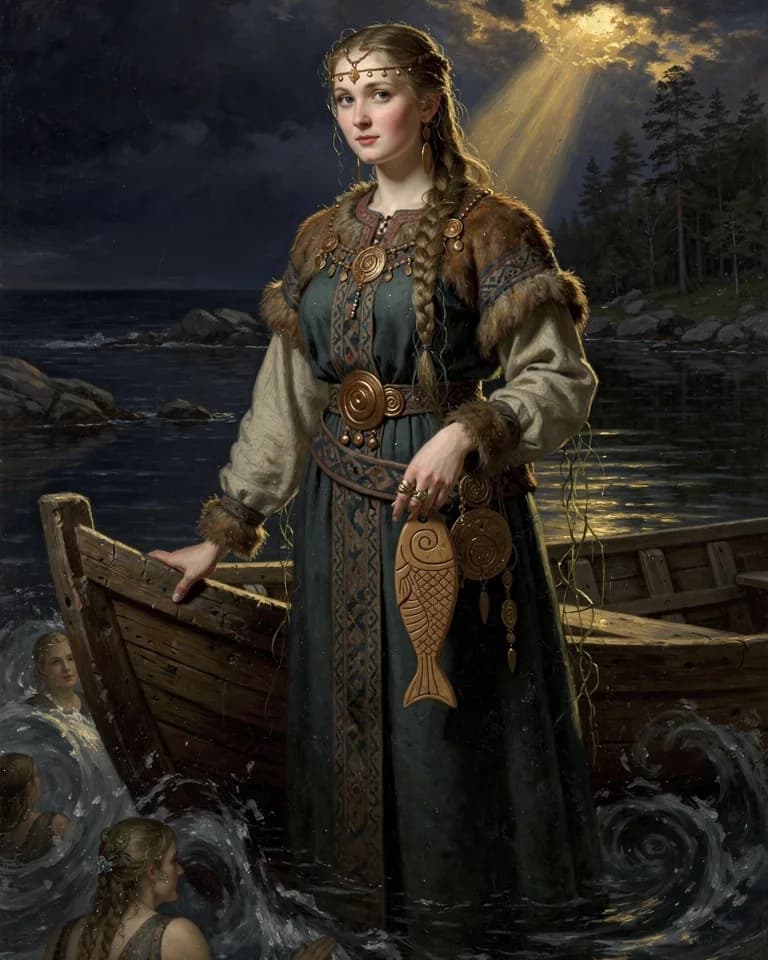
The mistress of the waters and wife of Ahti in Finnish runo-song, whose water-maidens appear in the Kalevala and who was asked for good fishing and calm seas.
About Vellamo
Mistress of the water
In Finnish folk poetry and charms, Vellamo is the mistress of the waters (veden emäntä) and the wife of Ahti. She and her maidens, the water-maidens (Vellamon neidot), live in the depths, and fishermen addressed her for a good catch and for calm weather.
In the Kalevala
Vellamo and her maidens appear among the water beings of the epic. In Rune 5 the drowned Aino has become one of Vellamo's water-maidens, and Vellamo is named again in the runes of the lost kantele (Runes 42 and 44); in Rune 41, the rune of Väinämöinen's music, an unnamed hostess of the waters rises to listen alongside Ahto. Lönnrot's use of her follows the folk poems' pairing of the water's king and queen.
Evidence
Vellamo is not in Agricola's list but is attested in folk poetry and in Ganander's Mythologia Fennica (1789). The maritime museum center Vellamo in Kotka is named after her.
Origin story
No origin is told.
Worship and cult
Temples, festivals, and practices recorded for Vellamo
Fishermen's and seafarers' prayers for a good catch and calm water, paired with prayers to Ahti.
Family
Sources and further reading
Source notes
These references are recorded in the catalog. Their passage wording and translation have not been checked, so quotations are not displayed here.
- Kalevala, Rune 5 (paraphrase)
About this entry
By Elizabeth Stein for Mythos Atlas. About the author. Editorial notes are grounded in the site's cited sources and can be challenged through the contact page.
Parallels are editorial comparisons across traditions: a shared role does not, by itself, establish a shared origin.
Family relationships come from the atlas's kinship records. Ancient sources often disagree on divine genealogy.
Genealogy
Family tree
Vellamo's parents, consorts, children and rivals, as recorded in the atlas.