Chinese Pantheon
Zao Jun
Also known as Kitchen God, Zao Shen, Stove Master
- kitchen
- hearth
- family
- domestic harmony
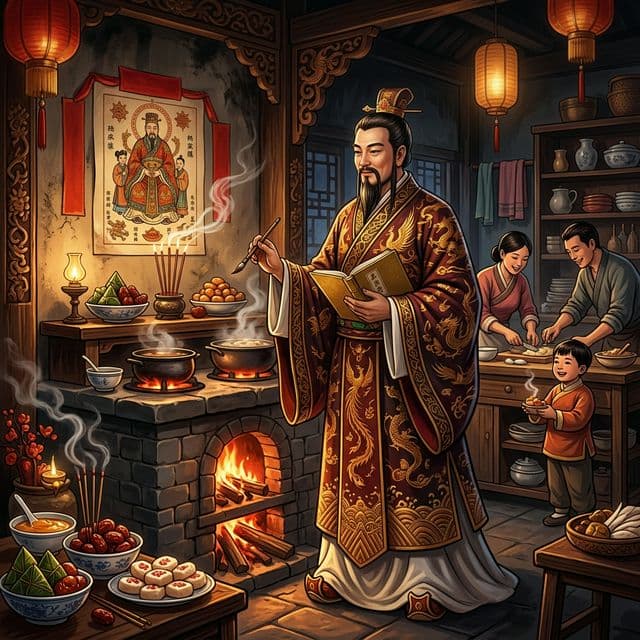
The domestic deity who resides in the kitchen and reports on each household's conduct to the Jade Emperor at the end of each year. Families make sweet offerings to ensure his favorable report.
About Zao Jun
The Watchful Hearth Guardian
Zao Jun, the Kitchen God, is perhaps the most intimate deity in Chinese folk religion. He resides in every kitchen, observing the daily life of the family and keeping record of their deeds. His annual report to the Jade Emperor determines the household's fortune for the coming year.
The Watchman in Every Home
Unlike remote celestial deities, Zao Jun lives among the people. A paper image of him is placed above the stove in traditional Chinese homes, where he witnesses all family activities - arguments, reconciliations, acts of kindness, and moments of cruelty. Nothing escapes his notice.
Origin Stories
Several stories explain Zao Jun's origins. In one popular tale, Zhang Lang abandoned his virtuous wife for another woman. After his second wife abandoned him and he went blind, he became a beggar. Unknowingly, he came to his first wife's door. She recognized him and cooked him a meal. When he realized whose kindness had saved him, he was so ashamed he threw himself into the stove. Taking pity, the Jade Emperor made him the Kitchen God.
The Annual Report
On the 23rd day of the twelfth lunar month, Zao Jun ascends to Heaven to report to the Jade Emperor. To ensure a favorable report, families smear honey or sweet sticky rice on the paper god's lips - either to sweeten his words or to seal them shut. They then burn the paper image, sending him heavenward. On New Year's Eve, a new image is pasted up to welcome him back.
Cultural Significance
Zao Jun represents the integration of religion with daily life in traditional Chinese culture. He embodies the belief that divine observation extends into the most private domestic spaces, encouraging moral behavior through constant awareness of spiritual scrutiny.
Origin story
Zhang Lang, having abandoned his virtuous wife, fell into ruin and became a blind beggar. When his first wife showed him kindness, he was so ashamed he threw himself into the cooking fire. The Jade Emperor, moved by the story, appointed him guardian of all kitchens.
Across traditions
Parallel figures
Figures who play a role like Zao Jun's in other traditions.
 GreekHestiaIllustration
Both are hearth deities associated with domestic life and the sacred fire of the home
Compare Zao Jun and Hestia side by side RomanVestaIllustration
Both protect the household and are associated with the hearth fire
Compare Zao Jun and Vesta side by side
Worship and cult
Temples, festivals, and practices recorded for Zao Jun
Paper horse, sweet glue on the lips, and a report to heaven. The cult is domestic surveillance with candy. No cathedral required.
Sacred sites
- The kitchen stove in every house
Festivals
- Little New Year, when the Kitchen God is sent up
Sources and further reading
Source notes
These references are recorded in the catalog. Their passage wording and translation have not been checked, so quotations are not displayed here.
- Chinese domestic almanac and stove-god folk texts (composite)
About this entry
By Elizabeth Stein for Mythos Atlas. About the author. Editorial notes are grounded in the site's cited sources and can be challenged through the contact page.
Parallels are editorial comparisons across traditions: a shared role does not, by itself, establish a shared origin.
Keep exploring
One myth a week, with its sources in a short email. The sign-up form is just below.
Genealogy
Family tree
Zao Jun's parents, consorts, children and rivals, as recorded in the atlas.