Celtic PantheonBattlefield
Mag Tuired (Moytirra)
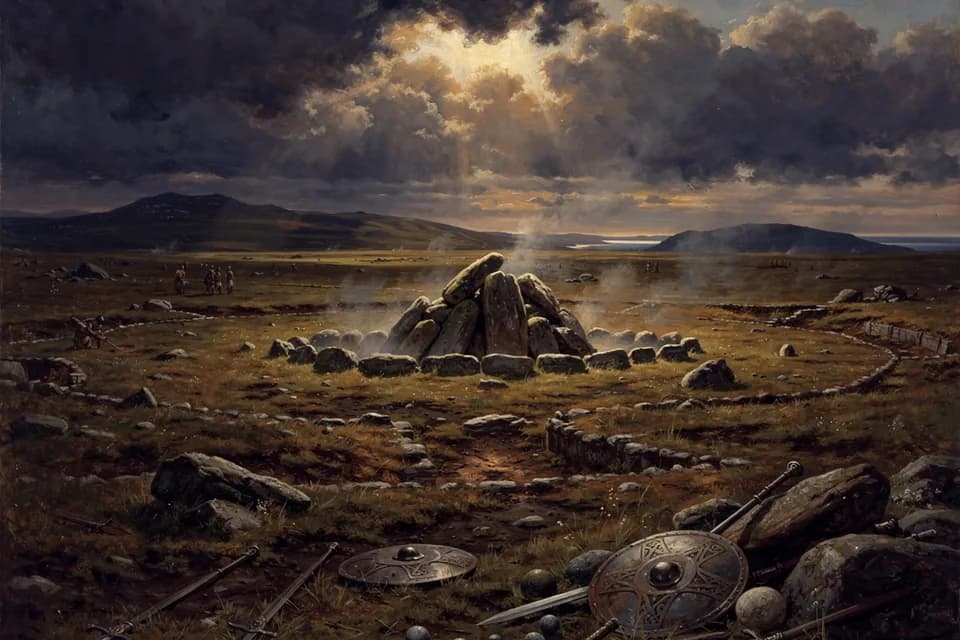
The plain in County Sligo identified with the second Battle of Mag Tuired, where, in Irish mythic history, the Túatha Dé Danann defeated the Fomorians and Lug killed Balor with a sling-stone.
About Mag Tuired (Moytirra)
Two battles
Irish mythic history, as told in the Lebor Gabála Érenn and in the tale Cath Maige Tuired, describes two battles on plains called Mag Tuired, 'the plain of towers' or 'of pillars'. In the first, the Túatha Dé Danann defeat the Fir Bolg, and their king Núadu loses his arm. In the second, they fight the Fomorians under the tyranny of Bres.
The second battle
Cath Maige Tuired, preserved in a 16th-century manuscript of an older text, tells how Lug, master of every art, organises the Túatha Dé for war; Dian Cécht's healing well restores the wounded each night and Goibniu's forge replaces broken weapons. In the battle Balor of the baleful eye, whose gaze destroys armies, is killed by Lug's sling-stone, which drives the eye through the back of his head against his own host. The Morrígan's prophecy closes the tale.
On the map
The second battle was placed near Lough Arrow in County Sligo, where the townland of Moytirra and a landscape of cairns and megalithic tombs keep the name. The identification is medieval learned tradition attached to an ancient ritual landscape, not a record of a real battle.
On the map
Mag Tuired (Moytirra) among other places of the Celtic Pantheon.
Sources and further reading
Source notes
These references are recorded in the catalog. Their passage wording and translation have not been checked, so quotations are not displayed here.
- Cath Maige Tuired (The Second Battle of Mag Tuired)
About this entry
By Elizabeth Stein for Mythos Atlas. About the author. Editorial notes are grounded in the site's cited sources and can be challenged through the contact page.
Coordinates mark where the myths place a site, or where the tradition locates it today. Mythic realms are left off the map or marked as symbolic placements.