Aztec PantheonTemple
Templo Mayor
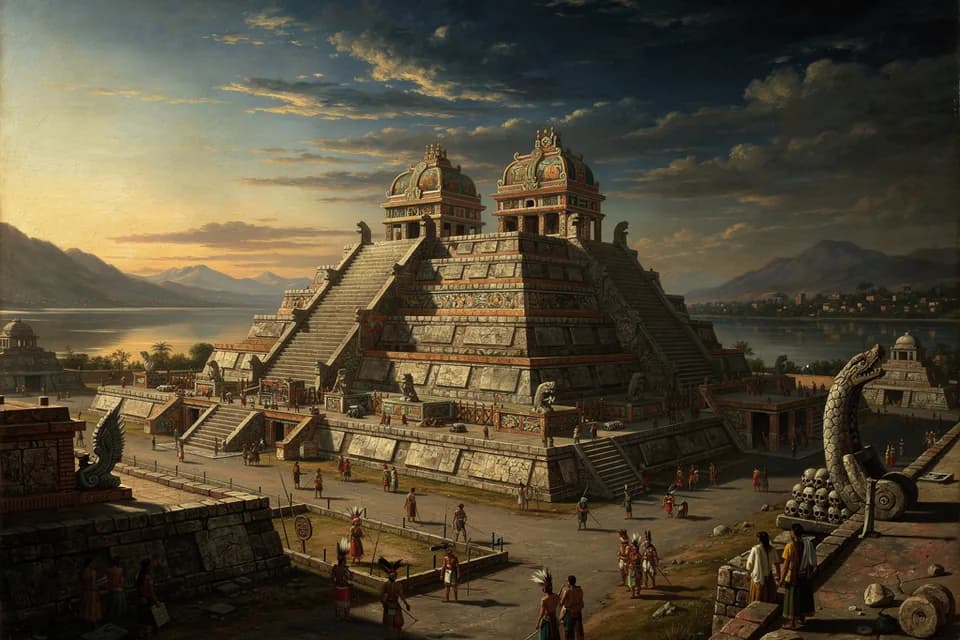
The great twin temple at the heart of Tenochtitlan, dedicated to Huitzilopochtli and Tlaloc, built as an image of the mountain Coatepec where Huitzilopochtli was born; excavated since 1978 in the centre of Mexico City.
About Templo Mayor
Two shrines on one pyramid
The Huey Teocalli, the Templo Mayor, stood at the centre of the Mexica capital. Its double stairway led to two shrines: on the south side Huitzilopochtli, god of war and the sun, and on the north Tlaloc, god of rain, the two powers on which the city depended. The temple was enlarged at least seven times between the 14th century and its destruction by the Spanish in 1521.
Coatepec made visible
The Huitzilopochtli side re-created the myth of his birth on Coatepec, Serpent Mountain, told in Book 3 of the Florentine Codex: born fully armed, he killed his sister Coyolxauhqui and threw her body down the mountain, where it broke apart. In 1978 electrical workers uncovered the great stone disc showing Coyolxauhqui dismembered at the foot of the stairs, exactly where the myth places her, and the discovery began the modern excavation.
Today
The Museo del Templo Mayor beside the ruins holds the finds, including the Tlaltecuhtli monolith discovered in 2006.
On the map
Templo Mayor among other places of the Aztec Pantheon.
Sources and further reading
Source notes
These references are recorded in the catalog. Their passage wording and translation have not been checked, so quotations are not displayed here.
- Bernardino de Sahagún, Florentine Codex, Book 3
- Eduardo Matos Moctezuma, The Great Temple of the Aztecs
About this entry
By Elizabeth Stein for Mythos Atlas. About the author. Editorial notes are grounded in the site's cited sources and can be challenged through the contact page.
Coordinates mark where the myths place a site, or where the tradition locates it today. Mythic realms are left off the map or marked as symbolic placements.