Canaanite Pantheon (Ugarit)City
Ugarit (Ras Shamra)
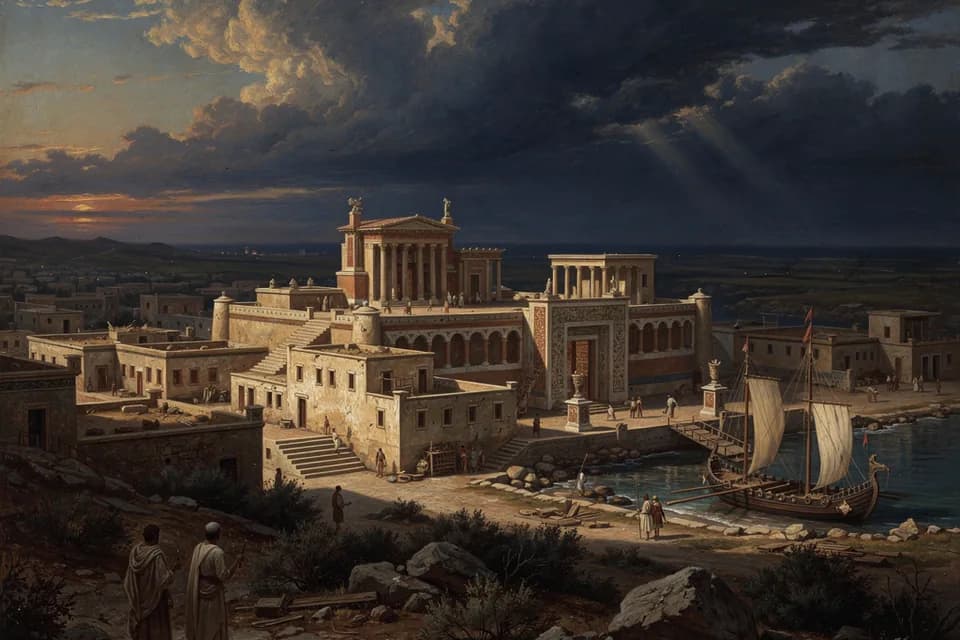
The Late Bronze Age port city on the Syrian coast whose archives of alphabetic cuneiform tablets preserve the Baal Cycle and the epics of Aqhat and Kirta; destroyed around 1185 BCE.
About Ugarit (Ras Shamra)
Discovery
In 1928 a farmer ploughing near the bay of Minet el-Beida, north of Latakia, broke into an ancient tomb. The following year French excavators under Claude Schaeffer began digging at the nearby mound of Ras Shamra and found the city of Ugarit, known from Egyptian and Hittite records but until then unlocated. Excavation has continued, with interruptions, ever since.
A cosmopolitan port
Ugarit was a wealthy kingdom trading with Egypt, Cyprus, the Aegean, the Hittite empire (to which it was a vassal), and Mesopotamia. Its scribes wrote in Akkadian, Sumerian, Hurrian, Hittite, Egyptian, Cypro-Minoan, and in their own Ugaritic language, for which they used an alphabet of thirty cuneiform signs. Multilingual god-lists from the site equate the Ugaritic gods with Hurrian and Mesopotamian ones.
Temples and archives
Two temples on the acropolis are generally identified as those of Baal and of Dagan. The mythological tablets were found mostly in the house of the high priest nearby, and several carry the colophon of the scribe Ilimilku. The city was destroyed around 1185 BCE during the upheavals that ended the Late Bronze Age, and never reoccupied as a city.
On the map
Ugarit (Ras Shamra) among other places of the Canaanite Pantheon (Ugarit).
Sources and further reading
Source notes
These references are recorded in the catalog. Their passage wording and translation have not been checked, so quotations are not displayed here.
- Baal Cycle, KTU 1.6 VI (colophon)
About this entry
By Elizabeth Stein for Mythos Atlas. About the author. Editorial notes are grounded in the site's cited sources and can be challenged through the contact page.
Coordinates mark where the myths place a site, or where the tradition locates it today. Mythic realms are left off the map or marked as symbolic placements.