Canaanite Pantheon (Ugarit)Hero
Kirta
Also known as Keret, Kirta the Noble (krt tʿ)
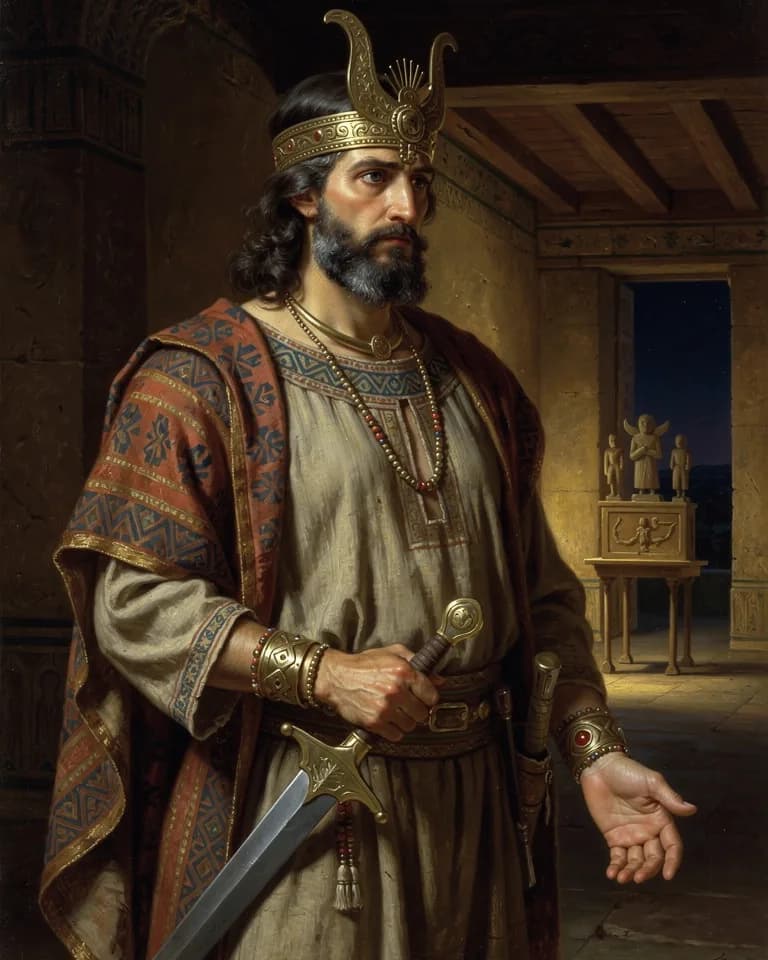
A legendary king, called a son of El, who loses his whole family, wins a new bride on El's instructions, forgets his vow to the goddess Athirat, falls mortally ill, and is healed, only to face a challenge from his own son.
About Kirta
A king without heirs
The Epic of Kirta (KTU 1.14-1.16) begins with catastrophe. Kirta's house is destroyed: his wives and children die one after another, by disease, flood, and the sword. The king weeps himself to sleep, and El comes to him in a dream.
El's instructions
El tells Kirta to wash, make offerings, gather an army, and march for seven days to Udm, the city of King Pabil, and to refuse Pabil's offers of silver, gold, and horses and demand only his daughter Hurriya. On the way Kirta stops at the shrine of "Athirat of Tyre, goddess of Sidon" and vows to give her double Hurriya's weight in silver and triple in gold if he succeeds. Everything happens as El said, and Kirta brings Hurriya home. El blesses the marriage, promising sons and daughters, among them a son who will be nursed by goddesses.
The forgotten vow
But Kirta does not pay his vow, and Athirat remembers (KTU 1.15 III). Kirta falls ill; his son Ilhu mourns that a son of El should die; and drought falls on the land. When none of the gods will act, El himself shapes a healing being, Shaʿtaqat, who flies to Kirta and drives out the illness.
The challenge
Restored, Kirta returns to his throne, but his eldest son Yassib, believing him still weak, tells him he has failed to judge the widow and the orphan and should step down. Kirta curses him. The tablet ends there, and whether a missing fourth tablet continued the story is unknown.
Why it matters
The poem is a meditation on kingship and mortality: a king who is called a son of El, who can fall ill and nearly die, and whose legitimacy rests on protecting the weak.
On parentage: Kirta is repeatedly called a 'son of El', a royal title; his children ask in dismay whether a son of El can die. The text does not name human parents.
Key deeds
- Followed El's dream-instructions to march on Udm and win Hurriya as his bride
- Vowed silver and gold to Athirat at her shrine, and failed to pay
- Recovered from mortal illness through Shaʿtaqat, the healer El created
Fate
Healed and restored to his throne, Kirta curses his son Yassib for trying to depose him; the surviving text ends with the curse.
Sources and further reading
Source notes
These references are recorded in the catalog. Their passage wording and translation have not been checked, so quotations are not displayed here.
- Epic of Kirta, KTU 1.14 I-III
Appears in
Ancient and classical works featuring this figure.
The Epic of Kirta (KTU 1.14-1.16)
the king whose house is restored and then endangered (KTU 1.14-1.16)
About this entry
By Elizabeth Stein for Mythos Atlas. About the author. Editorial notes are grounded in the site's cited sources and can be challenged through the contact page.
Hero legends were retold for centuries, and the sources often disagree on parentage, deeds and death. This entry follows the best-known versions and notes the main alternatives.