Ghana and eastern Côte d’Ivoire
Akan Tradition
The sky god Nyame and the earth Asase Yaa, the river abosom such as Tano, and Kwaku Ananse the spider, who bought the world's stories from Nyame: the religious and storytelling tradition of the Akan peoples of Ghana and Côte d'Ivoire.
History and context
Sky, earth, and the abosom
Akan religion recognises a supreme sky god, Nyame (also Onyame or Onyankopon), and the earth, Asase Yaa, who is honoured rather than served through shrines and priests. Between people and the sky god stand the abosom, powers associated with rivers, lakes, and other features of the land, such as Tano of the Tano River, and the ancestors (nsamanfo), whose presence is central to Akan religious and political life. Akan religion is a living tradition in Ghana today, alongside Christianity and Islam.
Rattray and the record
Much of the written record comes from R. S. Rattray, a British colonial anthropologist in the Gold Coast, whose Ashanti (1923), Religion and Art in Ashanti (1927), and Akan-Ashanti Folk-Tales (1930) recorded Asante belief and storytelling, the last with the Twi text beside the English. Rattray worked through colonial structures and his interpretations should be read critically, but the tales he printed were told to him by named and unnamed Akan speakers. Akan scholars such as J. B. Danquah, in The Akan Doctrine of God (1944), wrote about the same tradition from within it.
Anansesem
Akan folktales are called anansesem, 'spider stories', whether or not Kwaku Ananse appears in them, because of the tale Rattray printed as the account of how all stories came to belong to the spider: Ananse buys them from Nyame by capturing the python, the leopard, the hornets, and the forest fairy. Tellings traditionally open and close with set formulas disclaiming literal truth. Ananse stories travelled with enslaved Akan people to the Caribbean and the Americas, where he survives as Anansi, Anancy, and Aunt Nancy.
Dates
The tradition has no recorded founding date; Akan states such as Bono and later Asante emerged between roughly the 13th and 18th centuries, but the religion is older than any one state and this site does not assign it a start year.
Cosmology
Nyame Above, Asase Yaa Below
In Akan thought the sky god Nyame is above and remote, the earth Asase Yaa is below and honoured on her day, and the abosom of rivers and the ancestors stand between. The dead go on to Asamando, the land of the ancestors.
The sky
AboveThe earth and its waters
MiddleAsamando
BelowAsamando
The land of the ancestors (nsamanfo), where the dead continue and from which they remain concerned with the living lineage.
 Nyame
Nyame Anansi
 Asase Yaa
 Tano
Tano Bia
Bia Asanbosam
 Mmoatia
Sources
Works cited
Akan-Ashanti Folk-Tales
R. S. Rattray, collector and translator
Ashanti
R. S. Rattray
Religion and Art in Ashanti
R. S. Rattray
The Akan Doctrine of God
J. B. Danquah
About this guide
By Elizabeth Stein for Mythos Atlas. About the author. Editorial notes are grounded in the site's cited sources and can be challenged through the contact page.
The catalog period is the span of the sources this atlas draws on, not the age of the tradition itself. Many traditions are older than their first written record, and many are still practised.
5 in the atlas
Nyame, the Abosom & Ananse



2 retold
Stories and myths
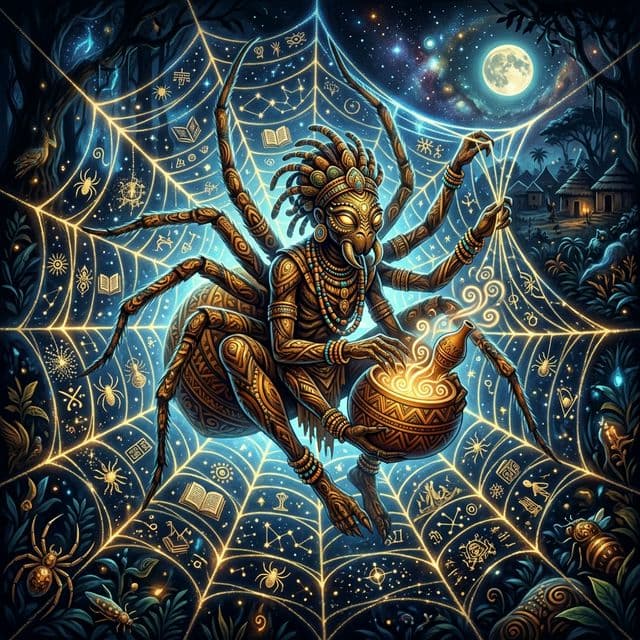
 How Anansi Bought the World's StoriestricksterThe clever spider Anansi bargains with the sky god Nyame to purchase all the world's stories by completing four impossible tasks.
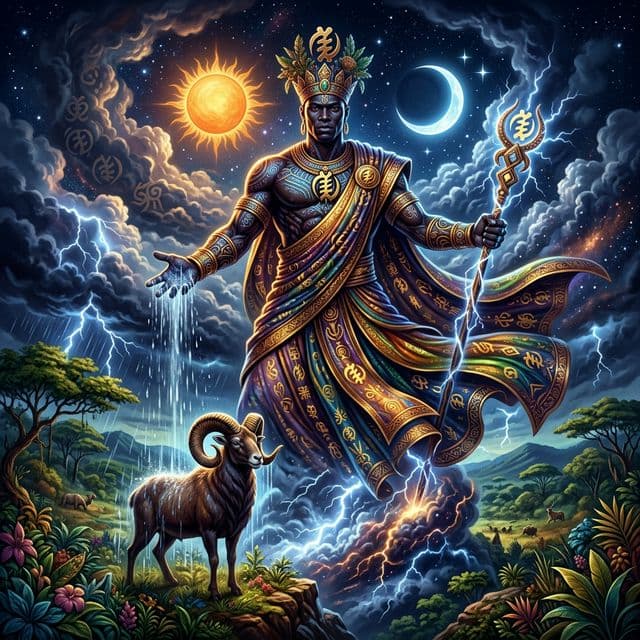
 Tano and Bia Divide the LandrivalryThe sky god Nyame means to divide his lands between his sons Tano and Bia, but a goat's advice sends the wrong son to receive the fertile country, and the rivalry of two rivers begins.