Korean Traditioncreation
Mireuk and Seokga: The Song of Creation
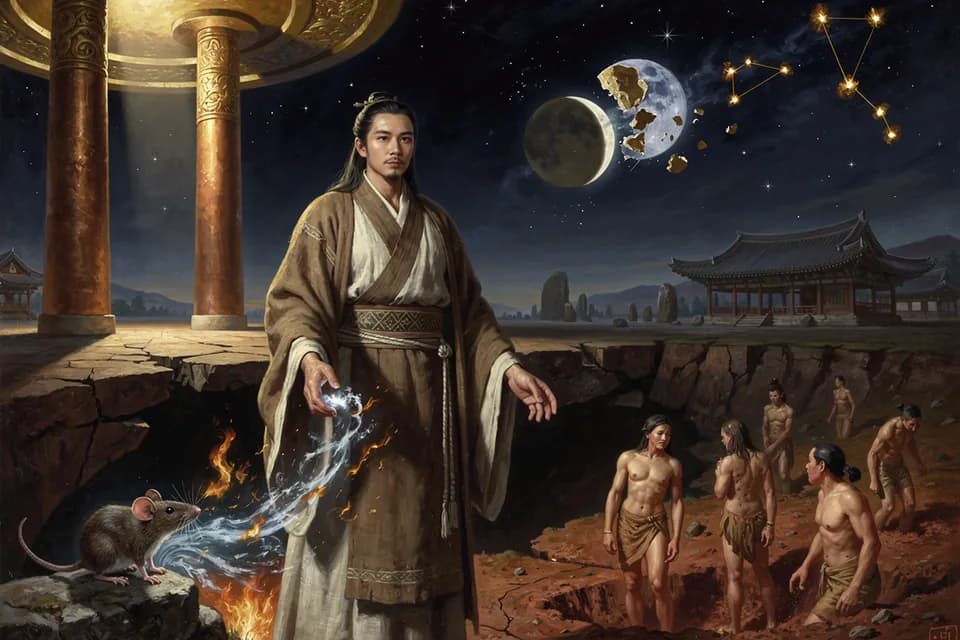
Mireuk separates heaven and earth, props the sky with copper pillars, makes stars from an extra sun and moon, learns the secrets of fire and water from a mouse, and creates people; but the rival Seokga wins the world by stealing the flower that bloomed on Mireuk's knee, and so the present age is full of wrongs.
An editorial retelling
The story
Heaven and earth apart
The Changse-ga, 'Song of the Creation of the World', was sung in 1923 by the shaman Kim Ssang-dori of Hamheung and recorded by the folklorist Son Jin-tae. When heaven and earth came into being, it begins, Mireuk was born. Heaven and earth clung together and would not separate, so Mireuk pushed the sky up until it bulged like the lid of a pot, and at the four corners of the earth he set up copper pillars to hold it.
Stars and clothing
In those days there were two suns and two moons. Mireuk took down one of the moons and made from it the Big Dipper and the Southern Dipper, and took down one of the suns and made the great stars and the small stars. He had no clothes, so he gathered arrowroot vines from the mountains, spun them, and wove himself a robe.
Fire and water
Mireuk wanted to know where fire and water come from. He caught a grasshopper and asked it, but it said to ask the frog, who knew more; the frog said to ask the mouse. The mouse asked what it would be given for the answer, and Mireuk promised it all the rice chests in the world. The mouse told him to go to one mountain and strike stone against steel for fire, and to another to find a spring of water. So people learned fire and water, and the mouse has eaten from the rice chests ever since.
The first people
Then Mireuk held a golden tray in one hand and a silver tray in the other and prayed to heaven. Insects fell from the sky, five on each tray. The insects on the golden tray became men, and those on the silver tray became women, and they grew up and married, and the world was filled with people living in peace.
Seokga
Then Seokga appeared and said that he would rule the world. Mireuk said his age had not yet ended. They agreed to contests. First each lowered a bottle into the East Sea on a cord, Mireuk's golden and Seokga's silver; Seokga's cord broke. Next each tried to freeze a river in the middle of summer; Mireuk's river froze. Then they agreed to lie down together and sleep, and whoever grew a flower on his knee would have the world. As they slept, a flower bloomed on Mireuk's knee. Seokga, who was only pretending to sleep, snapped it off and set it on his own knee.
The curse
When Mireuk woke, he knew. Because you have stolen my flower, he said, in your age the flowers will wither in ten days; and your age will be full of thieves and cheats, of misery and wrongdoing. Then he went away, and Seokga began to rule the world. That, the song says, is why the world is as it is.
One motif, many songs
The flower contest reappears in the Jeju creation myth Cheonjiwang bonpuri, where twin brothers, Daebyeol-wang and Sobyeol-wang, compete by growing flowers, and the younger cheats to win this world, leaving the elder to rule the world of the dead. Across Korea the story explains the imperfection of the present world as the result of a stolen victory.
Listen or change reading mode
Highlights
Mireuk raises the sky and sets copper pillars at the earth's corners, makes stars from an extra sun and moon, learns fire and water from a mouse rewarded with the rice chests, and creates people from insects on golden and silver trays; Seokga wins the world by stealing the flower from Mireuk's knee.
Why it matters
The fullest Korean shamanic creation narrative from the mainland, preserved in a single 1923 recording, and a key example of how Korean shamanism reused Buddhist names for its own gods.
Other versions
1 alternate account in the catalog.
Cheonjiwang bonpuri (Jeju shamanic myth)
Twin sons of the Heavenly King, Daebyeol-wang and Sobyeol-wang, shoot down the extra sun and moon with arrows and hold the flower-growing contest; the cheating younger brother gets this world and the elder the world of the dead.
Note: A separate Jeju tradition sharing the stolen-flower motif.
Sources and further reading
By Elizabeth Stein for Mythos Atlas. About the author. Editorial notes are grounded in the site's cited sources and can be challenged through the contact page.
Works cited
Changse-ga, in Joseon Singa Yupyeon
sung by Kim Ssang-dori; recorded by Son Jin-tae