Korean TraditionUsurper of the World
Seokga
석가(Seokga)
Also known as Seokga-nim
- the present age of the world
- trickery
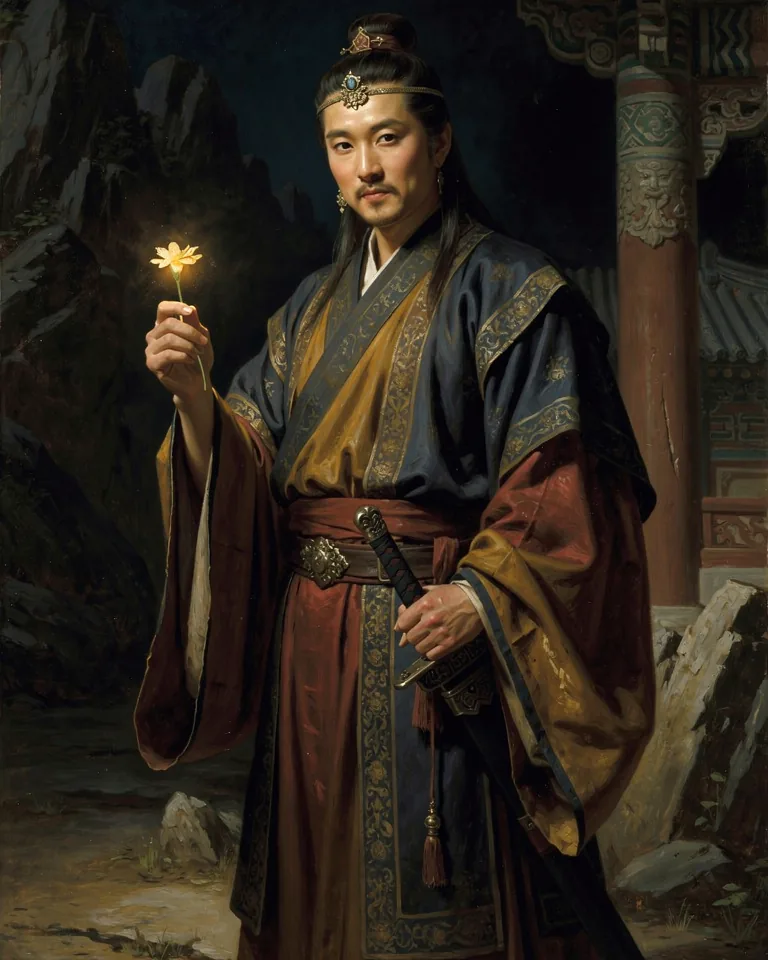
The rival of Mireuk in the Korean shamanic Song of Creation, who wins rule of the world by stealing the flower that blossomed on Mireuk's knee while they slept, bringing about the imperfect present age.
About Seokga
The contest
In the Changse-ga recorded in 1923 from the shaman Kim Ssang-dori, Seokga appears after Mireuk has ordered the world and demands to rule it. Mireuk proposes contests. In the first, each lowers a bottle into the East Sea, Mireuk on a golden cord and Seokga on a silver one; Seokga's cord breaks. In the second, each tries to freeze a river in summer; again Mireuk succeeds. In the last, they agree to lie down and sleep, and the one on whose knee a flower blooms will rule. A flower blooms on Mireuk's knee; Seokga, only pretending to sleep, breaks it off and puts it on his own.
The curse
Waking, Mireuk knows what has happened and yields the world, but curses Seokga's age: because it was won by theft, the world will be full of cheats, thieves, and misery, and its flowers will quickly wither. Seokga then begins his rule; in the song he goes hunting with his followers, some of whom refuse to eat the meat and turn into rocks and pine trees.
A shamanic, not Buddhist, story
Although Seokga bears the Buddha's name, the song is not Buddhist doctrine; it uses the names of the present Buddha and the future Buddha for the rulers of the present, flawed age and the lost first age. A similar flower-growing contest between twin brothers, Daebyeol-wang and Sobyeol-wang, appears in the Jeju creation myth Cheonjiwang bonpuri, suggesting a shared Korean shamanic motif.
Origin story
No origin is told; he arrives after Mireuk has made the world (Changse-ga).
Worship and cult
Temples, festivals, and practices recorded for Seokga
A figure of the shamanic creation song rather than of worship; the song explains why the present world is flawed.
In the atlas
Where Seokga appears
Sources and further reading
Source notes
These references are recorded in the catalog. Their passage wording and translation have not been checked, so quotations are not displayed here.
- Changse-ga (Song of Creation), sung by Kim Ssang-dori, in Son Jin-tae, Joseon Singa Yupyeon (paraphrase)
About this entry
By Elizabeth Stein for Mythos Atlas. About the author. Editorial notes are grounded in the site's cited sources and can be challenged through the contact page.
Parallels are editorial comparisons across traditions: a shared role does not, by itself, establish a shared origin.
Genealogy
Family tree
Seokga's parents, consorts, children and rivals, as recorded in the atlas.