Korean TraditionCreator
Mireuk
미륵(Mireuk)
Also known as Mireuk-nim
- creation
- the separation of heaven and earth
- the first age of the world
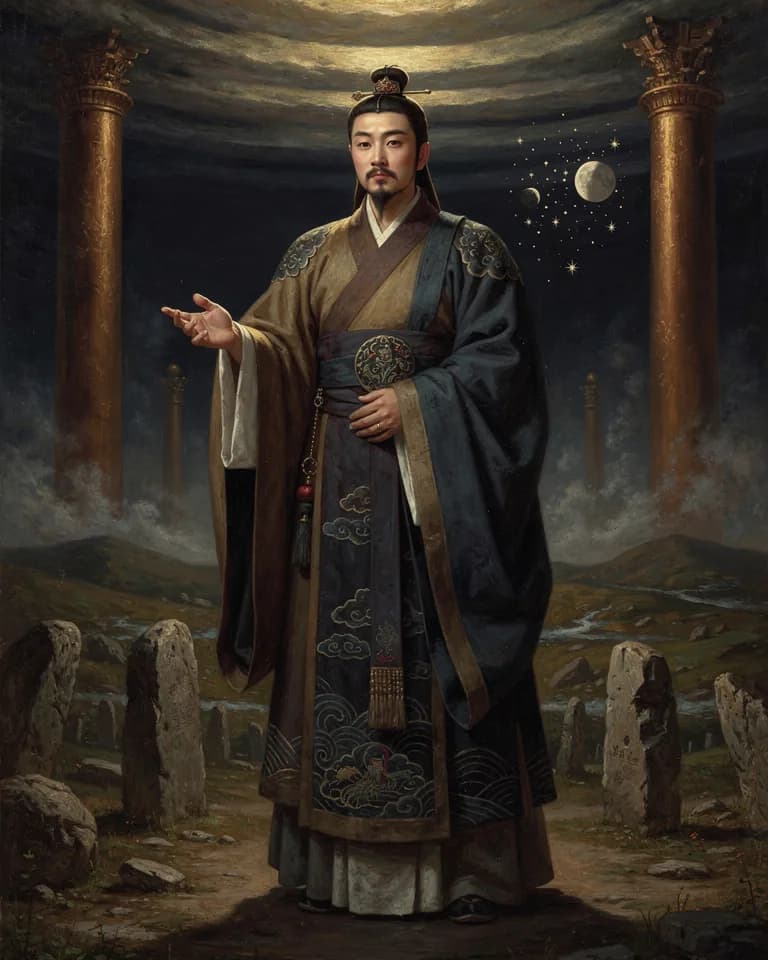
The creator of the world in the Korean shamanic Song of Creation, who separates heaven and earth, props up the sky with copper pillars, makes stars from an extra sun and moon, and creates the first humans, before losing the world to the cheating Seokga.
About Mireuk
The Song of Creation
In 1923 the folklorist Son Jin-tae recorded the Changse-ga ('Song of the Creation of the World') from the shaman Kim Ssang-dori of Hamheung in northern Korea, publishing it in 1930. It begins when heaven and earth came into being and Mireuk was born. Heaven and earth were stuck together, and Mireuk pushed the sky up like the lid of a pot and set copper pillars at the four corners of the earth to hold it. There were two suns and two moons; Mireuk took one moon to make the stars of the Big Dipper and the Southern Dipper, and one sun to make the great and small stars.
Fire, water, and people
Mireuk wove clothes from arrowroot vines. To learn where fire and water come from, he questioned a grasshopper and a frog, who did not know, and then a mouse, who told him to strike stone and steel on one mountain and find spring water on another, and was rewarded with the right to all the rice chests in the world. Then Mireuk held a golden tray in one hand and a silver tray in the other and prayed to heaven; five insects fell on each, and they grew into the first men and women.
The lost world
When Seokga came to claim the world, Mireuk won their first contests, but in the last, a contest of growing a flower while asleep, Seokga cheated and stole the flower from Mireuk's lap. Mireuk surrendered the world with a curse on Seokga's age: it would be full of wickedness and misery. The name Mireuk, the future Buddha Maitreya, gives this lost golden age a hope of return, a theme found in Korean messianic movements.
A note on gender
The Korean song does not mark Mireuk's gender: it describes a giant creator and uses no gendered pronouns. English retellings, including this one, conventionally say 'he', and this entry is filed as male on that convention rather than on anything the song states.
Origin story
Born when heaven and earth came into being (Changse-ga, recorded 1923).
Across traditions
Parallel figures
Figures who play a role like Mireuk's in other traditions.
 ChinesePangu
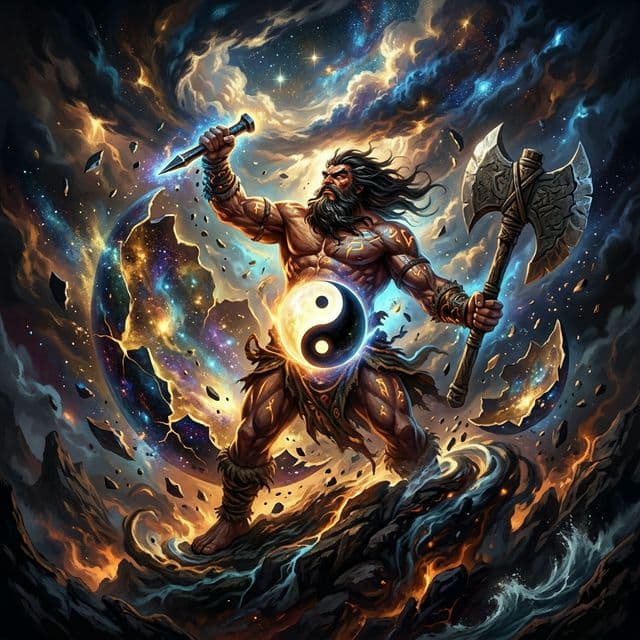
Both are primordial beings who separate a joined heaven and earth at the beginning of the world; the Korean song adds pillars at the earth's corners, recalling Nüwa's repair of the sky.
Compare Mireuk and Pangu side by side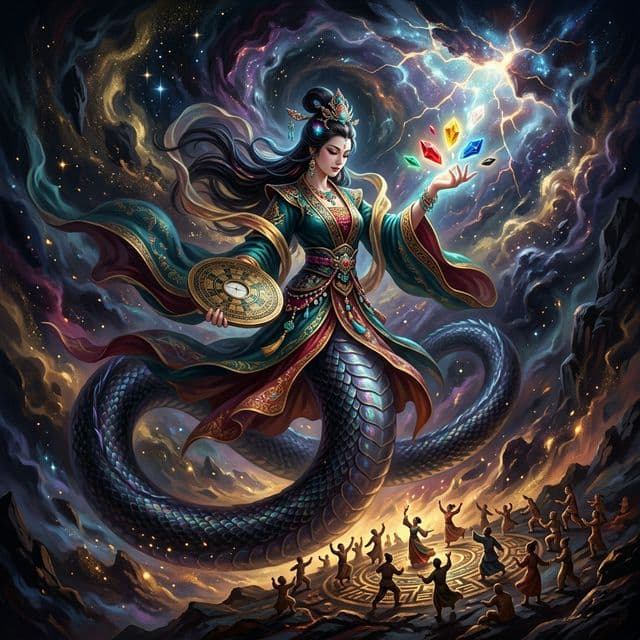 ChineseNuwa
Nüwa props up the sky with four pillars (the legs of a great turtle) after it collapses, as Mireuk sets copper pillars at the earth's four corners; Nüwa also creates humans, as Mireuk does from insects on golden and silver trays.
Compare Mireuk and Nuwa side by side
Worship and cult
Temples, festivals, and practices recorded for Mireuk
Invoked as creator in the shamanic creation songs of the Hamgyeong region; folk veneration of stone Mireuk statues in Korean villages, often for children and protection, draws on the same name.
In the atlas
Where Mireuk appears
Sources and further reading
Source notes
These references are recorded in the catalog. Their passage wording and translation have not been checked, so quotations are not displayed here.
- Changse-ga (Song of Creation), sung by Kim Ssang-dori, in Son Jin-tae, Joseon Singa Yupyeon (paraphrase)
About this entry
By Elizabeth Stein for Mythos Atlas. About the author. Editorial notes are grounded in the site's cited sources and can be challenged through the contact page.
Parallels are editorial comparisons across traditions: a shared role does not, by itself, establish a shared origin.
Genealogy
Family tree
Mireuk's parents, consorts, children and rivals, as recorded in the atlas.