Mythos Atlas

Side by sideParallel across traditions

Ares vs Verethragna

Ares
AresGreek
Verethragna
VerethragnaPersian (Iranian)

At Nemrut Dağ in Commagene (1st century BCE) Antiochus I honored a combined Artagnes-Heracles-Ares, a Hellenistic equation of Verethragna with Greek gods of strength and war.

At a glance

Ares and Verethragna compared
AresVerethragna
TraditionGreek PantheonPersian (Iranian) Tradition
Domainswar, violence, bloodshedvictory, strength, protection in battle
Symbolssword, spear, shield, helmet, vulturethe boar, the raven-like bird Varaghna, ten incarnations
Also calledMarsBahram, Wahram, Vahagn (Armenian)

Where they meet

The atlas records no domain or symbol that Ares and Verethragna share.

They are compared for the part each plays in their own tradition rather than for any attribute in common.

Where they part

Only Ares

Associated with war, violence, and bloodshed.

Only Verethragna

Associated with victory, strength, and protection in battle.

How each was worshipped

Ares

Cult sites
Temple of Ares in the Athenian Agora (moved stone, late); Theban and Spartan cults of the war god
Festivals
Areia; Gymnopaidiai (Spartan war festivals, adjacent)

Athens gave him little love and less architecture. Sparta and Thebes treated the war god as a fact. Dogs and night sacrifices appear in some rites. He is battlefield panic, not a patriotic mascot.

Verethragna

Cult sites
Atash Behram fire temples, the highest grade of Zoroastrian fire, whose name means the fire of Bahram (Verethragna): among them the fires at Yazd in Iran and at Udvada and Mumbai in India.

Invoked for victory and protection; the Bahram Yasht is recited for protection, and the twentieth day of each Zoroastrian month is dedicated to him.

The two figures

Greek Pantheon

Ares

God of war, violence, and bloodshed. Son of Zeus and Hera, representing the brutal and chaotic aspects of warfare.

Ares embodies the physical valor and untamed violence of war. While Athena represents strategy, Ares is the chaotic frenzy of battle. He was not well-liked by the Greeks, who found him dangerous and overwhelming.

Read the full Ares entry

Persian (Iranian) Tradition

Verethragna

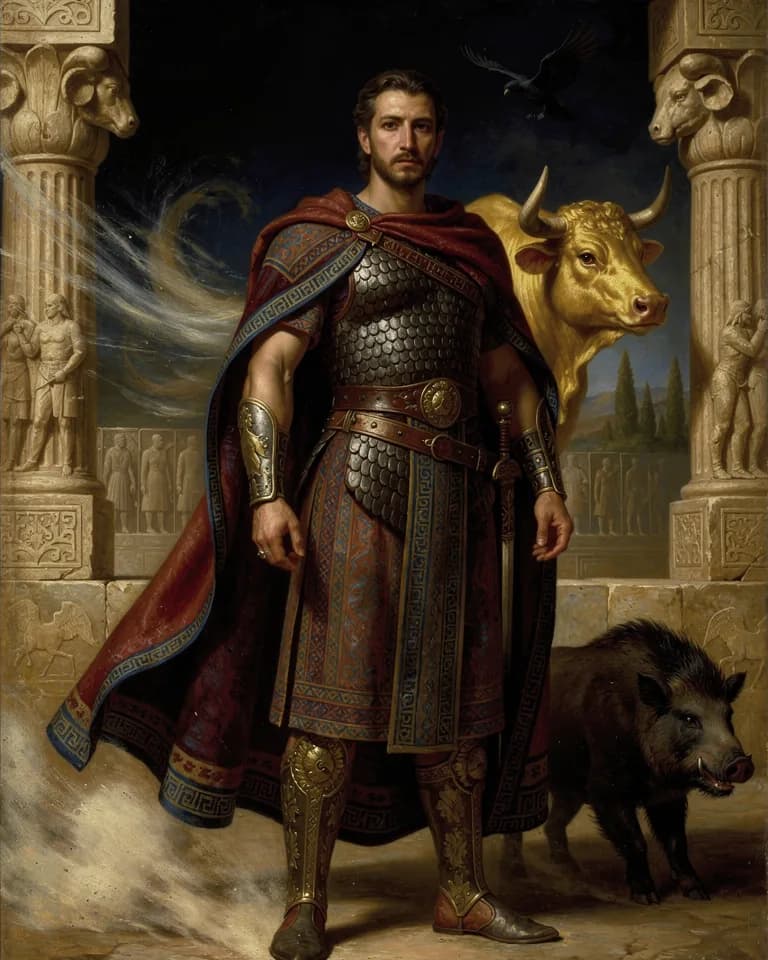
The yazata of victory, 'best-armed of the heavenly gods', who comes to Zarathushtra in ten shapes, from a strong wind and a golden-horned bull to a boar and a raven-like bird, and who gives his name to the highest grade of sacred fire.

A being 'made by Ahura' (Yasht 14.1); no birth narrative is told.

Yasht 14 answers Zarathushtra's question, 'Who is the best-armed of the heavenly gods?', with Verethragna, and describes him coming in ten successive forms: a strong, beautiful wind; a bull with yellow ears and golden horns; a white horse with a golden caparison; a burden-bearing camel; a sharp-toothed boar; a youth of fifteen; the swift bird Varaghna; a wild ram; a fighting buck; and a man holding a golden sword. Each bears the Glory made by Mazda. His feather, the hymn says, protects the one who carries it, a motif that recurs in the Shahnameh with the Simurgh's feather.

Read the full Verethragna entry
About this comparison

Comparisons pair figures that play a similar role across traditions, or that the myths connect within one. A shared role does not, by itself, establish a shared origin.