Persian (Iranian) Tradition
Verethragna
Vərəθraγna(Verethragna; Middle Persian Wahram, Bahram)
Also known as Bahram, Wahram, Vahagn (Armenian)
- victory
- strength
- protection in battle
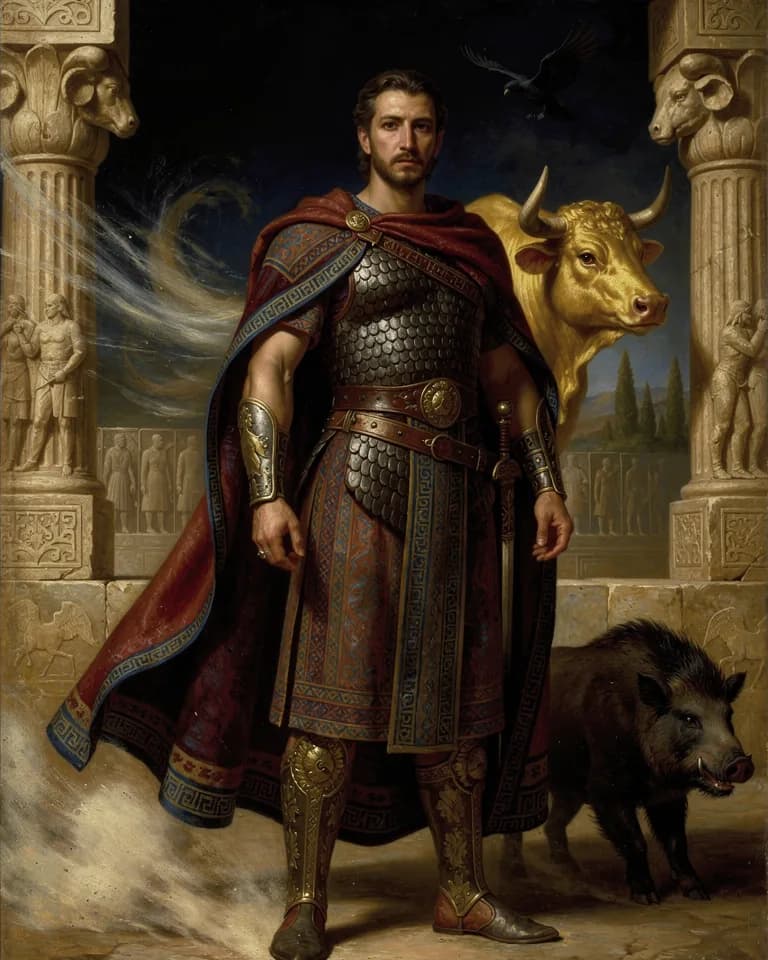
The yazata of victory, 'best-armed of the heavenly gods', who comes to Zarathushtra in ten shapes, from a strong wind and a golden-horned bull to a boar and a raven-like bird, and who gives his name to the highest grade of sacred fire.
About Verethragna
Ten incarnations
Yasht 14 answers Zarathushtra's question, 'Who is the best-armed of the heavenly gods?', with Verethragna, and describes him coming in ten successive forms: a strong, beautiful wind; a bull with yellow ears and golden horns; a white horse with a golden caparison; a burden-bearing camel; a sharp-toothed boar; a youth of fifteen; the swift bird Varaghna; a wild ram; a fighting buck; and a man holding a golden sword. Each bears the Glory made by Mazda. His feather, the hymn says, protects the one who carries it, a motif that recurs in the Shahnameh with the Simurgh's feather.
Companion of Mithra
In the Mihr Yasht Verethragna runs before Mithra's chariot in the form of a fierce boar. Kings and warriors invoked him for victory; several Sasanian kings bore his name as Bahram (Wahram), and the Kushan kings of Central Asia put him on their coins as Orlagno.
The victorious fire
The highest grade of Zoroastrian sacred fire is the Atash Behram, the 'victorious fire' or 'fire of Verethragna', consecrated from sixteen kinds of fire. The name Vrtrahan ('slayer of Vrtra') is an epithet of the Vedic Indra, and the Iranian and Indian words derive from the same Indo-Iranian root.
Origin story
A being 'made by Ahura' (Yasht 14.1); no birth narrative is told.
Across traditions
Parallel figures
Figures who play a role like Verethragna's in other traditions.
 HinduIndra
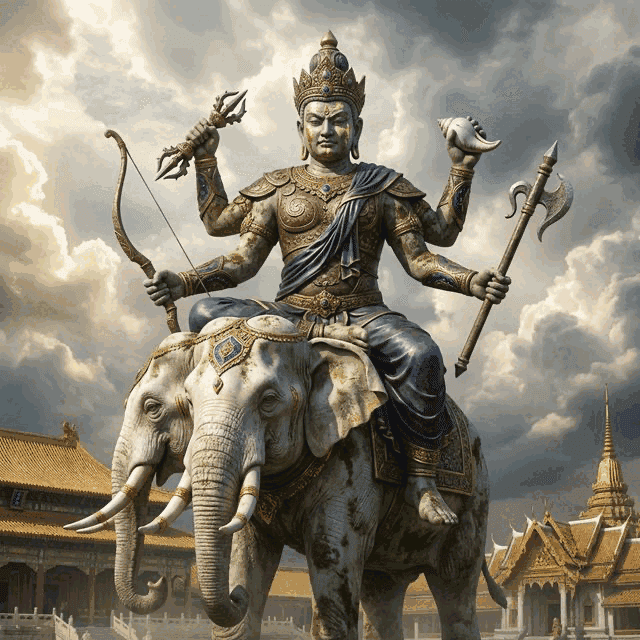
Verethragna's name is cognate with Vrtrahan, 'slayer of Vrtra', the chief epithet of the Vedic Indra; in Iran the word became a god of victory in his own right rather than an epithet of a storm god.
Compare Verethragna and Indra side by side GreekAres
At Nemrut Dağ in Commagene (1st century BCE) Antiochus I honored a combined Artagnes-Heracles-Ares, a Hellenistic equation of Verethragna with Greek gods of strength and war.
Compare Verethragna and Ares side by side GreekHeracles
The Commagene inscriptions equate Artagnes (Verethragna) with Heracles, and Parthian and Kushan images show Verethragna with Heracles' club; the pairing is iconographic and Hellenistic.
Worship and cult
Temples, festivals, and practices recorded for Verethragna
Invoked for victory and protection; the Bahram Yasht is recited for protection, and the twentieth day of each Zoroastrian month is dedicated to him.
Sacred sites
- Atash Behram fire temples, the highest grade of Zoroastrian fire, whose name means the fire of Bahram (Verethragna): among them the fires at Yazd in Iran and at Udvada and Mumbai in India.
Sources and further reading
Source notes
These references are recorded in the catalog. Their passage wording and translation have not been checked, so quotations are not displayed here.
- Avesta, Yasht 14.1 (trans. Darmesteter)
- Avesta, Yasht 14.2 (trans. Darmesteter)
Appears in
Ancient and classical works featuring this figure.
victory, coming in ten shapes (Yasht 14 (Bahram Yasht))
About this entry
By Elizabeth Stein for Mythos Atlas. About the author. Editorial notes are grounded in the site's cited sources and can be challenged through the contact page.
Parallels are editorial comparisons across traditions: a shared role does not, by itself, establish a shared origin.
Genealogy
Family tree
Verethragna's parents, consorts, children and rivals, as recorded in the atlas.