Mythos Atlas

Side by sideSiblings

Atlas vs Prometheus

Atlas
AtlasGreek
Prometheus
PrometheusGreek

Atlas and Prometheus are recorded as siblings in the Greek Pantheon.

At a glance

Atlas and Prometheus compared
AtlasPrometheus
TraditionGreek PantheonGreek Pantheon
Domainsendurance, the heavensforethought, fire, crafts, humanity
Symbolsthe sky borne on his shoulders, the western edge of the worldfire, torch, fennel stalk, eagle
Also calledNone recordedForethinker, Fire-Bringer

Where they meet

The atlas records no domain or symbol that Atlas and Prometheus share.

They are compared because of how the myths connect them, not because of what they rule.

Where they part

Only Atlas

Associated with endurance and the heavens.

Only Prometheus

Associated with forethought, fire, crafts, and humanity.

How each was worshipped

Atlas

No cult sites or festivals are recorded in the atlas.

Prometheus

Cult sites
Altar in the Athenian Academy, with torch races toward the city; Cult at Kolonos with Athena
Festivals
Prometheia torch races

Almost no panhellenic temple. Athens ran torch races from his altar. He is a craftsman's and a thinker's god more than a state's. The chained Titan of tragedy is larger than the small civic footprint.

The two figures

Greek Pantheon

Atlas

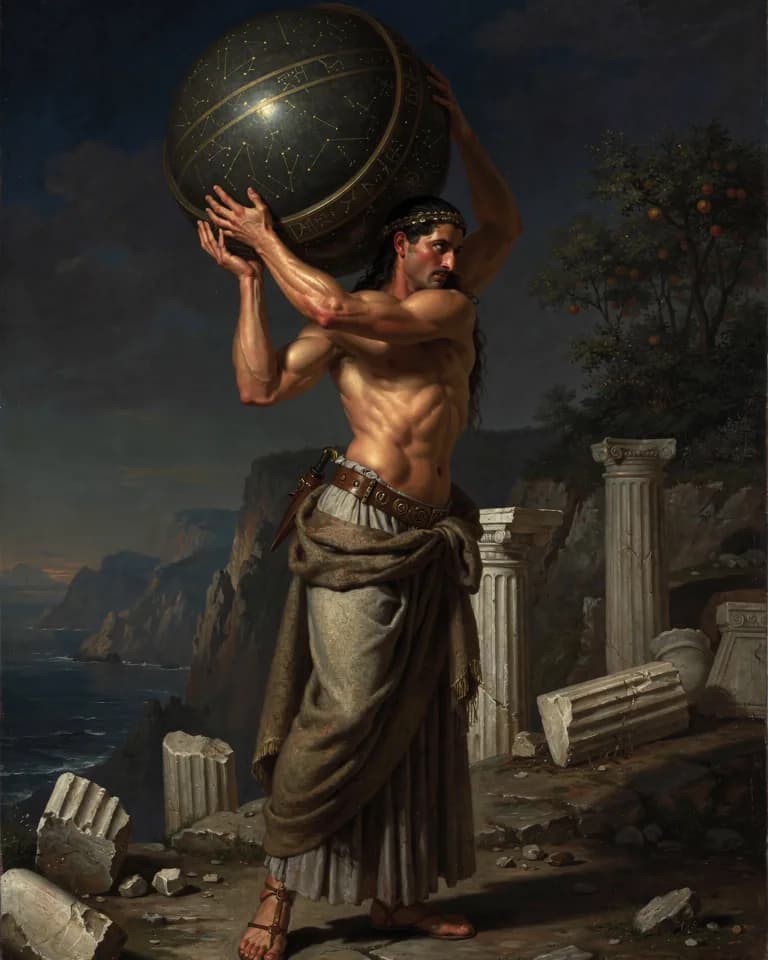
The Titan son of Iapetus whom Zeus set to hold up the sky at the western edge of the world, near the garden of the Hesperides. Brother of Prometheus and father of Maia and Calypso, he appears in Heracles' quest for the golden apples, and in Ovid is turned to stone as the Atlas mountains.

Atlas is the son of the Titan Iapetus and the Oceanid Clymene, and the brother of Menoetius, Prometheus and Epimetheus (Hesiod, Theogony 507-514). His task of holding up the sky is the lot Zeus assigned him.

Hesiod makes Atlas one of the four sons of the Titan Iapetus and the Oceanid Clymene, with Menoetius, Prometheus and Epimetheus. Zeus deals with each of them, and Atlas's lot is to stand at the ends of the earth, before the clear-voiced Hesperides, holding up the wide sky with his head and arms. The *Theogony* presents this as an assignment by Zeus, not as the aftermath of any single battle.

Read the full Atlas entry

Greek Pantheon

Prometheus

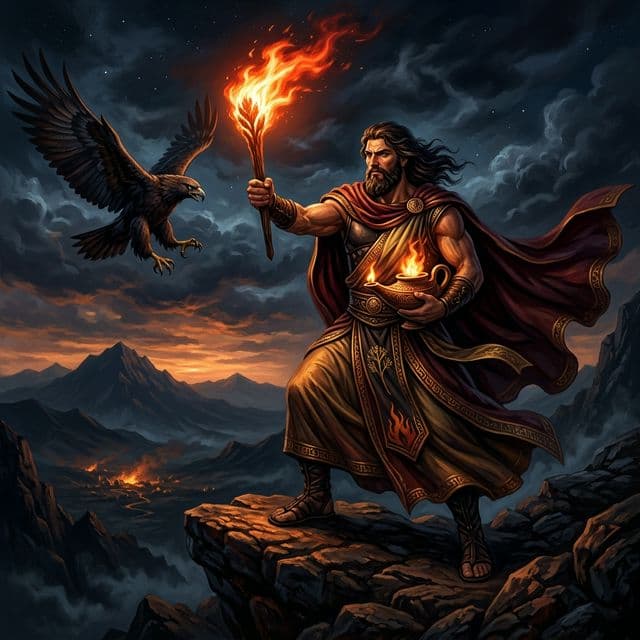
Titan who defied Zeus by stealing fire from the gods and giving it to humanity. For this transgression, Zeus chained him to a rock where an eagle devoured his liver daily.

Prometheus was a Titan, son of **Iapetus** and the Oceanid **Clymene**. Unlike most Titans, he sided with Zeus during the Titanomachy. He later created humanity from clay, and when Zeus denied them fire, Prometheus stole it from Hephaestus's forge, hiding it in a fennel stalk. Zeus punished him with eternal torment on Mount Caucasus.

**Prometheus** stands apart among the Titans as the great benefactor of humankind. His name means "forethought," contrasting with his brother **Epimetheus** ("afterthought"), and his actions shaped the relationship between gods and mortals.

Read the full Prometheus entry
About this comparison

Comparisons pair figures that play a similar role across traditions, or that the myths connect within one. A shared role does not, by itself, establish a shared origin.