Greek Pantheon
Atlas
Ἄτλας(Atlas)
- endurance
- the heavens
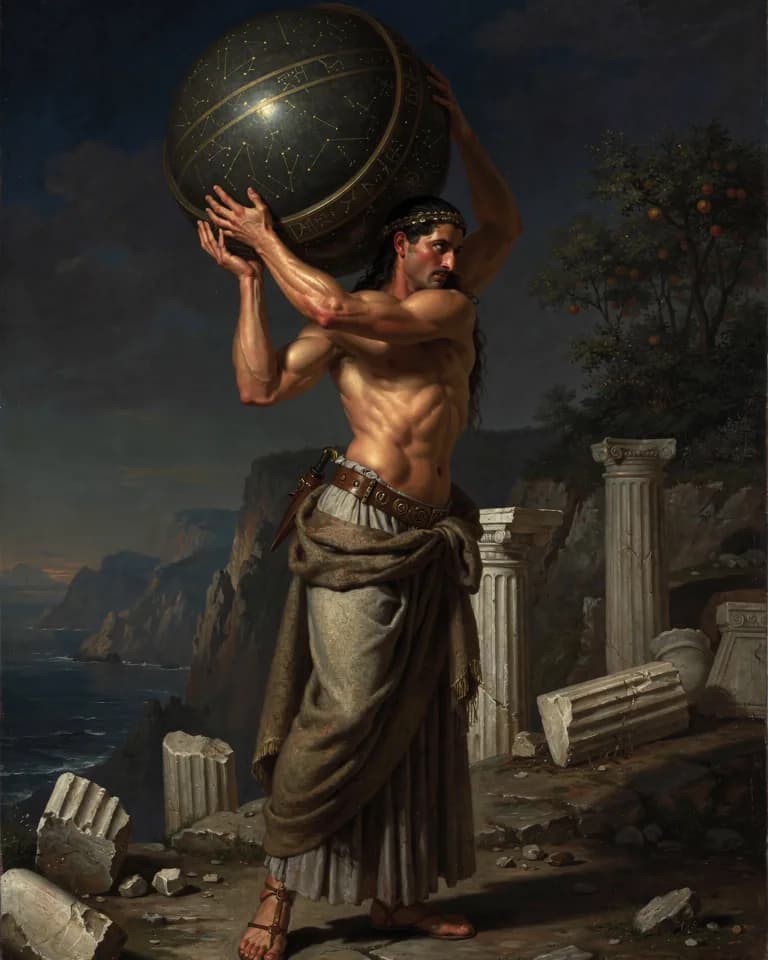
The Titan son of Iapetus whom Zeus set to hold up the sky at the western edge of the world, near the garden of the Hesperides. Brother of Prometheus and father of Maia and Calypso, he appears in Heracles' quest for the golden apples, and in Ovid is turned to stone as the Atlas mountains.
About Atlas
Bearer of the Sky
Hesiod makes Atlas one of the four sons of the Titan Iapetus and the Oceanid Clymene, with Menoetius, Prometheus and Epimetheus. Zeus deals with each of them, and Atlas's lot is to stand at the ends of the earth, before the clear-voiced Hesperides, holding up the wide sky with his head and arms. The Theogony presents this as an assignment by Zeus, not as the aftermath of any single battle.
The Odyssey gives a different image of the same figure: the nymph Calypso is the daughter of Atlas, who knows the depths of every sea and keeps the tall pillars that hold earth and sky apart. Hesiod also names him as the father of Maia, mother of Hermes.
The Golden Apples
Apollodorus's handbook tells how Heracles, sent for the golden apples of the Hesperides, was advised by Prometheus not to fetch them himself but to send Atlas, taking the sky onto his own shoulders meanwhile. Atlas came back with three apples and proposed to deliver them to Eurystheus himself; Heracles, by a trick, got him to take the sky back and left with the apples. Apollodorus adds that some say Heracles picked the apples himself after killing the guardian serpent.
The Stone Mountain
Ovid ties Atlas to the mountains of north-west Africa. In the Metamorphoses Perseus, returning with Medusa's head, asks Atlas for hospitality and is refused, because Atlas remembers a prophecy that a son of Zeus would rob him of his golden fruit. Perseus shows him the Gorgon's head and Atlas becomes a mountain range that carries the sky and its stars.
Origin story
Atlas is the son of the Titan Iapetus and the Oceanid Clymene, and the brother of Menoetius, Prometheus and Epimetheus (Hesiod, Theogony 507-514). His task of holding up the sky is the lot Zeus assigned him.
Across traditions
Parallel figures
Figures who play a role like Atlas's in other traditions.
 EgyptianShu
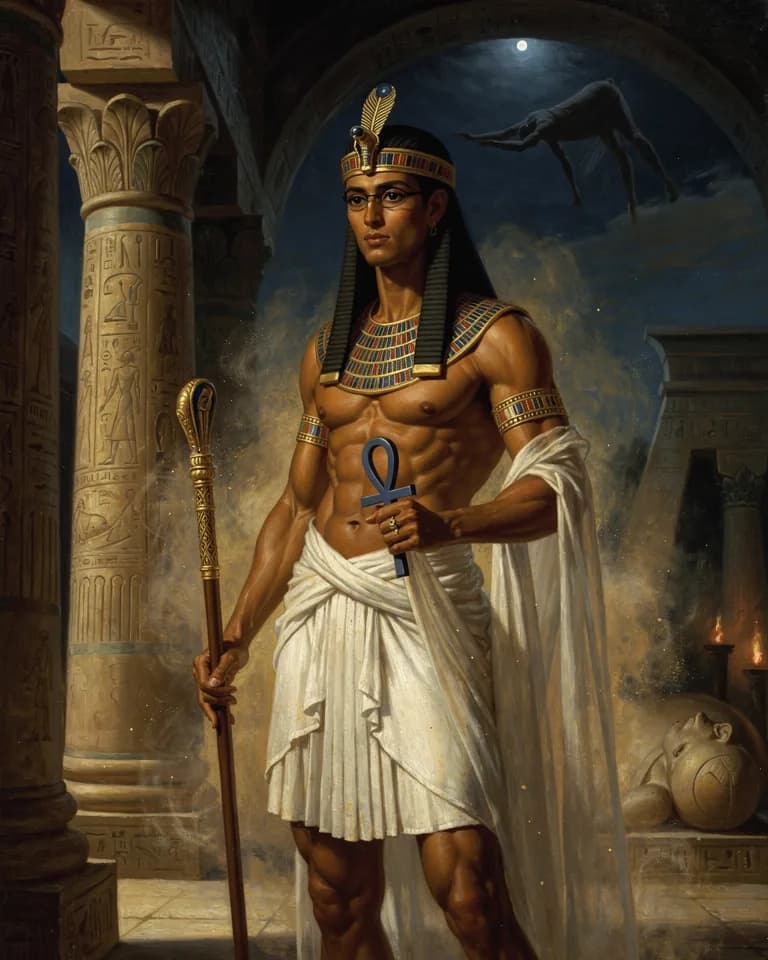
Both hold the sky apart from the earth, though Shu is the air that separates Nut from Geb while Atlas bears the sky as the lot Zeus assigned him
Compare Atlas and Shu side by side
Family
Atlas's family at a glance
- Who are Atlas's siblings?
- Siblings of Atlas recorded in the atlas: Prometheus.
In the atlas
Where Atlas appears
Sources and further reading
Source notes
These references are recorded in the catalog. Their passage wording and translation have not been checked, so quotations are not displayed here.
- Hesiod, Theogony 517-520 (paraphrase)
- Homer, Odyssey 1.52-54 (paraphrase)
Further reading
2.5.11: Atlas fetches the golden apples while Heracles holds the sky
Read online: Bibliotheca (Library) (opens in new tab)Book 4: Perseus turns Atlas to stone with Medusa's head
Read online: Metamorphoses (opens in new tab)
About this entry
By Elizabeth Stein for Mythos Atlas. About the author. Editorial notes are grounded in the site's cited sources and can be challenged through the contact page.
Parallels are editorial comparisons across traditions: a shared role does not, by itself, establish a shared origin.
Family relationships come from the atlas's kinship records. Ancient sources often disagree on divine genealogy.
Genealogy
Family tree
Atlas's parents, consorts, children and rivals, as recorded in the atlas.