Guide · Homer
The Odyssey: A Guide to Homer's Epic
Twenty years, fourteen landfalls and twenty-four books: where Odysseus goes, what happens in each book, and who he meets on the way.
Christopher Nolan's The Odyssey (2026) has sent a new generation to Homer's poem. This guide is about the poem itself: the route, the story book by book, and the gods and mortals in it, each linked to its entry in the atlas. It does not describe or review the film; wherever an adaptation departs from Homer, the text below is the place to check.
Odysseus's route home
Homer never gives coordinates, and only Troy, the Cicones' Ismarus and Ithaca are places a traveller could plan to reach. The others were located by later Greek and Roman readers, mostly around Sicily and southern Italy; each entry says which kind of place it is. Trace them on the map in the Odyssey journey.
1. Book 9; the siege is the Iliad's · Real place
TroyThe fleet sails for home after the ten-year war.
The legendary walled city besieged for ten years by the Greeks, eventually fallen to the cunning of the wooden horse.
2. Book 9 · Real place
Cicones CoastA raid on Ismarus; the crews linger and the Cicones strike back.
The Thracian coast of the Cicones at Ismarus, where Odysseus's fleet made its first raid after Troy and lost men when the crews lingered and the inland Cicones counterattacked (Odyssey 9).
3. Book 9 · Mythic place, later identified with a real site
Land of the Lotus-EatersScouts who eat the lotus forget their homecoming.
The unnamed shore in Odyssey 9 where people live on the honey-sweet lotus, whose fruit made Odysseus's scouts forget their homecoming until he dragged them back to the ships in tears.
4. Book 9 · Mythic place, later identified with a real site
Cave of PolyphemusOdysseus, calling himself Nobody, blinds Polyphemus and earns Poseidon's anger.
The cave of the Cyclops Polyphemus in Odyssey 9, where Odysseus, calling himself Nobody, blinded the one-eyed son of Poseidon and escaped beneath his sheep; later tradition placed it in Sicily.
5. Book 10 · Mythic place, later identified with a real site
Island of AeolusThe bag of winds, opened within sight of Ithaca.
Aeolia, the floating island with a bronze wall where Aeolus, keeper of the winds, gave Odysseus the storm-winds tied in a bag, which his crew opened within sight of Ithaca (Odyssey 10).
6. Book 10 · Mythic place, later identified with a real site
Laestrygonian HarborEleven of the twelve ships are destroyed.
The enclosed harbour of the giant Laestrygonians in Odyssey 10, where the giants speared Odysseus's men and smashed eleven of his twelve ships; only his own ship, moored outside, escaped.
7. Books 10 and 12 · Mythic place, later identified with a real site
Aeaea (Circe's Island)The men become pigs; Hermes gives Odysseus moly; a year with Circe.
Aeaea, the island of the goddess Circe in Odyssey 10, where her drugs turned Odysseus's men into pigs until Hermes gave him the herb moly, and where he stayed a year before seeking the dead.
8. Book 11 · Mythic place, later identified with a real site
The UnderworldTiresias's prophecy, his mother's shade, and the heroes of Troy.
The realm of the dead beneath the earth, ruled by Hades and Persephone, which Greek poets filled over time with rivers, gates, judges, and the dog Cerberus; the Odyssey's Book 11 is its earliest great portrait.
9. Book 12 · Mythic place, later identified with a real site
Sirens' StraitBound to the mast, he hears the song; the crew row with wax in their ears.
The waters of the Sirens in Odyssey 12, whose song promised knowledge and lured sailors to their deaths; Odysseus heard it bound to the mast while his crew rowed with wax-stopped ears.
10. Book 12 · Mythic place, later identified with a real site
Scylla and CharybdisHe steers past the whirlpool and loses six men to Scylla.
The narrow passage of Odyssey 12 between six-headed Scylla on her cliff and the whirlpool Charybdis, later identified with the Strait of Messina; Odysseus chose Scylla and lost six men.
11. Book 12 · Mythic place, later identified with a real site
ThrinaciaThe crew kill the Sun's cattle; Zeus wrecks the last ship.
The island of the sun god Helios in Odyssey 12, pasture of his immortal cattle, where Odysseus's starving crew slaughtered the herds and were destroyed by Zeus's thunderbolt at sea.
12. Books 5, 7 and 12 · Mythic place, later identified with a real site
Ogygia (Calypso's Isle)Seven years with Calypso until Hermes brings Zeus's order to release him.
Ogygia, the wooded island of the nymph Calypso in Odyssey 5, where she kept Odysseus seven years and offered him immortality until Hermes brought Zeus's order to let him go.
13. Books 6 to 13 · Mythic place, later identified with a real site
Phaeacia (Scheria)Nausicaa finds him; he tells his story at Alcinous's court.
Scheria, land of the seafaring Phaeacians in Odyssey 6 to 13, where Nausicaa found the shipwrecked Odysseus and King Alcinous heard his tale before a magic ship carried him home to Ithaca.
14. Books 13 to 24 · Real place
IthacaHome in disguise, the bow, the suitors, and Penelope's test.
The island kingdom of Odysseus, whose twenty-year journey home from Troy is told in Homer's Odyssey.
The Odyssey book by book
Book 1. The gods in council
Odysseus is held on Calypso's island. Athena wins Zeus's agreement to bring him home and, disguised as Mentes, urges his son Telemachus to stand up to the suitors besieging his mother Penelope.
Book 2. Assembly on Ithaca
Telemachus calls an assembly that fails to curb the suitors, and sails secretly with Athena, now disguised as Mentor, to seek news of his father.
Book 3. Pylos
Old Nestor receives Telemachus and tells of the Greeks' scattered homecomings, including Agamemnon's murder, then sends him on to Sparta.
Book 4. Sparta
Menelaus and Helen tell stories of Troy; Menelaus reports that the sea-god Proteus saw Odysseus captive on Calypso's island. On Ithaca the suitors plan an ambush.
Book 5. Calypso
Hermes brings Zeus's command, Calypso lets Odysseus go, and he builds a raft. Poseidon wrecks it; the sea-goddess Ino lends him her veil and he swims ashore on Scheria.
Book 6. Nausicaa
The Phaeacian princess Nausicaa, washing clothes by the river, finds the shipwrecked stranger and tells him how to approach her parents.
Book 7. The palace of Alcinous
Odysseus supplicates Queen Arete and King Alcinous, who promise him passage home.
Book 8. Games and songs
Odysseus proves himself at the Phaeacian games. The bard Demodocus sings of Ares and Aphrodite and of the wooden horse, and Odysseus weeps.
Book 9. Nobody
He reveals his name and begins his tale: the Cicones, the Lotus-Eaters, and the cave of the Cyclops Polyphemus.
Book 10. Aeolus, the Laestrygonians, Circe
The bag of winds, the loss of eleven ships, and a year on Circe's island after she turns his men into pigs.
Book 11. The dead
At the edge of the world he calls up the dead: the prophet Tiresias, his mother Anticlea, and the shades of Agamemnon, Achilles and Ajax.
Book 12. The Sirens and the Sun's cattle
The Sirens, Scylla and Charybdis, and Thrinacia, where the crew eat the cattle of the Sun and are destroyed. Odysseus alone drifts to Calypso's island.
Book 13. Ithaca at last
The Phaeacians carry him home asleep; Poseidon turns their ship to stone. Athena disguises Odysseus as an old beggar.
Book 14. The swineherd
The loyal swineherd Eumaeus shelters the beggar without recognizing his master.
Book 15. Telemachus returns
Warned by Athena, Telemachus sails home from Sparta and avoids the suitors' ambush.
Book 16. Father and son
In Eumaeus's hut Odysseus reveals himself to Telemachus, and they plan the suitors' downfall.
Book 17. The beggar at the palace
Odysseus enters his own hall in disguise. His old dog Argos knows him and dies. The suitors mock and strike him.
Book 18. Irus
He beats the palace beggar Irus in a fight; Penelope appears before the suitors and draws gifts from them.
Book 19. The scar
Penelope questions the stranger by night. The old nurse Eurycleia, washing his feet, recognizes a scar from a boar hunt and is sworn to silence.
Book 20. Omens
Signs of doom gather over the suitors' last feast; the seer Theoclymenus sees the hall running with blood.
Book 21. The bow
Penelope offers to marry whoever can string Odysseus's bow and shoot through twelve axes. No suitor can; the beggar does.
Book 22. The suitors
With Telemachus and two loyal herdsmen, Odysseus kills the suitors and punishes the disloyal servants.
Book 23. The bed
Penelope tests him with their bed, built around a living olive tree, and only then accepts that he is her husband.
Book 24. Peace
The suitors' shades go down to Hades. Odysseus reveals himself to his father Laertes, and Athena ends the feud with the suitors' families.
Cast of characters
 Odysseus
Protagonist, Books 1-24
King of Ithaca famed for cunning rather than brute strength. Deviser of the Trojan Horse and protagonist of Homer's Odyssey, his ten-year voyage home after the Trojan War.
 Penelope
His wife, holding off the suitors
Wife of Odysseus, who held off more than a hundred suitors for twenty years while he was away at Troy and on his long voyage home, becoming an ancient byword for marital fidelity and cunning.
 Helen
HelenHosts Telemachus at Sparta, Book 4
Daughter of Zeus and the most beautiful woman in the ancient world, whose abduction (or elopement) by the Trojan prince Paris was the mythic cause of the Trojan War.
 Agamemnon
His shade warns Odysseus, Book 11
King of Mycenae and commander-in-chief of the Greek forces at Troy. His quarrel with Achilles opens the Iliad, and his murder upon returning home became the basis of Aeschylus's tragedy.
 Achilles
His shade speaks of death, Book 11
Greatest warrior of the Greek forces at Troy, whose wrath and grief drive the plot of Homer's Iliad. Son of the mortal king Peleus and the sea-goddess Thetis.
 Ajax
AjaxHis shade refuses to speak, Book 11
Second-mightiest Greek warrior at Troy after Achilles. Lost the contest for Achilles's armor to Odysseus and, in Sophocles's telling, took his own life in shame.
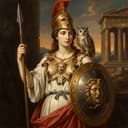 Athena
Odysseus's protector throughout
Goddess of wisdom, warfare, and crafts. Born fully armed from Zeus's forehead after he swallowed her mother Metis.
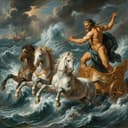 Poseidon
Pursues him for blinding Polyphemus
God of the sea, earthquakes, and horses. Brother of Zeus and Hades, ruler of the oceans and all waters.
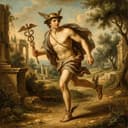 Hermes
Brings moly (Book 10) and Zeus's order (Book 5)
God of messengers, commerce, thieves, and travelers. Son of Zeus and the nymph Maia, known for his cunning and speed.
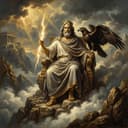 Zeus
ZeusAllows the homecoming; wrecks the last ship
King of the gods and ruler of Mount Olympus. God of the sky, thunder, and justice. Zeus overthrew his father Cronus to become the supreme deity of the Greek pantheon.
 Helios
Owner of the cattle of Thrinacia
The Titan-born sun who drives his chariot across the sky each day and sees everything beneath it. Son of Hyperion and Theia, brother of Selene (Moon) and Eos (Dawn), Helios is the witness gods and mortals call on because nothing happens outside his gaze.
 Atlas
AtlasFather of Calypso, Book 1
The Titan son of Iapetus whom Zeus set to hold up the sky at the western edge of the world, near the garden of the Hesperides. Brother of Prometheus and father of Maia and Calypso, he appears in Heracles' quest for the golden apples, and in Ovid is turned to stone as the Atlas mountains.
 Cyclops
Polyphemus, son of Poseidon, Book 9
One-eyed giants of immense strength. The most famous, Polyphemus, trapped Odysseus and his men in his cave. They were master craftsmen who forged Zeus's thunderbolts.
Before you watch: what Homer's text does
- The poem begins in the middle: Odysseus is already on Calypso's island, and the first four books belong to his son Telemachus.
- The Cyclops, Circe, the Underworld and the Sirens are told by Odysseus himself at the Phaeacian court (Books 9 to 12), so the most famous episodes are his own account.
- Half the poem happens on Ithaca: the disguise, the recognitions, the bow and the suitors fill Books 13 to 24.
- The gods are characters, not symbols. Athena plans and intervenes throughout, Poseidon pursues him, and Zeus sends Hermes to free him.
- The wooden horse is only remembered, never shown, and the poem ends not with the killing of the suitors but with Athena imposing peace on Ithaca.
Questions readers ask
- How long was Odysseus away from Ithaca?
- Twenty years: ten at the siege of Troy and ten more getting home. Homer says he returns in the twentieth year, and seven of the ten years of wandering are spent on Calypso's island.
- How many books are in the Odyssey?
- Twenty-four. Books 1 to 4 follow Telemachus; Books 5 to 12 bring Odysseus from Calypso's island to Phaeacia, where he tells his earlier adventures himself (Books 9 to 12); Books 13 to 24 take place on Ithaca.
- Where did Odysseus go on his journey home?
- From Troy to the Cicones at Ismarus, the Lotus-Eaters, the Cyclops's island, Aeolus's floating island, the Laestrygonians, Circe's island of Aeaea, the Underworld, past the Sirens and Scylla and Charybdis to Thrinacia, then to Calypso's Ogygia, Phaeacia (Scheria), and finally Ithaca.
- Is the Trojan Horse in the Odyssey?
- Only as a story told after the fact: Menelaus recalls it in Book 4, the bard Demodocus sings of it in Book 8, and the shade of Achilles hears of Neoptolemus inside it in Book 11. The Iliad ends before the horse, and the fullest ancient telling is in Virgil's Aeneid.
Keep exploring
- Map the journeyEvery landfall on an interactive map.
- The Odyssey as a sourceTranslations, key scenes and the characters it names.
- OdysseusThe man of many ways, from Troy to the Telegony.
- The Trojan WarThe war the Odyssey looks back on.
- Test yourselfQuizzes on the Greek gods and heroes.
- All guidesEpics, novels and games, read against the myths.