Greek Pantheon
Hermes
Also known as Mercury
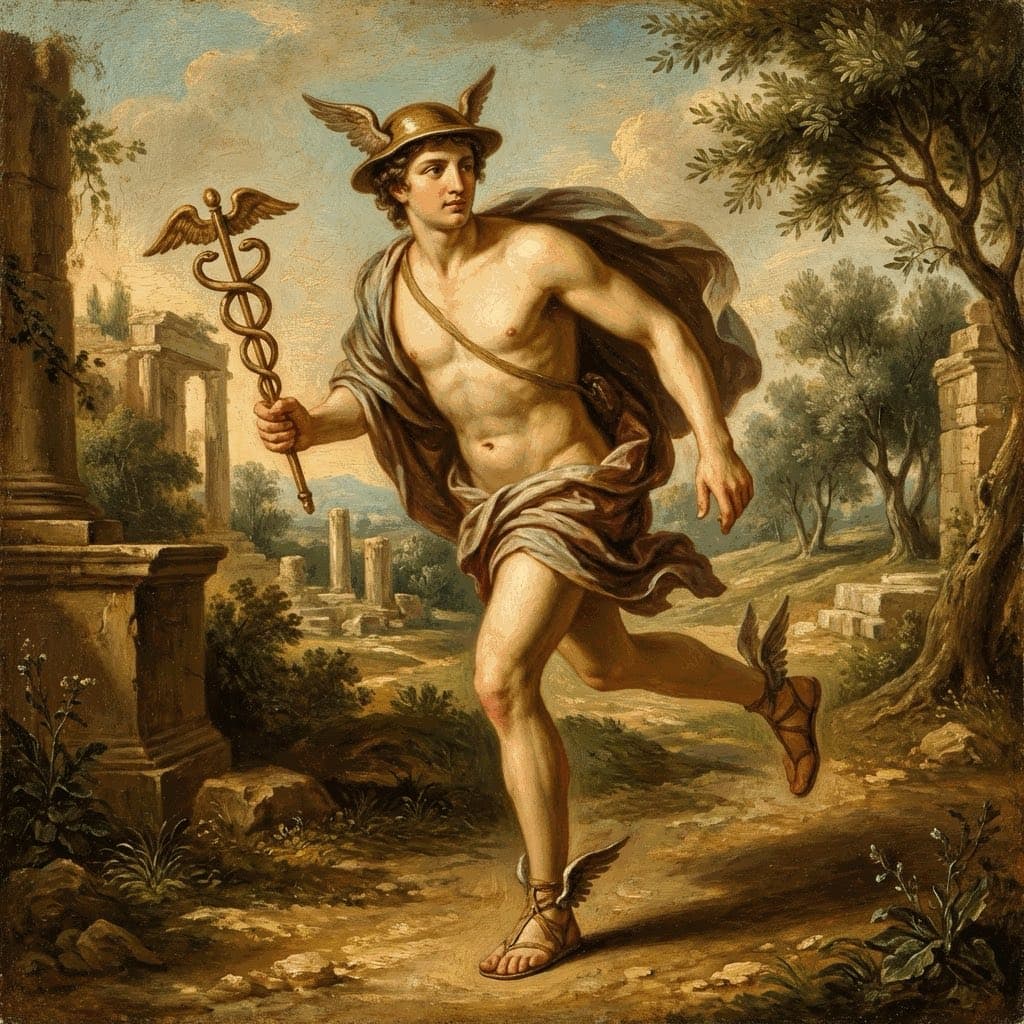
- messengers
- commerce
- thieves
- travelers
- boundaries
God of messengers, commerce, thieves, and travelers. Son of Zeus and the nymph Maia, known for his cunning and speed.
About Hermes
The Divine Messenger
Hermes is the swift messenger of the gods, wearing winged sandals and carrying the caduceus. He is the patron of boundaries and travelers, and the only god (besides Hades and Persephone) who can freely travel to the Underworld.
The Infant Thief
On the very day he was born, Hermes stole Apollo's sacred cattle. To reconcile, he invented the lyre from a tortoise shell and gifted it to Apollo. This established his role as a trickster and patron of thieves and merchants.
Across traditions
Parallel figures
Figures who play a role like Hermes's in other traditions.
 RomanMercuryIllustration
Mercury is the direct Roman equivalent, serving as messenger of the gods and patron of commerce and travelers
Compare Hermes and Mercury side by side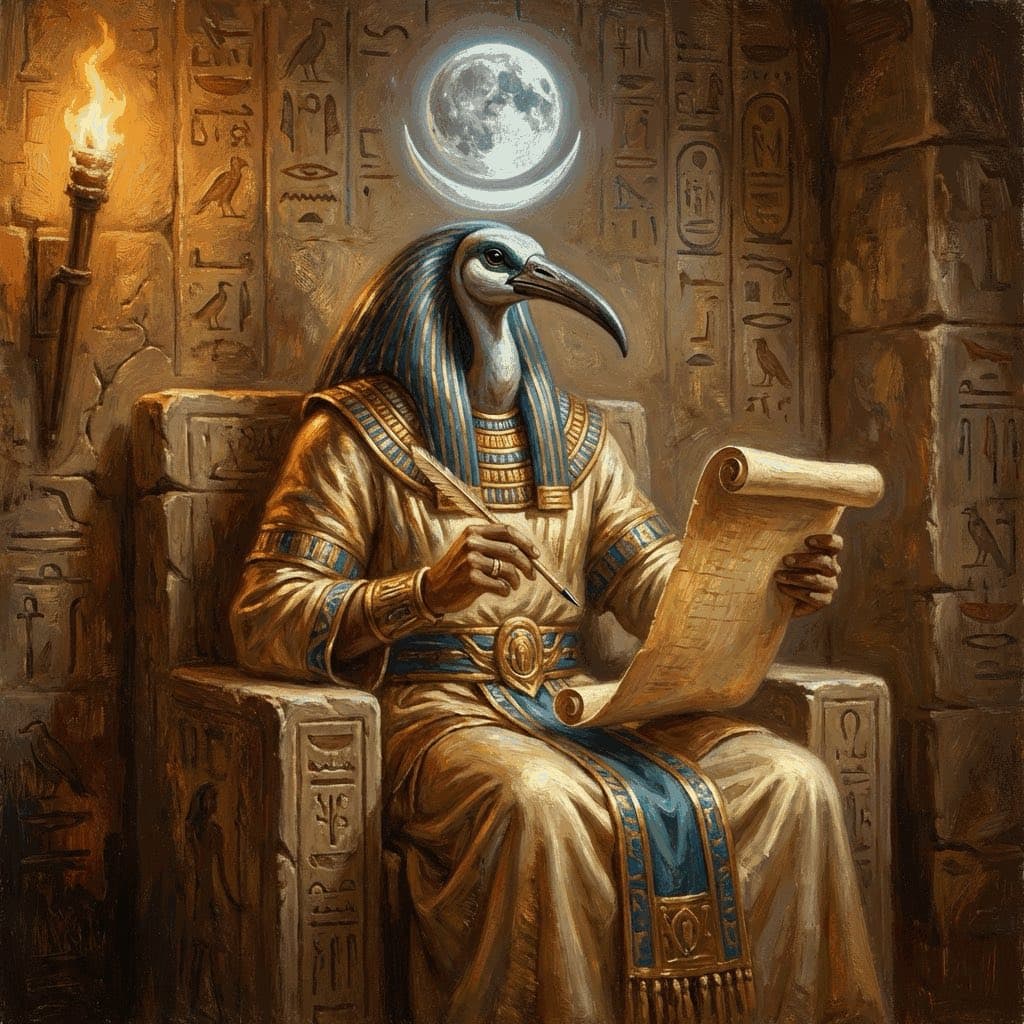 EgyptianThothIllustration
Both serve as divine messengers and are associated with writing, knowledge, and guiding souls to the afterlife
Compare Hermes and Thoth side by side
Worship and cult
Temples, festivals, and practices recorded for Hermes
The herm, a bearded head on a pillar, is the cult you actually meet: boundaries, luck, and theft. Athletic Hermaia marked boys. He leads souls and goats with the same staff. A marketplace god before he is a cute messenger.
Sacred sites
- Hermo on roads and at doorways more than a single great temple
- Sanctuary of Hermes at Pheneos in Arcadia
Festivals
- Hermaia
Family
 Hermes
Relationship sources
Theogony — Zeus parent of Hermes
Hesiod · Hugh G. Evelyn-White, Hesiod, the Homeric Hymns and Homerica (1914), Project Gutenberg #348 · Theogony 938–939
Questions about Hermes's family
- Who are Hermes's parents?
- The atlas's kinship records name one parent of Hermes: Zeus. Ancient accounts do not always agree on divine parentage.
In the atlas
Where Hermes appears
In the museums
Hermes in art
Real objects in public collections, released into the public domain by the museums that hold them. Dates refer to when each object was made. Objects made within the tradition come first, later depictions after.
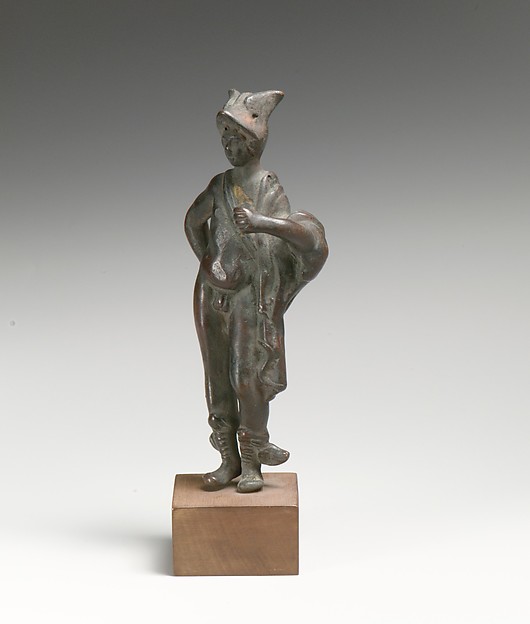 (opens the museum record)
Ancient object
Bronze statuette of Hermes (opens the museum record)
A bronze statuette the museum catalogs as Hermes, messenger god and patron of travelers and trade. Its Greek-or-Roman dating reflects how the type continued across the transition between the two cultures.
Sources and further reading
Source notes
These references are recorded in the catalog. Their passage wording and translation have not been checked, so quotations are not displayed here.
- Homeric Hymn IV, To Hermes (trans. Evelyn-White)
Appears in
Ancient and classical works featuring this figure.
Messenger god who guides Pandora to Epimetheus and instills within her a shameless mind and deceitful nature (Lines 67-85)
Trickster infant born at dawn who invents the lyre, steals Apollo's cattle at noon, and plays for Zeus at dusk (Hymn 4)
About this entry
By Elizabeth Stein for Mythos Atlas. About the author. Editorial notes are grounded in the site's cited sources and can be challenged through the contact page.
Parallels are editorial comparisons across traditions: a shared role does not, by itself, establish a shared origin.
Family relationships come from the atlas's kinship records. Ancient sources often disagree on divine genealogy.
Keep exploring
One myth a week, with its sources in a short email. The sign-up form is just below.
Genealogy
Family tree
Hermes's parents, consorts, children and rivals, as recorded in the atlas.