Greek PantheonCreature
Cyclops
- Immense Strength
- Master Craftsmanship
- Stone Throwing
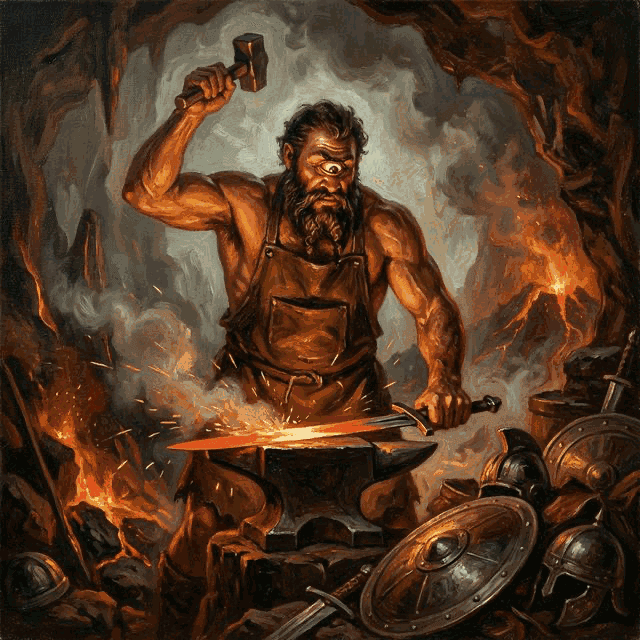
One-eyed giants of immense strength. The most famous, Polyphemus, trapped Odysseus and his men in his cave. They were master craftsmen who forged Zeus's thunderbolts.
About Cyclops
One Eye, Two Stories
Hesiod's Cyclopes — Brontes, Steropes, Arges — forge Zeus's thunderbolt. Homer's Polyphemus is a pastoral giant who cages Odysseus and is blinded for it. Later myth tries to join the smiths to the shepherds; the poems keep them apart.
The Odyssey episode is the one travelers remember: no wine-guest law, a cave, and a name stolen as 'Nobody.'
Makers of the thunderbolt
In the Theogony the three Cyclopes are sons of Gaia and Uranus, imprisoned by their father and freed by Zeus, to whom they give thunder and lightning in gratitude. Callimachus and Virgil later put them to work as Hephaestus's smiths under Etna. Homer's Cyclopes are a lawless people who neither plough nor hold assemblies; Polyphemus, son of Poseidon, is one of them, and his blinding is the cause of Poseidon's anger that keeps Odysseus from home.
Quick answers about Cyclops
- What is Cyclops?
- One-eyed giants of immense strength. The most famous, Polyphemus, trapped Odysseus and his men in his cave. They were master craftsmen who forged Zeus's thunderbolts.
- Where does Cyclops live?
- The atlas lists Cyclops's habitat as Sicily and Volcanic Islands.
- What abilities does Cyclops have?
- The atlas lists these abilities for Cyclops: Immense Strength, Master Craftsmanship, and Stone Throwing.
Sources and further reading
Source notes
These references are recorded in the catalog. Their passage wording and translation have not been checked, so quotations are not displayed here.
- Homer, Odyssey 9
About this entry
By Elizabeth Stein for Mythos Atlas. About the author. Editorial notes are grounded in the site's cited sources and can be challenged through the contact page.
The danger rating is an editorial shorthand for how the myths portray the creature, not a claim made by the sources.
Keep exploring
One myth a week, with its sources in a short email. The sign-up form is just below.