Mythos Atlas

Guide · Percy Jackson

The Myths Behind Percy Jackson: The Titan's Curse

Every god, monster and place in Rick Riordan's third novel has an ancient source behind it, and Riordan changes nearly all of them. Here is what the Greek texts actually say.

The Titan's Curse (2007) is the third Percy Jackson and the Olympians novel and the basis for the third season of the Disney+ series, which premieres on November 20, 2026. Its quest runs through some of the oldest material in Greek myth: the Titan who holds up the sky, the garden of the golden apples, and the war between the Titans and the gods.

Each section below sets the novel beside the ancient sources, with links to the full entries in the atlas. Descriptions of the novel are brief and contain spoilers. This is an independent guide, not affiliated with Rick Riordan, Disney or the series.

The novel beside the myths

Left: what the novel does, in a sentence or two. Right: what the Greek sources say, with the passages to read.

Artemis and the Hunters

In The Titan's Curse

Artemis leads the Hunters, a band of immortal girls who have sworn off romance and follow her across the country. She is captured, and the quest to find her drives the plot.

In the ancient sources

Artemis, daughter of Zeus and Leto and twin of Apollo, is the huntress of the mountains and protector of young women and wild animals. The Homeric Hymn to Artemis shows her hunting and then leading the dance at Delphi. Her companions are nymphs: Ovid tells of Callisto, expelled from the band after Zeus seduced her, and of Actaeon, who saw the goddess bathing with her nymphs. An order of immortal Hunters recruiting modern girls is Riordan's invention.

Sources: Homeric Hymn 27, To Artemis; Ovid, Metamorphoses 2 (Callisto) and 3 (Actaeon)

In the atlasArtemis
Apollo and the sun

In The Titan's Curse

Apollo drives the sun chariot, which takes the form of a sports car, and gives the heroes a ride.

In the ancient sources

Apollo is the god of music, prophecy, healing and archery. The sun that crosses the sky in a chariot belongs, in Homer and Hesiod, to a different god, Helios. Classical and later writers increasingly identified Apollo with the sun, and Riordan uses that later, merged figure.

Sources: Homeric Hymn 31, To Helios; Hesiod, Theogony 371-374

In the atlasApollo · Helios

Atlas and the weight of the sky

In The Titan's Curse

Atlas is the Titans' general. Free of the sky while others are forced to bear it, he leads the enemy; Percy briefly takes the weight himself before Atlas is trapped beneath it again.

In the ancient sources

Hesiod's Atlas is a son of Iapetus and brother of Prometheus whom Zeus set at the western edge of the world, before the Hesperides, to hold up the sky. Apollodorus tells how Heracles took the sky onto his own shoulders while Atlas fetched the golden apples, then tricked him into taking it back: the scene Riordan echoes. Hesiod gives Atlas no command in the war.

Sources: Hesiod, Theogony 507-520; Apollodorus, Library 2.5.11

In the atlasAtlas · Heracles

Zoë Nightshade and the Hesperides

In The Titan's Curse

Zoë Nightshade, lieutenant of the Hunters, turns out to be a daughter of Atlas and one of the Hesperides, cast out for helping Heracles. At the end of the novel she is placed among the stars.

In the ancient sources

The Hesperides tend the golden apples in a garden beyond the ocean. Hesiod calls them daughters of Night; later writers make them daughters of Atlas. Apollodorus names four (Aegle, Erythia, Hesperia and Arethusa), and in Apollonius of Rhodes they mourn the serpent Heracles killed. No ancient Hesperid is called Zoë or helps Heracles. Her transformation into a constellation follows an ancient pattern, like Callisto becoming the Great Bear in Ovid.

Sources: Hesiod, Theogony 215-216; Apollodorus, Library 2.5.11; Apollonius of Rhodes, Argonautica 4

In the atlasGarden of the Hesperides · Nyx · Atlas

The Nemean Lion

In The Titan's Curse

The lion attacks the heroes inside a museum in Washington, D.C., and they have to find a way past a hide no blade can cut.

In the ancient sources

Hesiod has Hera rear the lion and set it on the hills of Nemea. Killing it was Heracles' first labour: his arrows glanced off, so he trapped it in its two-mouthed cave and strangled it, and wore its skin ever after.

Sources: Hesiod, Theogony 326-332; Apollodorus, Library 2.5.1

In the atlasNemean Lion · Nemea · Heracles

Ladon, the dragon of the garden

In The Titan's Curse

A many-headed dragon coils around the tree of golden apples in the garden.

In the ancient sources

Hesiod mentions an unnamed serpent guarding the golden apples at the ends of the earth. Apollodorus gives it a hundred heads and many voices; Apollonius of Rhodes names it Ladon and shows it lying dead, killed by Heracles, the day before the Argonauts arrive.

Sources: Hesiod, Theogony 333-336; Apollodorus, Library 2.5.11; Apollonius of Rhodes, Argonautica 4

In the atlasLadon · Garden of the Hesperides

The Ophiotaurus

In The Titan's Curse

A gentle creature, part bull and part serpent, follows Percy. Whoever sacrifices it, the heroes learn, gains the power to destroy the gods.

In the ancient sources

The creature comes from a short passage in Ovid's Fasti about a monster that was a bull in front and a serpent behind, and a prophecy that whoever burned its entrails would overcome the gods. That passage is essentially its only ancient witness, so Riordan's premise is Ovid's, nearly unchanged. It has no entry in the atlas because there is almost nothing more to say.

Sources: Ovid, Fasti 3.793-808

Mount Othrys and the garden in California

In The Titan's Curse

The Titans rebuild their stronghold on Mount Othrys, which has risen on Mount Tamalpais above San Francisco, with the Garden of the Hesperides at its foot.

In the ancient sources

Othrys is a real mountain range in central Greece, facing Olympus across the Thessalian plain. Hesiod names it as the Titans' side in their ten-year war with the gods; a palace on its summit belongs to later retellings. The garden lies at the western edge of the known world. Moving both to California is Riordan's invention, in keeping with his premise that the gods follow Western civilization.

Sources: Hesiod, Theogony 630-636

In the atlasMount Othrys · Garden of the Hesperides · Mount Olympus

Kronos, lord of time

In The Titan's Curse

Kronos, the Titan lord, is slowly regaining his power, and his followers prepare for war on Olympus. Across the series, Riordan's Kronos commands time.

In the ancient sources

Cronus, youngest of the Titans, overthrew his father Uranus, swallowed his own children to escape the same fate, and was overthrown by Zeus. He is not a god of time; that is Chronos, Time personified, a different figure. The names were confused in antiquity (Plutarch notes that the Greeks allegorized Cronus as time), and Riordan builds on that confusion.

Sources: Hesiod, Theogony 453-506; Plutarch, On Isis and Osiris

In the atlasCronus · Zeus

Also in the novel

Dionysus is still the camp director, the Olympian council meets on Olympus, and the manticore that attacks early in the book comes from Persian lore reported by the Greek writer Ctesias rather than from Greek myth proper.

  • Dionysus

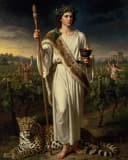
    God of wine, festivity, and theater. Son of Zeus and the mortal Semele, the only Olympian born to a mortal parent.

  • Zeus

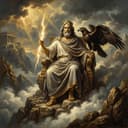
    King of the gods and ruler of Mount Olympus. God of the sky, thunder, and justice. Zeus overthrew his father Cronus to become the supreme deity of the Greek pantheon.

  • Heracles

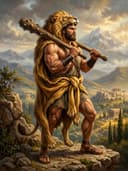
    The most famous Greek hero, son of Zeus, celebrated for superhuman strength and the Twelve Labors he performed in atonement for killing his own children in a fit of madness sent by Hera.

  • Mount Olympus

    The highest mountain in Greece, on the border of Thessaly and Macedonia, which Homer and Hesiod made the home of Zeus and the Olympian gods, a peak above the clouds where the gods feast and hold council.

Questions readers ask

Is Zoë Nightshade from Greek mythology?
No. Zoë Nightshade is Rick Riordan's character. She is written as one of the Hesperides, the nymphs who tend the golden apples, and ancient writers do name individual Hesperides (Apollodorus lists Aegle, Erythia, Hesperia and Arethusa), but none is called Zoë and no ancient source has a Hesperid help Heracles.
Is the Ophiotaurus a real Greek myth?
Barely. The creature comes from a short passage in Ovid's Fasti (book 3) about a monster that was a bull in front and a serpent behind, and a prophecy that whoever burned its entrails would overcome the gods. That passage is essentially its only ancient witness; Riordan keeps Ovid's premise.
Who holds up the sky in Greek mythology?
Atlas. Hesiod says Zeus set him at the western edge of the world, before the Hesperides, to hold up the wide sky. In Apollodorus's account of the golden apples, Heracles takes the sky onto his own shoulders while Atlas fetches the apples, then tricks him into taking it back.
Where is Mount Othrys?
Mount Othrys is a real mountain range in central Greece, south of the Thessalian plain. Hesiod says the Titans fought the ten-year war against the Olympians from Othrys. Placing it on Mount Tamalpais in California is Riordan's invention.

Keep exploring