Greek PantheonCreature
Ladon
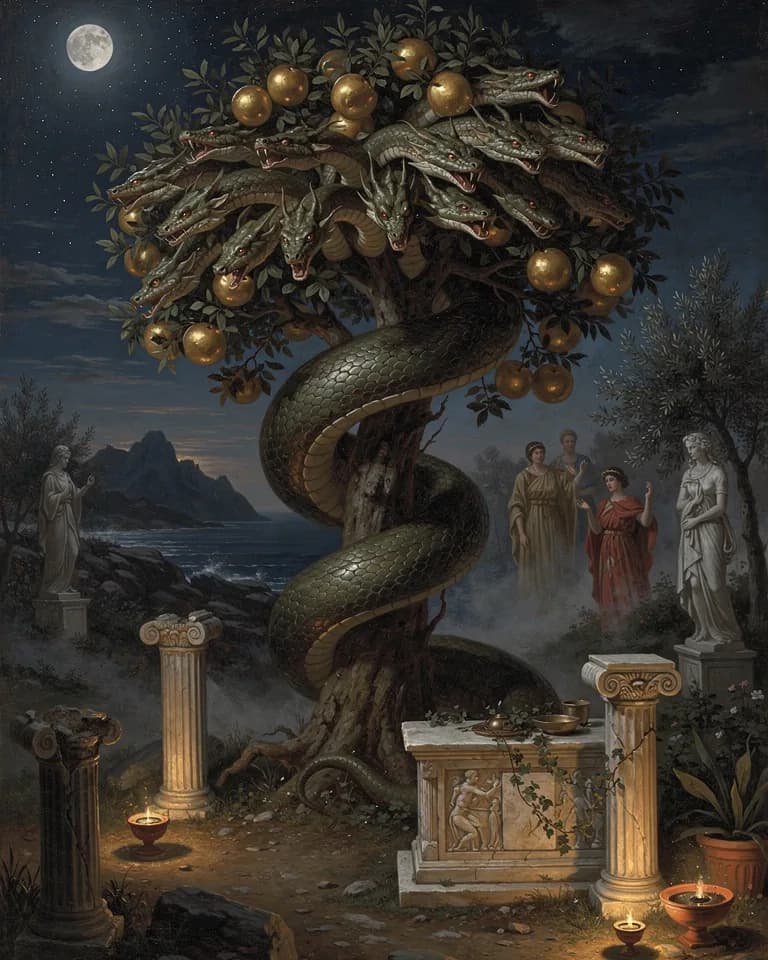
- Many heads
- Many voices
- Guardian of the golden apples
The serpent that guarded the golden apples in the garden of the Hesperides. Hesiod calls it the youngest child of Ceto and Phorcys; Apollodorus gives it a hundred heads; Apollonius of Rhodes names it Ladon and shows it lying dead the day after Heracles took the apples.
About Ladon
Guardian of the Apples
The golden apples were Earth's gift at the wedding of Zeus and Hera, planted in a garden beyond the ocean and tended by the Hesperides. Hesiod ends his list of the children of the sea-powers Ceto and Phorcys with a terrible serpent that guards the golden apples in the hidden places of the dark earth at its far bounds. Apollodorus makes the guardian an immortal dragon with a hundred heads, born of Typhon and Echidna, which spoke with many different voices.
The Name and the Death
The name Ladon is best known from Apollonius of Rhodes. In the Argonautica, the Argonauts, parched in the Libyan desert, come upon the garden the day after Heracles has passed through: the serpent Ladon lies dead by the golden apple tree, shot with arrows dipped in the Hydra's poison, while the Hesperides lament. Apollodorus preserves two versions of how Heracles got the apples: by sending Atlas for them while he held the sky, or by killing the serpent and picking them himself.
Sources and further reading
Source notes
These references are recorded in the catalog. Their passage wording and translation have not been checked, so quotations are not displayed here.
- Hesiod, Theogony 333-336 (paraphrase)
- Apollodorus, Library 2.5.11 (paraphrase)
- Apollonius of Rhodes, Argonautica 4 (paraphrase)
About this entry
By Elizabeth Stein for Mythos Atlas. About the author. Editorial notes are grounded in the site's cited sources and can be challenged through the contact page.
The danger rating is an editorial shorthand for how the myths portray the creature, not a claim made by the sources.