Greek PantheonCreature
Nemean Lion
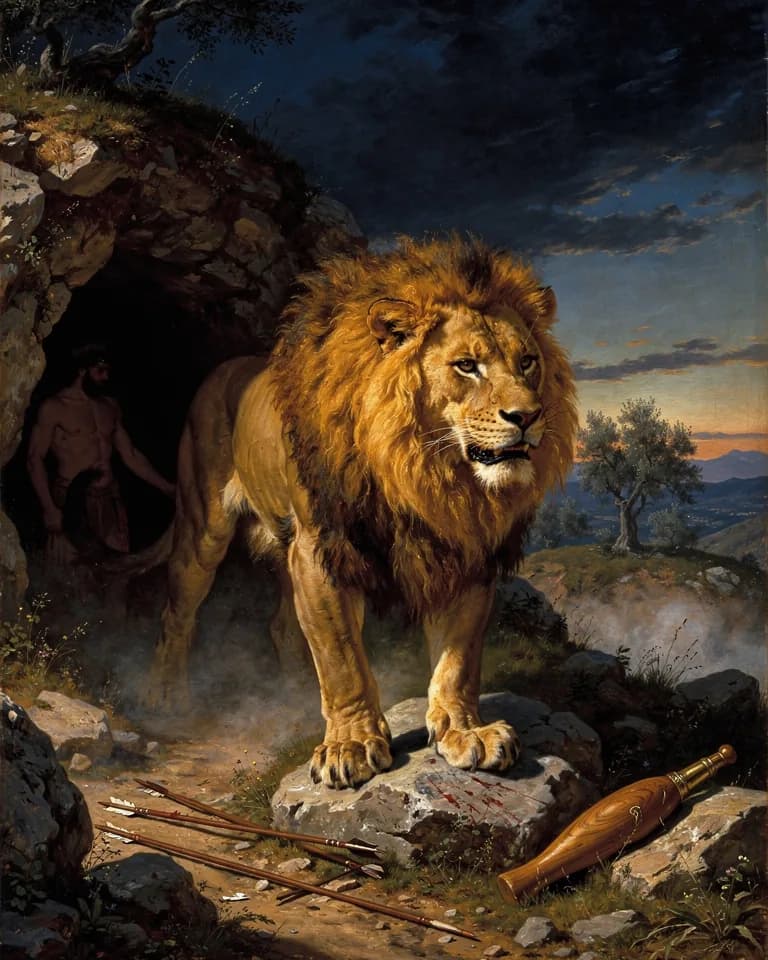
- Hide no weapon could pierce
- Twin-mouthed lair
The lion of Nemea whose hide no weapon could pierce. Killing it was the first of Heracles' labours: when his arrows glanced off, he trapped it in its cave and strangled it, and its skin became his emblem.
About Nemean Lion
Hera's Nursling
Hesiod places the lion in the brood of monsters descended from Echidna: mated with the dog Orthus, the mother of the Sphinx (Hesiod's 'she' may be Echidna or the Chimera) bore the Nemean lion, which Hera reared and settled in the hills of Nemea as a plague to the people there. Apollodorus instead calls it the offspring of Typhon.
The First Labour
In Apollodorus's account Eurystheus's first command was to bring back the lion's skin. The beast could not be wounded, so when Heracles' arrows failed he drove it into its cave, which had two mouths, blocked one entrance, went in by the other and choked it to death. He carried the carcass to Mycenae; Eurystheus was so frightened that he forbade Heracles to enter the city again and had him display his future trophies outside the gates. The lion skin, worn as a cloak with the head as a hood, became Heracles' constant attribute in art. Nemea later hosted the Nemean Games, one of the four great Panhellenic festivals.
Sources and further reading
Source notes
These references are recorded in the catalog. Their passage wording and translation have not been checked, so quotations are not displayed here.
- Hesiod, Theogony 326-332 (paraphrase)
- Apollodorus, Library 2.5.1 (paraphrase)
About this entry
By Elizabeth Stein for Mythos Atlas. About the author. Editorial notes are grounded in the site's cited sources and can be challenged through the contact page.
The danger rating is an editorial shorthand for how the myths portray the creature, not a claim made by the sources.