Greek Pantheon
Nyx
Νύξ(Nyx)
Also known as Night, Nox (Roman)
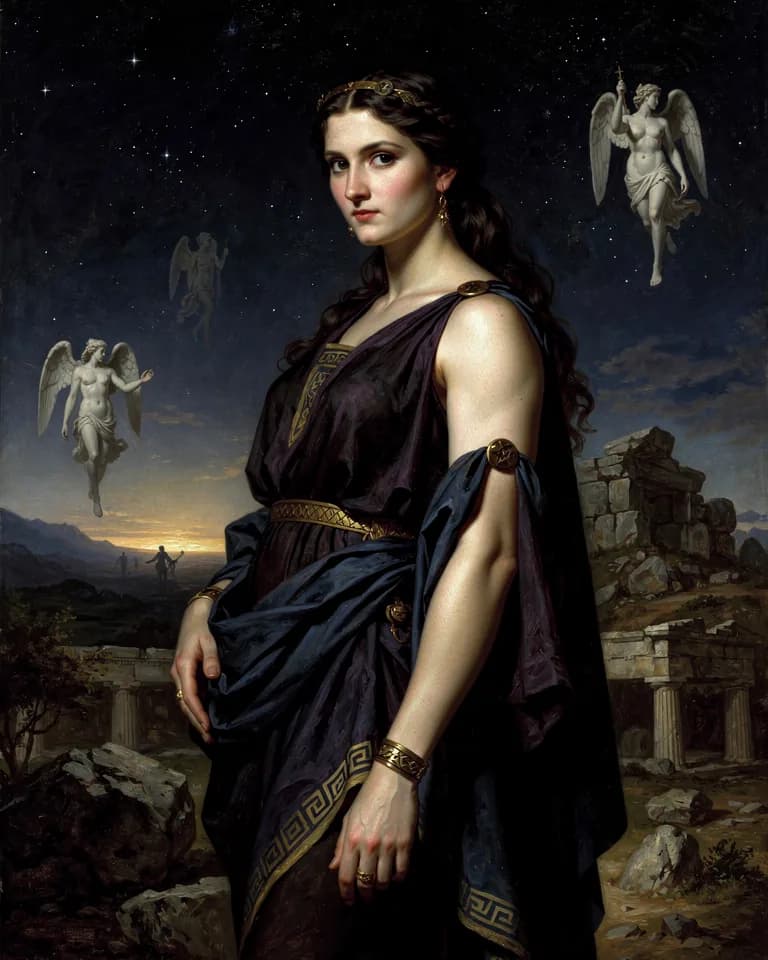
- night
Night, one of the first powers in Hesiod's account of creation: born from Chaos, she bears Day and Aether and, on her own, a long brood of forces that trouble mortals, among them Death, Sleep, Doom and Nemesis. Even Zeus, in the Iliad, hesitates to anger her.
About Nyx
First Darkness
In the Theogony Night comes out of Chaos together with Erebus, the darkness below. Joined with Erebus she bears the bright Aether and Day, and Hesiod then lists the children she bore with no partner at all: Moros (Doom), black Ker, Thanatos (Death), Hypnos (Sleep) and the tribe of Dreams, Blame and Woe, the Hesperides who tend the golden apples beyond the ocean, the Fates, Nemesis, Deceit, Friendship, Old Age and Strife.
The House of Night
Hesiod places Night's house at the edge of Tartarus, where Night and Day greet each other at a great bronze threshold as one goes in and the other comes out; the house never holds them both at once. Her sons Sleep and Death live nearby.
A Power Zeus Respects
In Iliad 14 Sleep reminds Hera of the last time he lulled Zeus for her: the enraged god would have hurled him from the sky if Night, 'subduer of gods and men', had not sheltered him, and Zeus held back because he was unwilling to displease swift Night. It is one of the few moments in Homer where Zeus defers to another power.
Night had little public cult; she matters above all as a cosmic power, and later Orphic poetry gives her a still larger place in the origin of the world.
Origin story
Night is born from Chaos alongside Erebus, at the very beginning of Hesiod's account of the world (Theogony 123). With Erebus she bears Aether and Day; alone, she bears Doom, Death, Sleep, Nemesis, Strife and many other powers (Theogony 211-225).
Family
Sources and further reading
Source notes
These references are recorded in the catalog. Their passage wording and translation have not been checked, so quotations are not displayed here.
- Hesiod, Theogony 123-125 (paraphrase)
- Homer, Iliad 14 (paraphrase)
Appears in
Ancient and classical works featuring this figure.
invoked as mother of gods and men (Hymn 3)
Further reading
Night's children (211-225) and her house by Tartarus (744-757)
Read online: Theogony (opens in new tab)
About this entry
By Elizabeth Stein for Mythos Atlas. About the author. Editorial notes are grounded in the site's cited sources and can be challenged through the contact page.
Parallels are editorial comparisons across traditions: a shared role does not, by itself, establish a shared origin.
Family relationships come from the atlas's kinship records. Ancient sources often disagree on divine genealogy.
Genealogy
Family tree
Nyx's parents, consorts, children and rivals, as recorded in the atlas.