Greek Pantheon
Thanatos
Θάνατος(Thánatos)
Also known as Death, Mors (Roman)
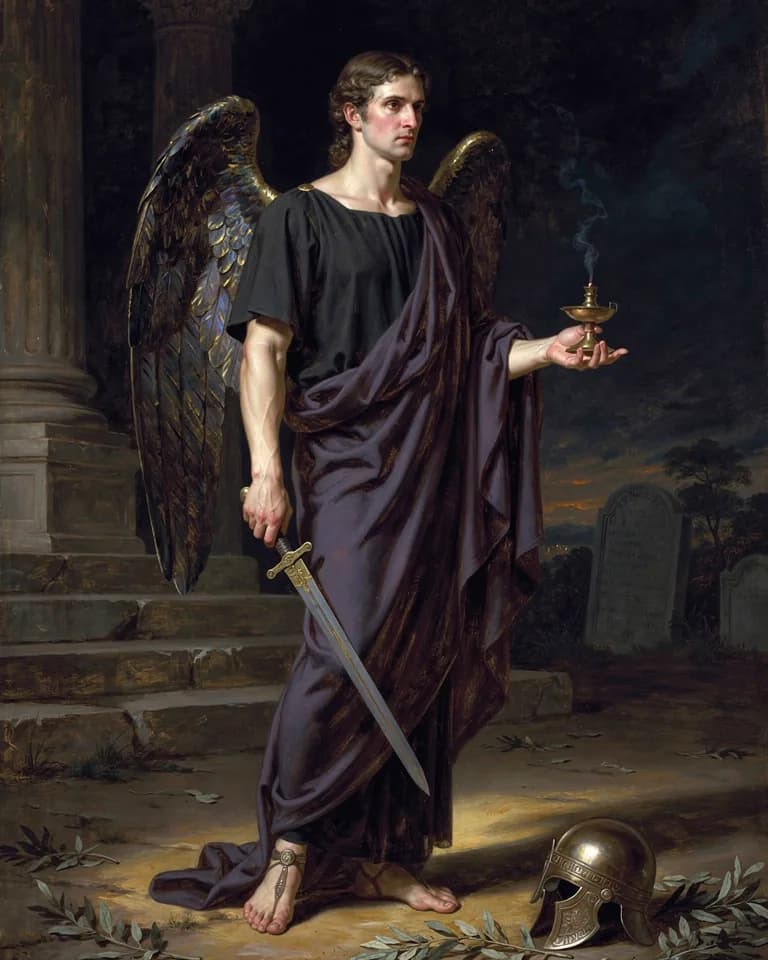
- death
Death personified, son of Night and twin brother of Sleep (Hypnos). Hesiod gives him a heart of iron, hated even by the gods; in the Iliad the twins carry the fallen Sarpedon home to Lycia, and in Euripides Heracles wrestles him for the life of Alcestis.
About Thanatos
Son of Night
Hesiod names Thanatos among the children of Night, together with his brother Hypnos, Sleep. The two live in Night's house near Tartarus, where the sun never looks on them. Sleep goes gently over land and sea, but Death has a heart of iron and a pitiless spirit of bronze; whoever he seizes he holds, and he is hateful even to the immortal gods.
Sarpedon's Bearer
In Iliad 16, when Zeus's son Sarpedon is killed at Troy, Apollo washes and anoints the body and hands it to the twin brothers Sleep and Death, who carry it swiftly to the broad land of Lycia for burial. The scene became a favourite of Athenian vase-painters, who show the two as winged young men lifting the body.
Wrestling Death
In Euripides' Alcestis, Death comes to take Alcestis, who has agreed to die in her husband Admetus's place; Heracles waits by the tomb, wrestles Death and brings her back. Later tradition also told how the trickster Sisyphus chained Death so that no one could die until Ares freed him.
Origin story
Thanatos is one of the children Night bore without a partner, twin of Hypnos, Sleep (Hesiod, Theogony 211-212).
Family
Sources and further reading
Source notes
These references are recorded in the catalog. Their passage wording and translation have not been checked, so quotations are not displayed here.
- Hesiod, Theogony 211-212 (paraphrase)
- Homer, Iliad 16 (paraphrase)
Appears in
Ancient and classical works featuring this figure.
invoked as Death (Hymn 87)
Further reading
The house of Sleep and Death beside Tartarus (758-766)
Read online: Theogony (opens in new tab)
About this entry
By Elizabeth Stein for Mythos Atlas. About the author. Editorial notes are grounded in the site's cited sources and can be challenged through the contact page.
Parallels are editorial comparisons across traditions: a shared role does not, by itself, establish a shared origin.
Family relationships come from the atlas's kinship records. Ancient sources often disagree on divine genealogy.
Genealogy
Family tree
Thanatos's parents, consorts, children and rivals, as recorded in the atlas.