Greek Pantheon
Nemesis
Νέμεσις(Némesis)
Also known as Rhamnousia
- retribution
- due measure
The daughter of Night whom Hesiod calls a bane to mortals: the indignation that answers excess and undeserved good fortune. She had a Classical temple at Rhamnous in Attica, and a lost early epic made her, not Leda, the mother of Helen.
About Nemesis
The Answer to Excess
Hesiod lists Nemesis among the children Night bore without a partner, 'a pain to mortal men'. The word means the indignation stirred by something out of proportion, and the power that restores the balance. In Works and Days, when the age of iron has fully decayed, Shame (Aidos) and Nemesis wrap themselves in white robes and leave the earth for the gods, abandoning humankind to its miseries.
Rhamnous
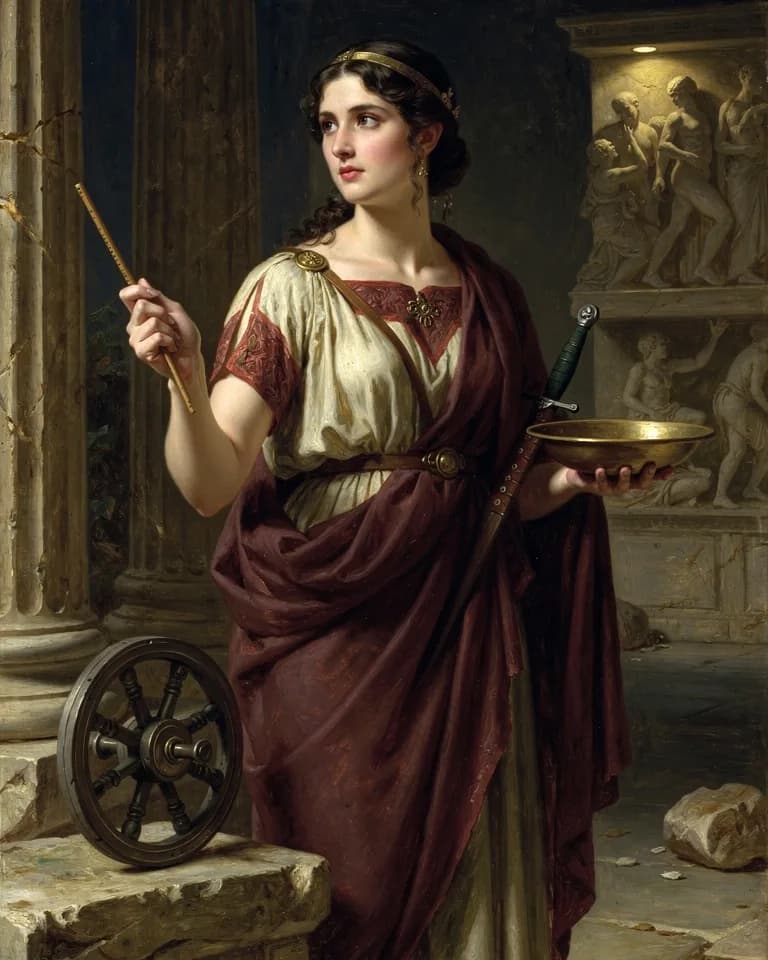
Nemesis was worshipped above all at Rhamnous on the north-east coast of Attica, where a Classical temple held her cult statue; she was known there as Rhamnousia. Later art gives her attributes of measure and restraint, such as the measuring rod and the bridle.
Mother of Helen
The Cypria, a lost epic of the Trojan cycle known through fragments, told how Zeus pursued Nemesis as she fled through many shapes and fathered Helen on her. Apollodorus records a version in which she became a goose and Zeus a swan, and the egg she laid was brought to Leda, who raised Helen as her own. The story sets the goddess of retribution at the origin of the Trojan War.
Origin story
Nemesis is one of the children Night bore without a father, set among Hesiod's list of powers that afflict mortals (Theogony 223-224).
Worship and cult
Temples, festivals, and practices recorded for Nemesis
Cult is best attested at Rhamnous, where she was honoured as Rhamnousia; elsewhere she was more often invoked than worshipped.
Sacred sites
- Rhamnous in Attica, a Classical temple of Nemesis
Family
Sources and further reading
Source notes
These references are recorded in the catalog. Their passage wording and translation have not been checked, so quotations are not displayed here.
- Hesiod, Theogony 223-224 (paraphrase)
- Hesiod, Works and Days 197-201 (paraphrase)
About this entry
By Elizabeth Stein for Mythos Atlas. About the author. Editorial notes are grounded in the site's cited sources and can be challenged through the contact page.
Parallels are editorial comparisons across traditions: a shared role does not, by itself, establish a shared origin.
Family relationships come from the atlas's kinship records. Ancient sources often disagree on divine genealogy.
Genealogy
Family tree
Nemesis's parents, consorts, children and rivals, as recorded in the atlas.