Chinese PantheonCreature
Fenghuang
- Auspicious Presence
- Harmonic Song
- Foresight
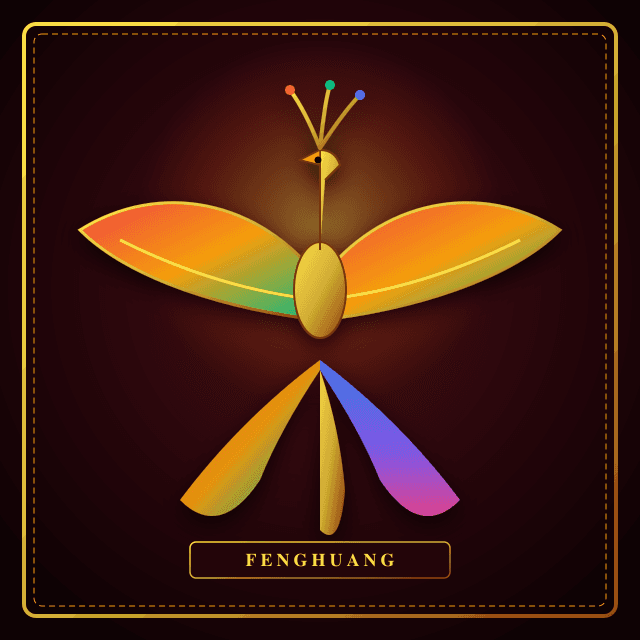
The Chinese phoenix, an auspicious bird embodying yin-yang harmony, virtue, and the union of heaven and earth. Its appearance heralds a peaceful, just age.
About Fenghuang
Auspicious Pair, Not a Fire-Suicide
Fenghuang in Chinese classics (Shijing allusions, later rishu and han rhapsodies) is an omen-bird of virtuous rule, often a feng-male and huang-female pair. It is not the Greek phoenix's pyre. Han tombs and palaces use it as a good-governance badge.
Danger 2: it appears when the age is already bearable.
Omen of good rule
The Analects has Confucius lament that the fenghuang does not come, a sign that no sage ruler is on the throne (9.9). The Shanhaijing describes the bird with markings forming the characters for virtue, righteousness, propriety, humaneness, and trustworthiness. From the Han onward the fenghuang became paired with the dragon as emblems of empress and emperor, and it appears on bridal embroidery and ceramics to this day.
Quick answers about Fenghuang
- What is Fenghuang?
- The Chinese phoenix, an auspicious bird embodying yin-yang harmony, virtue, and the union of heaven and earth. Its appearance heralds a peaceful, just age.
- Where does Fenghuang live?
- The atlas lists Fenghuang's habitat as Paulownia groves and high celestial peaks.
- What abilities does Fenghuang have?
- The atlas lists these abilities for Fenghuang: Auspicious Presence, Harmonic Song, and Foresight.
Sources and further reading
Source notes
These references are recorded in the catalog. Their passage wording and translation have not been checked, so quotations are not displayed here.
- Chinese classical omen lore (Shijing tradition; Han rhapsodies)
About this entry
By Elizabeth Stein for Mythos Atlas. About the author. Editorial notes are grounded in the site's cited sources and can be challenged through the contact page.
The danger rating is an editorial shorthand for how the myths portray the creature, not a claim made by the sources.
Keep exploring
One myth a week, with its sources in a short email. The sign-up form is just below.