Hindu PantheonCreature
Garuda
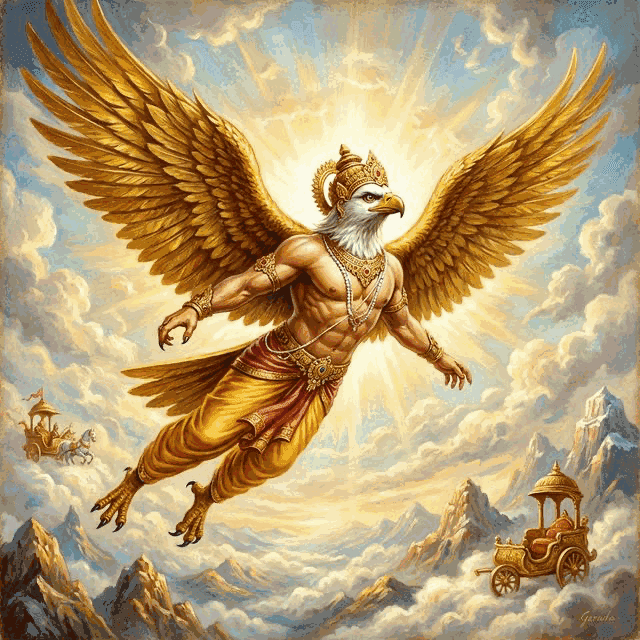
- Divine Flight
- Naga Slaying
- Thought-Speed Travel
The divine king of birds and mount of Lord Vishnu. Part eagle and part human, he is the eternal enemy of the Nagas and possesses speed that rivals thought itself.
About Garuda
Enemy of Serpents, Mount of Vishnu
Garuda, son of Vinata, wins amrita from the gods to free his mother from Kadru's naga-slavery, then becomes Vishnu's vahana. The Mahabharata's Adi Parva tells the raid; the Suparṇādhyāya and later Puranas expand the genealogy. He is both person and species-king.
Thai and Khmer courts reused him as a royal emblem. The Sanskrit core is still the bird who outflies thought to steal nectar.
Theft of the nectar
In the Adi Parva, Garuda breaks through the gods' defences, douses the ring of fire, slips through a whirling wheel of blades, and kills the serpents guarding the amrita, yet does not drink it himself. Impressed, Vishnu makes him his mount and grants him immortality, while Indra, whose thunderbolt could not harm him, strikes a bargain that lets the gods take back the nectar before the nagas can drink it. Garuda remains the national emblem of Indonesia and Thailand.
Quick answers about Garuda
- What is Garuda?
- The divine king of birds and mount of Lord Vishnu. Part eagle and part human, he is the eternal enemy of the Nagas and possesses speed that rivals thought itself.
- Where does Garuda live?
- The atlas lists Garuda's habitat as Vaikuntha (Vishnu's Realm).
- What abilities does Garuda have?
- The atlas lists these abilities for Garuda: Divine Flight, Naga Slaying, and Thought-Speed Travel.
In the museums
Garuda in art
Real objects in public collections, released into the public domain by the museums that hold them. Dates refer to when each object was made. Objects made within the tradition come first, later depictions after.
 (opens the museum record)
Ancient object
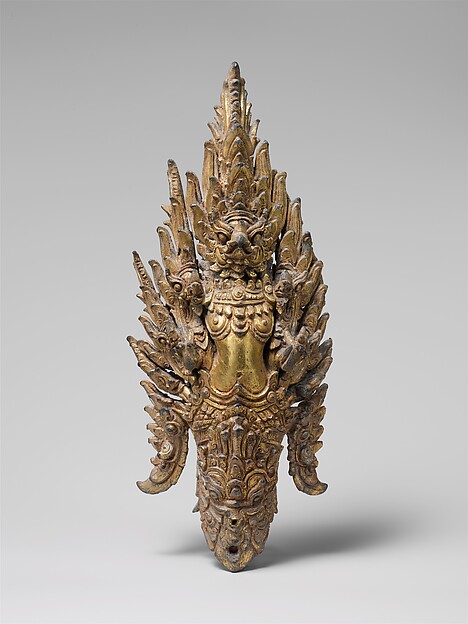
Garuda Finial (opens the museum record)
A gilt bronze finial in the form of Garuda, the half-man, half-bird creature and mount of Vishnu, made in Thailand for architectural decoration.
 (opens the museum record)
Ancient object
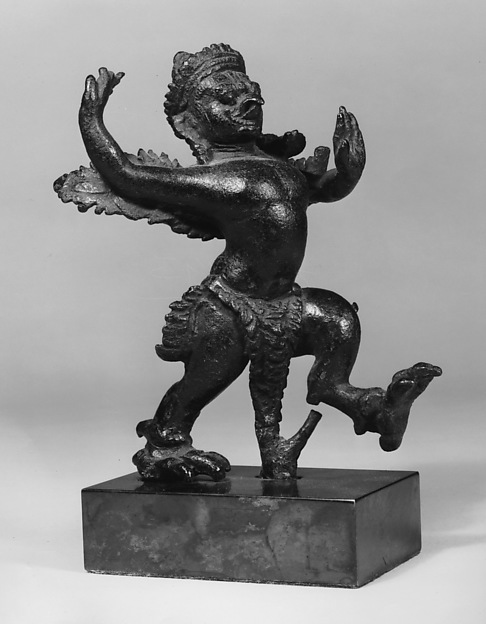
Striding Garuda (The Royal Solar Bird) (opens the museum record)
A Thai bronze the museum titles Striding Garuda (The Royal Solar Bird), showing the creature in an active pose rather than as a static architectural ornament.
Sources and further reading
Source notes
These references are recorded in the catalog. Their passage wording and translation have not been checked, so quotations are not displayed here.
- Mahabharata, Adi Parva (Astika Parva)
About this entry
By Elizabeth Stein for Mythos Atlas. About the author. Editorial notes are grounded in the site's cited sources and can be challenged through the contact page.
The danger rating is an editorial shorthand for how the myths portray the creature, not a claim made by the sources.
Keep exploring
One myth a week, with its sources in a short email. The sign-up form is just below.