Roman PantheonCreature
Manes
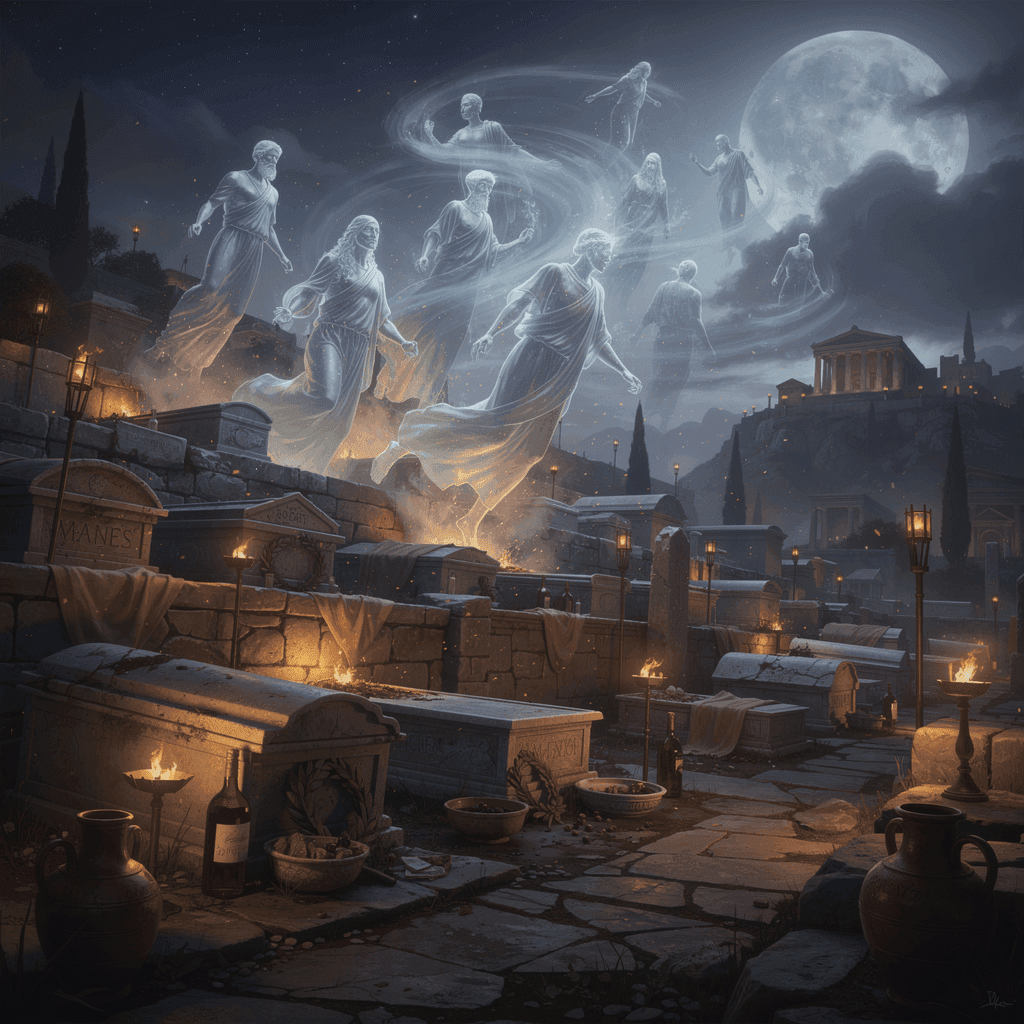
- Ancestral Wisdom
- Descendant Protection
- Dream Visitation
The collective spirits of deceased ancestors, honored as divine beings by their descendants. Romans inscribed 'Dis Manibus' (to the divine Manes) on tombs and offered food and wine at grave sites during the Parentalia festival.
About Manes
The Divine Dead
Di Manes are the deified dead as a collective. Tombstones across the empire open with Dis Manibus. Parentalia in February fed graves; the Manes were not a single ghoul. Cicero and funerary law treat them as recipients of ius, not as a species of monster.
They are a legal and cult category of the dead, not a species of ghoul to hunt.
Parentalia and Feralia
The Parentalia ran from 13 to 21 February, when families visited tombs with offerings of flowers, bread, wine, and salt; its last day, the Feralia, was a public festival for the dead (Ovid, Fasti 2.533-616). The formula D M or D M S, Dis Manibus (Sacrum), 'to the divine shades', heads thousands of Roman epitaphs, including Christian ones, which shows how conventional it became.
Quick answers about Manes
- What is Manes?
- The collective spirits of deceased ancestors, honored as divine beings by their descendants. Romans inscribed 'Dis Manibus' (to the divine Manes) on tombs and offered food and wine at grave sites during the Parentalia festival.
- Where does Manes live?
- The atlas lists Manes's habitat as The Underworld and Family Tombs.
- What abilities does Manes have?
- The atlas lists these abilities for Manes: Ancestral Wisdom, Descendant Protection, and Dream Visitation.
Sources and further reading
Source notes
These references are recorded in the catalog. Their passage wording and translation have not been checked, so quotations are not displayed here.
- Roman funerary inscriptions; Ovid, Fasti 2 (Parentalia)
About this entry
By Elizabeth Stein for Mythos Atlas. About the author. Editorial notes are grounded in the site's cited sources and can be challenged through the contact page.
The danger rating is an editorial shorthand for how the myths portray the creature, not a claim made by the sources.
Keep exploring
One myth a week, with its sources in a short email. The sign-up form is just below.