Aztec PantheonCreature
Maquizcoatl
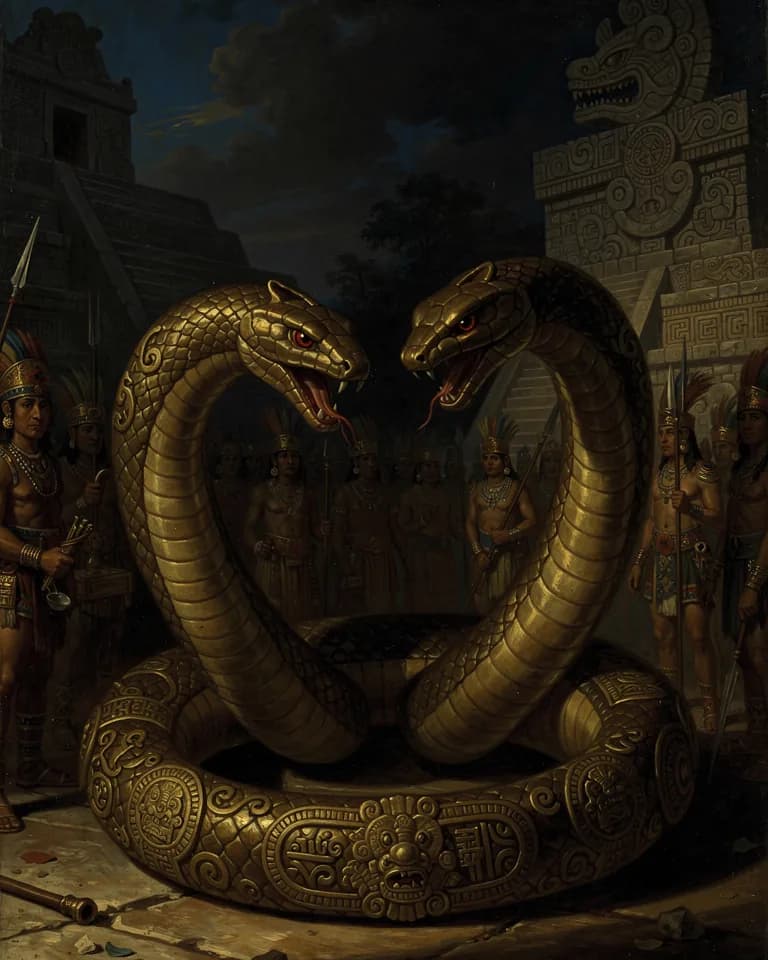
- Moving in either direction
- Foretelling misfortune
The 'bracelet serpent' of Nahua lore, a snake with a head at each end, listed and drawn among the serpents of New Spain in the Florentine Codex; two-headed serpents were regarded as bearers of bad omens.
About Maquizcoatl
A snake with two heads
Book 11 of the Florentine Codex, Sahagún's encyclopaedia of the natural world as described by his Nahua informants, includes a long chapter on serpents. Among them is the maquizcoatl, which the Nahua artist of Book 11 drew as a serpent with a head at each end. Its name joins maquiztli, a bracelet or precious bead, with coatl, serpent; the Spanish-era Nahuatl dictionary of Alonso de Molina glosses it simply as a two-headed snake, and the word could also be applied to a two-faced person or gossip.
An omen
Like many creatures in Book 11, the maquizcoatl is described with its meanings as well as its appearance, and two-headed serpents were regarded as bearers of bad omens. The chapter mixes observation of real animals with lore about them, and it is not always possible to tell where one stops and the other begins; blunt-tailed snakes whose tails resemble heads may lie behind the image.
Two-headed serpents in Mexica art
The best-known two-headed serpent of Mexica art is the turquoise-mosaic pectoral in the British Museum, which the museum connects with the maquizcoatl and its associations with omens and elite display; the object's precise meaning remains debated.
Sources and further reading
Source notes
These references are recorded in the catalog. Their passage wording and translation have not been checked, so quotations are not displayed here.
- Bernardino de Sahagún, Florentine Codex, Book 11
About this entry
By Elizabeth Stein for Mythos Atlas. About the author. Editorial notes are grounded in the site's cited sources and can be challenged through the contact page.
The danger rating is an editorial shorthand for how the myths portray the creature, not a claim made by the sources.